🍽️ Series 1: “Dog Nutrition Without Myths”
Today you’ll learn:
- how a homemade diet differs from a complete food;
- whether natural food is really healthier;
- whether it’s possible to create a fully balanced homemade diet;
- why many homemade rations end up unbalanced;
- whether different feeding types can be combined.
Why does this topic cause so much debate?
Perhaps no other topic in dog nutrition sparks as much discussion. Some people are sure that commercial food is nothing but “chemicals,” while others believe that natural food is always healthier.
As usual, the truth lies somewhere in the middle. The feeding format by itself does not determine the quality of the diet. The main question is always the same: Is the dog getting all the necessary Nutrients?
What is a complete food?
We’ve already used this term several times.
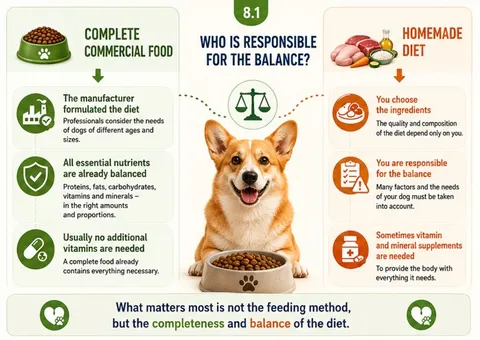
A complete food is a diet that contains all the necessary Nutrients in amounts that meet the needs of a healthy dog of a specific age and size. With such a diet, there is usually no need to add extra vitamins, minerals, or other dietary supplements.
What is a homemade diet?
A homemade diet is food that the owner prepares themselves.
It is by no means only raw meat.
It may include:
- meat;
- fish;
- vegetables;
- grains;
- eggs;
- dairy products;
- oils;
- vitamin and mineral supplements.
But there is one important detail: with a homemade diet, it is the owner who is responsible for making sure the food is complete and balanced.
Natural doesn’t mean balanced
This is one of the most common myths.
Many people believe that if the ingredients are fresh and high-quality, the diet is automatically good.
Unfortunately, that’s not the case. Even the highest-quality ingredients on their own do not guarantee that the dog will receive all the necessary proteins, fats, carbohydrates, vitamins, and minerals. The completeness of a diet is determined not by how “natural” the ingredients are, but by the correct balance of Nutrients.
Is it possible to create a good homemade diet?
Yes. But it is much harder than it looks.
It’s not enough to simply boil some meat with rice for the dog or add a bit of vegetables; when formulating a homemade diet, many different factors must be taken into account.
Protein
It is important not only to provide enough protein, but also to choose the right sources.
Animal proteins (meat, organ meats, eggs) contain the most complete set of essential amino acids and are generally better digested by the dog’s body.
Plant proteins can be used in the diet, but on their own they cannot fully supply the dog with all essential amino acids, so they should not become the only protein source.
Carbohydrates
When cooked, white rice, potatoes, corn, and wheat are well digested and serve as sources of energy.
If you need to increase dietary fiber, oats, brown rice, or sweet potato are more commonly used.
Fats
Fats are necessary for the absorption of fat-soluble vitamins and are a source of essential fatty acids.
But they are also the most calorie-dense component of food. Excess fat can lead to obesity and, in some dogs, increase the risk of pancreatitis.
At the same time, extra fat is often unnecessary: if the diet already includes fatty meat or eggs, that may be quite sufficient.
And that’s still not all
Beyond proteins, fats, and carbohydrates, you also need to correctly calculate:
- the energy content of the diet;
- calcium and phosphorus levels;
- the calcium-to-phosphorus ratio;
- vitamins;
- trace elements;
- essential fatty acids;
- the dog’s age and body weight;
- level of physical activity;
- health status.
Veterinary nutritionists use dedicated ration-formulation software rather than doing this “by eye.”
Important: You can find countless recipes for homemade dog food online, but there is no universal recipe that will suit every dog equally well. A diet must reflect the age, size, activity level, and health of the individual animal.
Our experience: why we switched from a natural diet to dry food
In our kennel there was a period when all the dogs were fed a commercially produced natural diet—frozen raw meat with vegetables and other ingredients. This food is made specifically for dogs and is complete.
We were satisfied with this experience and can genuinely point out several advantages of this feeding method.
What we liked ➕
The dogs drank noticeably less water.
A natural diet contains significantly more moisture than dry food. Because of this, the dogs felt thirsty less often and, accordingly, asked to go outside less frequently.
Their stools were smaller and less frequent.
The diet was well digested, so there were fewer undigested leftovers. For owners of multiple dogs, this is a very noticeable advantage.
However, over time we nevertheless decided to switch to a dry commercial food.
Why we gave up the natural diet ➖
The cost of feeding is significantly higher.
When you keep several dogs, the difference in expenses becomes quite substantial.
You need a large freezer.
Frozen diets take up a lot of space, especially if you have several dogs at home or run a kennel.
The food must be thawed in advance.
You constantly have to monitor your stock and move portions from the freezer to the fridge in time. If you forget to do this beforehand, the pack simply will not defrost by the next feeding.
For our kennel, these practical aspects turned out to be decisive.
Today our dogs eat a high-quality complete dry food that fully meets their needs and greatly simplifies day-to-day feeding.
This does not mean that one feeding method is better than the other. If you have only one dog and can store and handle a commercially made complete natural diet correctly, that can also be an excellent choice.
The key is that the diet is complete, balanced, and suitable specifically for your dog.
Is commercial food always perfect?
No, it isn’t.
We have already discussed in previous articles that the quality of foods can vary greatly.
It is important to choose products from reliable manufacturers and to understand how to assess a diet, rather than relying solely on attractive marketing claims.
Can you mix commercial food and homemade food?
Yes, you can.
But it is important to understand the goal of such feeding: if homemade food is only used as a small treat or a minor addition to the main diet, this usually does not cause problems. If, however, a significant proportion of a complete food is replaced by homemade foods, it disrupts the Nutrient balance calculated by the manufacturer.
That’s why, with mixed feeding, moderation is crucial, as is understanding exactly what the dog is actually getting.
What is worth remembering
There is no single “correct” way to feed a dog. Both a well-designed homemade diet and a complete commercial food can supply everything the dog needs; the difference lies in who is responsible for balancing the Nutrients.
With a ready-made complete food, that work has already been done by the manufacturer.
With a homemade diet, the responsibility lies entirely with the owner.

🦴 Myth of the week
“Natural food is always healthier than commercial food.”
Fresh ingredients on their own still do not guarantee a complete diet.
For a dog’s health, the crucial factor is not the origin of the food, but how well it supplies the body with all the necessary Nutrients.
🔜 What’s next?
➡️ Article 9. Dog treats: benefits, mistakes, and hidden calories
In the final article of the series we’ll talk about treats.
You’ll learn:
- how many treats you can give without harming your dog’s health;
- why even “healthy” snacks should be limited;
- which foods must never be used as treats;
- how to reward your dog without throwing their overall diet off balance.