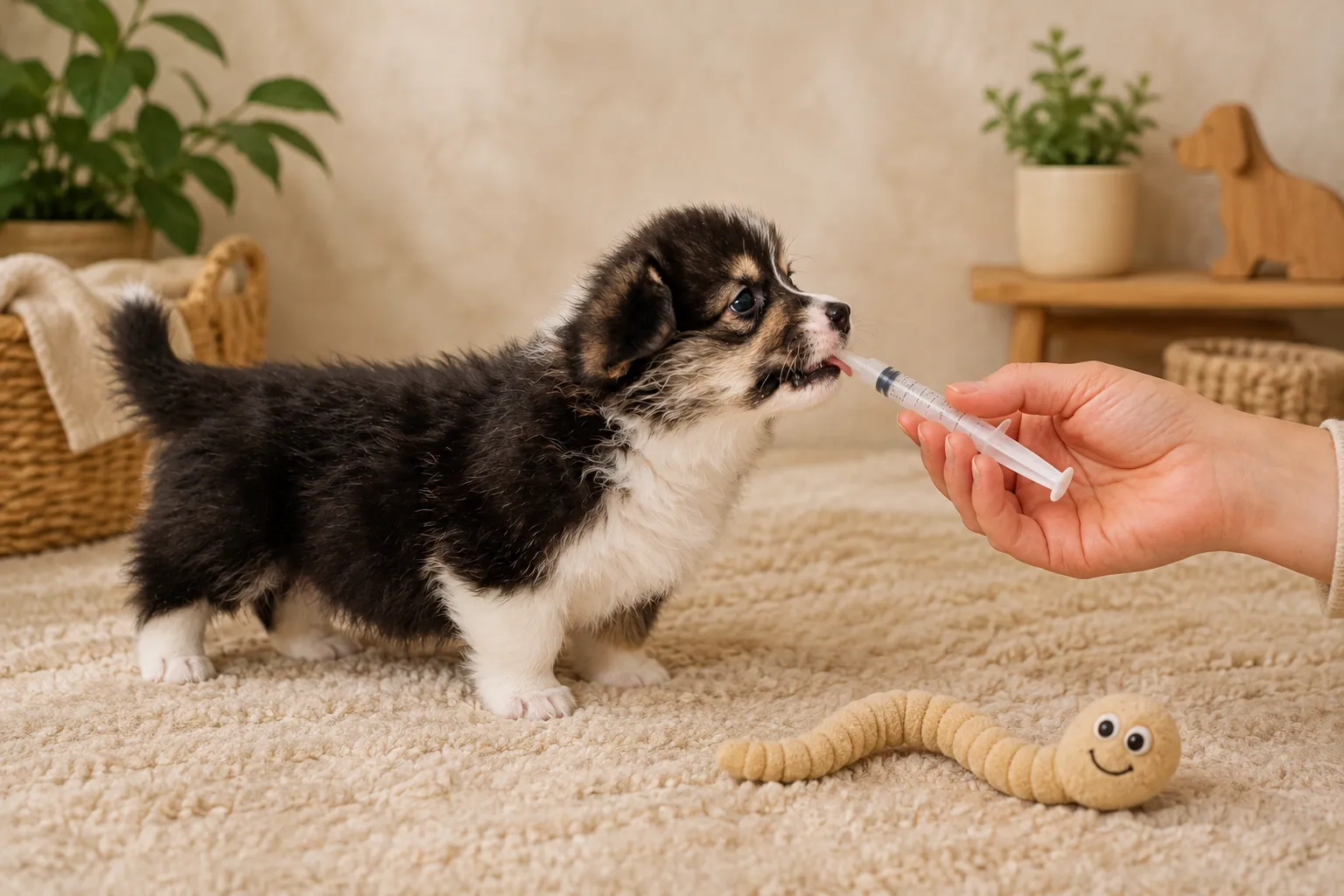
A puppy can look perfectly healthy, eat well, play and gain weight — and still be infected with intestinal parasites. What’s more, they don’t even have to go outside to pick them up: some helminths can be transmitted from the mother before birth or with the milk.
That’s why puppies follow a separate deworming protocol, which starts much earlier than many owners expect.
How can a very young puppy have worms?
The sentence “he doesn’t even go for walks yet, how could he have worms?” sounds quite reasonable — but in puppies, infection can occur long before the first walk.
One of the parasites most typical for puppies is Toxocara canis (dog roundworm). Its life cycle clearly shows how a puppy can become infected with helminths long before the first time they go outside.
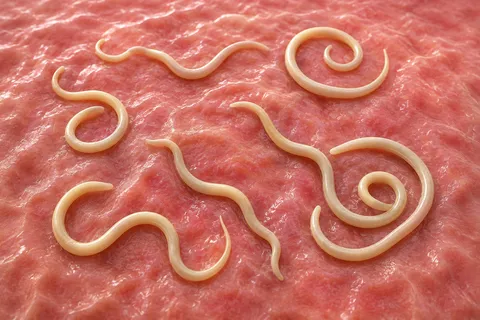
After infection, Toxocara larvae can persist in the tissues of an adult bitch for a long time. During pregnancy they may become active and cross the placenta to the fetuses. Transmission of larvae to the puppies with the milk is also possible, so a puppy may be born already infected or become infected in the first days of life — even if the mother looks completely healthy and regularly receives antiparasitic treatment.
As the puppy grows, the usual routes of infection are added: contaminated soil, feces of other animals, raw meat, hunting and eating prey, and some intermediate hosts of parasites.
This is why toxocara prevention starts early.
When do you first give a dewormer to a puppy?
According to ESCCAP (European Scientific Counsel Companion Animal Parasites) recommendations, the first treatment of puppies against roundworms is carried out at 14 days of age.
After the first treatment, puppies are given the product every two weeks. This schedule is continued throughout the entire nursing period and for another two weeks after complete weaning from the mother.
In practice, for most litters the protocol looks roughly like this:
| Puppy’s age | What happens |
|---|---|
| 2 weeks | first deworming |
| 4 weeks | repeat treatment |
| 6 weeks | repeat treatment |
| 8 weeks | repeat treatment |
| after weaning | treatments continue every 2 weeks until 2 weeks after complete weaning have passed |
The exact schedule may vary slightly depending on the weaning age and the product used, so the breeder must take into account the manufacturer’s instructions and the veterinarian’s recommendations.
Why isn’t one treatment enough?
This is related to the life cycle of the parasites.
The product kills the stages of helminths that are susceptible to it and present in the body at the time of treatment, but it does not necessarily affect all migrating larval stages.
After some time the larvae mature and become susceptible to the product, so young puppies are treated several times at short intervals. This is not “too many tablets”, but a way to sequentially interrupt parasite development.
What about the puppies’ mother?
The nursing bitch is also included in the antiparasitic program.
ESCCAP recommends treating her at the same time as the puppies’ first deworming, that is, about two weeks after whelping.
However, the antiparasitic program for a breeding bitch is best discussed with a veterinarian in advance — before mating or during pregnancy. Not all products are approved for pregnant and lactating dogs, and the protocols and spectra of activity of different products vary.
You should not give a pregnant bitch “the usual wormer we always use” on your own initiative.
What happens after the puppies are weaned?
After the early protocol is completed, the puppy gradually switches to a regular preventive program.
However, a universal rule like “all dogs should get a worming tablet every three months” does not actually exist.
The frequency of prevention depends on lifestyle and infection risk.
For puppies at higher risk — for example, those that actively attend puppy classes, dog parks and other places with many dogs — ESCCAP recommends considering monthly treatment up to six months of age.
The further protocol is determined individually.
How often should an adult dog be treated?
The risk of infection differs greatly between dogs and depends on a number of factors:
- whether the dog only walks on leash or runs off-leash;
- whether it has contact with many other dogs;
- whether it visits dog parks, shows, kennels or boarding facilities;
- whether it hunts rodents;
- whether it picks things up outside;
- whether it is fed raw meat and offal;
- whether small children or immunocompromised people live in the household;
- which parasites are common in the specific region.
Therefore, the modern approach is not one calendar protocol for everyone, but an assessment of individual risk.
Depending on that, the veterinarian may recommend preventive treatments at a certain frequency or regular fecal examinations with treatment when parasites are detected.
Is it really necessary to deworm a puppy before vaccination?
A very common piece of advice is: “Give a worming tablet 7–10 days before every vaccination.”
But this is not a universal requirement of modern vaccination guidelines.
The World Small Animal Veterinary Association (WSAVA) does not mandate compulsory deworming a certain number of days before each vaccination.
Something else is much more important: the puppy must be clinically healthy and receive appropriate antiparasitic prevention according to age and risk.
If a puppy is already on a normal age-appropriate deworming schedule, an extra treatment just because a vaccine is due in ten days is usually unnecessary.
The situation is completely different if there is a suspicion of a significant parasite burden: diarrhea, vomiting, poor weight gain, a pot-bellied abdomen, visible parasites in the stool. In such a case, the puppy’s condition and vaccination timing should be discussed with a veterinarian.
Thus, vaccination and deworming are two parallel preventive programs, not an obligatory link of “tablet → vaccination 10 days later”.
How to choose a product for a puppy?
A deworming product is not chosen simply on the principle of “for worms”.
Products differ in:
- approved age for use;
- minimum body weight;
- active ingredients;
- parasite spectrum;
- dosage;
- whether they can be used in pregnant and lactating dogs.
For a young puppy, accurate dosing to current body weight is especially important.
Puppies grow quickly, so it’s not a good idea to use last month’s weight to calculate the dose. Ideally, weigh the puppy before treatment.
And of course, the product must be approved for puppies of the appropriate age.
“Broad spectrum” does not mean “against all parasites”
This is another common misconception.
Different active ingredients work against different types of parasites. A product may be effective against roundworms and tapeworms, but that does not mean it automatically protects against all internal parasites.
It is especially important to remember Giardia and coccidia.
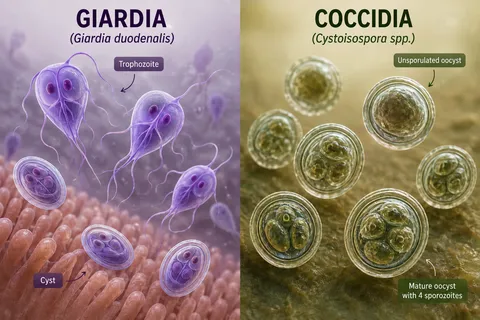
These are not helminths but protozoa, so a routine preventive “worming tablet” is not a universal prevention against giardiasis or coccidiosis.
If a puppy has prolonged or recurring diarrhea, simply giving a wormer “just in case” is not the best approach. A fecal examination and targeted treatment for a specific pathogen may be necessary.
We discuss the different types of internal parasites and routes of infection in more detail in our separate article “Internal Parasites in Dogs”.
Deworming tablet or fecal test?
Regular fecal examinations can be part of an antiparasitic program and in some situations make it possible to reduce the number of preventive treatments.
But there is an important limitation here — a negative test does not always mean a complete absence of parasites.
Eggs of some helminths are not shed continuously, and at an early stage of infection adult parasites may not yet be producing eggs at all, so a single fecal result should not be taken as an absolute guarantee: “nothing was found — so there are definitely no worms”.
To increase the usefulness of testing, a veterinarian may recommend examining samples collected on different days, or using specific diagnostic methods.
For young puppies, the early preventive protocol therefore cannot simply be replaced by a fecal test before every treatment.
What if worms appear in the stool after deworming?
This can happen and in itself does not mean that the product “didn’t work”.
After treatment, dead or paralyzed parasites can be passed in the stool. Sometimes the owner first learns of the infection only after deworming.
But if there are many parasites, they keep appearing in the stool over the following days, and the puppy develops vomiting, marked diarrhea, weakness or a distended abdomen, you need to see a veterinarian.
With heavy infestations, treatment of a young puppy must be carried out with particular care.
What if the puppy has diarrhea after deworming?
Mild short-lived digestive upset is possible after some antiparasitic products.
But marked or prolonged diarrhea, repeated vomiting, severe lethargy, refusal of water or food are not things that should simply be written off as “just the wormer”.
Very young puppies become dehydrated quickly, so in such a situation it’s best to contact a veterinarian.
What should a new owner receive from the breeder?
When the puppy is handed over, the breeder should not just say “he’s been dewormed”, but provide detailed information:
- dates of all treatments performed;
- product name;
- dose given;
- puppy’s weight at the time of treatment;
- date of the next planned treatment.
Ideally, this data should be entered in the pet passport or another document that goes with the puppy.
The new owner can show it to their veterinarian and continue prevention without unnecessary repeated treatments or, conversely, overly long gaps between them.
In short: puppy deworming protocol
For a healthy puppy, the basic protocol can be remembered like this:
first treatment at 2 weeks → then every 2 weeks → 2 weeks after weaning from the mother.
The nursing bitch is treated at the same time as the puppies’ first treatment.
After completing this protocol, the frequency of further prevention depends on infection risk; for high‑risk puppies, monthly treatment up to six months of age may be recommended.
And a few more important rules:
- Don’t automatically tie deworming to every vaccination.
- Weigh the puppy before calculating the dose.
- Check the minimum age and weight for the specific product.
- Remember that a single “worming tablet” does not protect against all internal parasites.
- If there are signs of illness, look for the cause instead of endlessly repeating preventive treatments.
Key point
Puppies are not dewormed early because breeders consider them especially “dirty” or infested. The reason is much more prosaic: the biology of some parasites allows them to be passed from mother to offspring before the puppy ever leaves the house.
Early deworming is a routine part of preventive care for a litter and is the breeder’s responsibility.
After the puppy moves to a new family, the owner’s task is not to mechanically give “a worming tablet every three months”, but to work with a veterinarian to choose a sensible prevention program that takes into account the dog’s age, lifestyle and actual individual risks.