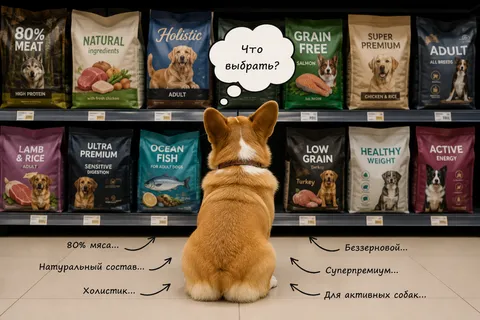
🍽️ Episode 1: Dog Nutrition Without Myths
Today you’ll learn:
- why the ingredients list is only part of the big picture;
- how manufacturers build that list;
- what the order of ingredients really means;
- and why two almost identical ingredient lists can indicate very different food quality.
Everyone says “read the ingredients”...
You’ve probably heard this advice dozens of times: “The main thing is to turn the bag over and carefully read the ingredients.”
At first glance that sounds perfectly logical—when we buy food for ourselves, we also look at the ingredients.
But here’s the problem: dog food is not the same as supermarket groceries, and the rules used to compile the ingredient list are completely different. An experienced veterinary nutritionist will never judge a food by the ingredient list alone.
So ingredients don’t matter at all?
No. They matter a lot.
But they don’t answer anywhere near all the questions.
The ingredients list cannot tell you:
- how well the protein is actually digested;
- whether the dog is getting enough essential amino acids;
- whether vitamins and minerals are properly balanced;
- how good the manufacturing process is;
- how carefully each batch is quality‑controlled.
In other words: the ingredients list shows what the food is made from, but tells you almost nothing about how well that food does its job.
Why the order of ingredients can be misleading
Here’s where it gets interesting.
Many people believe: If meat is listed first, then the food is great.
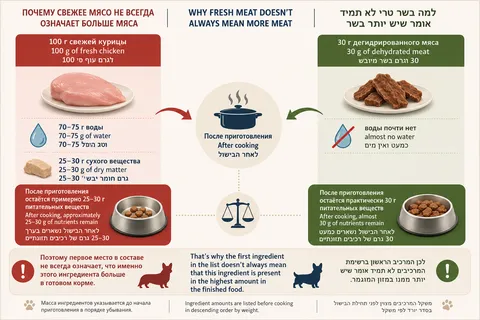
But it’s not that simple. In most countries, ingredients are listed from the one that makes up the largest share of the initial mix to the one that makes up the smallest. And this is based on their amount before processing. Specifically, BEFORE cooking.
Why does that matter? Because fresh meat contains about 70–75% water. Once the food is cooked, most of that water evaporates, and the ingredient that used to be first on the list may no longer be one of the main components in the finished food.
And vice versa.
Ingredients with low moisture content (for example, dehydrated meat) change their weight very little after cooking.
That’s why you can’t fairly compare ingredients based only on where they appear in the list.
And what does the product name mean?
Many owners assume that the name on the front of the bag accurately reflects the food’s composition, but that’s not always the case.
In many countries there are rules that define how much of an ingredient must be in a food for the manufacturer to use it in the product name, so the wording on the packaging can have a fairly specific meaning.
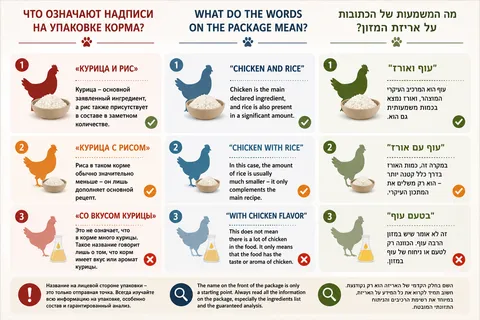
For example, “Chicken and Rice”.
This kind of name usually means that chicken is the main named ingredient, and rice is also present in a noticeable amount.
If the label says “Chicken with Rice”, there may be significantly less rice: it merely complements the main recipe.
And finally, “Chicken Flavour”.
This does not mean the food contains a lot of chicken; it only tells you that the food tastes or smells like chicken, while the actual ingredient may be present in a very small amount.
So the name on the front of the bag is just a starting point. To understand what’s really in the food, you have to look at all the information on the package, not just the marketing claims.
The same formula can look completely different on paper
Imagine two foods.
Food A
- fresh chicken meat;
- rice;
- corn.
Food B
- dehydrated chicken meat;
- rice;
- corn.
At first glance, the first option seems better, but in reality it may well be the other way round.
Once the water is removed during processing, the proportion of fresh meat drops dramatically, whereas dehydrated meat keeps almost the same weight.
Without knowing the manufacturing technology, you can’t tell which diet actually contains more animal protein.
Manufacturers know how to make the list look “prettier”
And it’s completely legal.
For example, instead of a single ingredient “rice”, a label might say:
- white rice;
- brown rice;
- rice flour;
- rice bran.
Looked at separately, each one makes up a smaller share of the formula, so they may all appear much lower in the list, even though the total amount of rice in the food is still quite high.
This technique is called ingredient splitting.
By itself it doesn’t mean the food is bad, but it does show you need to read the ingredients very carefully.
The ingredients list is only the beginning
Experienced professionals never draw conclusions from a single factor.
They look at everything together:
- the manufacturer;
- whether the food is complete and balanced;
- safety;
- the food’s intended use;
- the scientific evidence behind it;
- digestibility;
- and only then—the list of ingredients.
That’s why two bags with almost identical ingredient lists can be very different in quality.
Key takeaways
You shouldn’t choose a food just because:
- meat is listed first;
- the ingredient list “looks good”;
- the package says “natural”;
- or the formula is grain‑free.
None of these points, by themselves, tell you anything about the quality of the finished diet.
The ingredients list is just one part of a much bigger picture.
🦴 Myth of the week
“If meat is listed first, that means the food is better.”
In reality, an ingredient’s place in the list doesn’t tell you how much of it is in the finished product.
To understand why, you have to know what happens to ingredients during processing.
We’ll talk about that in the next article.
🔜 What’s next?
➡️ Article 4. Ingredients and Nutrients: What’s the Difference?
In the next article we’ll find out:
- what the difference is between ingredients and nutrients;
- why the body “doesn’t care” whether a dog gets protein from chicken, fish, or egg;
- what amino acids, fatty acids, vitamins and minerals are;
- and why veterinary nutritionists assess not individual foods, but the entire diet as a whole.