🍽️ Episode 1: “Dog Nutrition Without Myths”
Today you’ll learn:
- why choosing a dog food is harder than it seems;
- which three questions really matter;
- why you shouldn’t trust pretty claims on the bag alone.
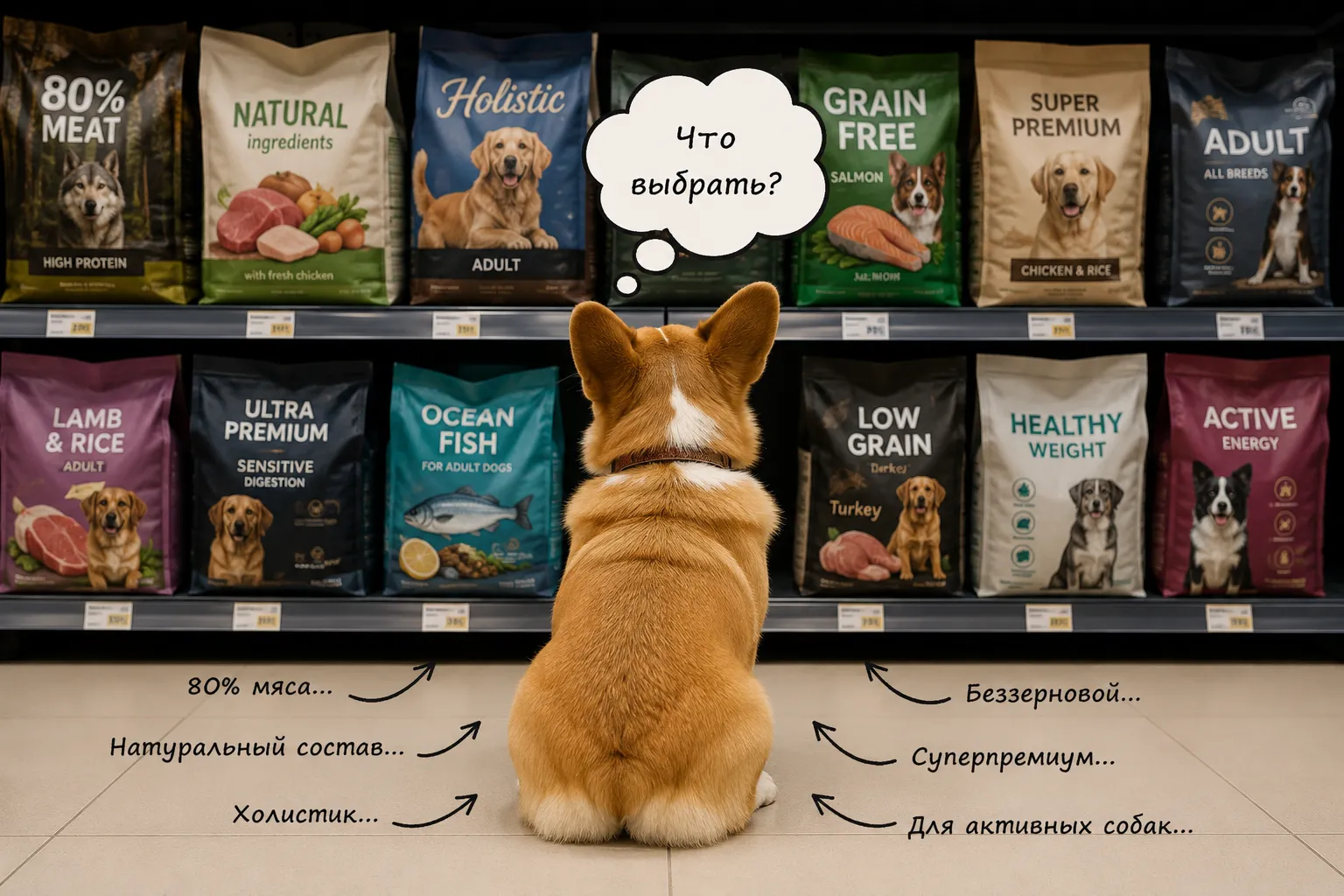
You walk into a pet store…
In front of you is a long row of dog food bags.
One says in big bold letters “80% meat”.
Another – Holistic.
A third – Grain Free.
A fourth promises a “natural recipe,” a fifth – “super premium,” and the sales assistant swears this is exactly what their own dog eats.
How do you know whom to believe?
Most owners feel exactly like this – lost. And that’s no surprise: the modern market offers hundreds of diets, and there’s so much information around that it only gets harder to figure things out.
But the good news is that choosing a suitable food becomes much easier when you understand what you actually need to pay attention to.
The first mistake almost everyone makes
The moment they pick up a bag, most people flip it over and start carefully studying the ingredient list.
The same things usually catch their eye:
- Meat must be listed first.
- The higher the percentage of meat, the better.
- Grain-free food is always healthier.
- The longer the list of meat ingredients, the higher the quality of the diet.
At first glance, it all sounds logical, but this is exactly where the first mistake lies.
The ingredient list is far from the only, and far from the most important, indicator of a food’s quality. Moreover, without understanding how it is put together, such a list can confuse the owner more than it helps them make the right choice.
Three questions to ask before buying any dog food
In reality it’s much simpler than it looks: instead of hunting for the “perfect formula,” you first need to answer just three questions.
1. Is this food safe?
This is the most important question of all.
Even the most attractive formula is meaningless if the product isn’t safe.
Safety starts not with pretty packaging and not with advertising – it starts at the manufacturing plant.
A good manufacturer controls the quality of raw materials, checks every batch, follows strict production standards, and is ready to openly talk about their quality control system. If a problem arises, a responsible company can quickly recall its products from the market to protect animals’ health.
That’s why safety must always come first.
How can an ordinary owner assess a food’s safety?
Of course, we can’t personally inspect the factory or the producer’s lab, but there are a few signs that show how open and responsible a company is about the quality of its products.
Pay attention to the following:
- The bag lists the manufacturer and their contact details. A reliable company doesn’t hide who makes the food or how to contact them.
- The producer openly talks about their quality standards. A good sign is when you can find information on the official website about the production process, quality control system, and scientific approach to formulating diets.
- The company is willing to answer owners’ questions. If the manufacturer provides customer support contacts and advises buyers, this shows transparency.
- Information about the food is clear and transparent. The producer doesn’t stop at catchy marketing slogans, but explains why they use this particular recipe.
None of these signs alone guarantees a food’s quality, but together they help you understand how trustworthy the manufacturer is.
2. Is this diet complete and balanced?
A dog’s body doesn’t just need meat, vegetables, or grains on a daily basis. It requires dozens of different nutrients: amino acids, fatty acids, vitamins, minerals, and trace elements — in strictly defined amounts and in the right proportions.
A complete diet is formulated to provide everything a dog needs when fed every day.
By contrast, complementary foods, treats, or home-made diets put together on your own often can’t do this.
3. Does this food suit my individual dog?
Even an excellent food won’t be right for absolutely every dog.
A growing puppy’s needs are very different from those of an adult dog.
An active sports corgi burns far more energy than an older couch companion.
Pregnancy, lactation, neutering, medical conditions, and a tendency to gain weight — all of this affects the choice of an appropriate diet.
So the right question is not “What is the very best food?”, but “Which food suits my particular dog best?”
Why there’s no such thing as one universally “best” food
We’d all love to find that one magic bag that suits every dog, but such a food simply doesn’t exist.
Even if two diets are equally high quality, one may be perfect for a young, active dog, while the other suits an elderly pet with sensitive digestion.
That’s why experienced veterinary nutritionists never choose food based only on brand name or ingredient list; they always start with the dog in front of them.
What about the ingredients?
Of course the formula matters — just not in the way it’s usually presented.
From the ingredient list alone you cannot tell:
- how well the proteins are digested and absorbed;
- whether the diet is properly balanced;
- whether it contains enough vitamins and minerals;
- how safely the production is organized;
- whether the food has been researched and tested.
That’s why veterinary nutritionists treat the ingredient list as only one of many criteria, not as the main quality marker.
In one of the upcoming articles in this series, we’ll discuss why judging food by ingredients alone is one of the most common mistakes dog owners make.
Key takeaways
If you remember just one idea from this article, that will already be enough.
Don’t chase the perfect ingredient list.
First make sure the food:
- is safe;
- is a complete diet;
- suits your particular dog.
Only after that does it make sense to look at other criteria.
If you’re just starting to learn about feeding dogs, don’t try to judge a food by a single feature — whether it’s the formula, meat percentage, or loud slogans on the packaging. A good choice is always made up of several factors.
In the following articles we’ll go through each of them one by one.
🦴 Myth of the week
“If food is expensive, it means it’s high-quality and safe.”
In reality, price alone guarantees nothing.
The cost of dog food is shaped by many things: marketing, packaging, logistics, ingredient prices, research, and even the country of origin. An expensive food is by no means always better than a more affordable one.
It’s much more important to understand who makes the food and how far you can trust this company.
We’ll talk about this in the next article.
🔜 What’s next?
➡️ Article 2. How can you tell if a manufacturer is trustworthy?
Pretty promises on the bag don’t yet say anything about the food’s actual quality.
In the next article we’ll look at:
- why a producer’s reliability matters more than loud marketing claims;
- which questions to ask the company before buying their food;
- what veterinary nutritionists recommend paying attention to;
- and which signs help you recognize a truly responsible manufacturer.