Allergies in Dogs: Not as Scary as They Seem
The word “allergy” often causes anxiety, especially if the owner has personal experience with allergic reactions. In people, allergies can be accompanied by a runny nose, watery eyes, breathing difficulties and, in severe cases, even anaphylactic shock, which requires immediate medical attention.
In dogs the situation is completely different.
In the vast majority of cases, allergies do not pose an immediate threat to life, but they significantly reduce the animal’s quality of life. The main problem is intense, sometimes almost unbearable itching, which makes the dog scratch constantly, chew on itself, lick its paws and damage the skin.
It’s important to understand that an allergy is not an infection and not a contagious disease. It is a peculiarity of the immune system, in which the body starts reacting too violently to substances that are completely harmless for most dogs.
This excessive immune response causes skin inflammation and persistent itching.
The Main Symptom of an Allergy Is Itching
Almost all allergic diseases in dogs present in a similar way.
A dog may:
- constantly scratch;
- chew or lick its paws;
- rub its muzzle against furniture or carpet;
- shake its head;
- scratch its neck, belly or the base of the tail;
- wake up at night because of severe itching.
Sometimes owners notice only a change in behavior: the dog becomes restless, sleeps worse, is constantly distracted by scratching and cannot relax and rest.
It’s important to remember that allergy is far from the only cause of itching. Similar symptoms can be caused by parasites, fungal and bacterial infections, certain endocrine diseases and other health problems, so it is impossible to make a diagnosis based only on a photo or a description of the symptoms.
In most dogs, allergies are accompanied by itching, but sometimes the first and only sign of disease is chronic inflammation of the outer ear (otitis externa), which recurs again and again despite treatment.
The Three Most Common Types of Allergies
In dogs, three types of allergic diseases are most commonly seen:
1. Flea allergy (flea allergy dermatitis).
2. Atopic dermatitis (allergy to environmental factors).
3. Food allergy.
All three conditions can look very similar, so it is almost impossible to determine the cause based on appearance alone.
However, there are certain features that help the veterinarian choose the right diagnostic direction.
Flea Allergy
This is the most common allergy in dogs worldwide and one of the most frequent causes of severe skin itching.
Many owners are surprised when the vet mentions fleas, because they haven’t seen any on the dog at all.
In fact, an allergic reaction does not require the animal to be literally covered in parasites. The point is that the allergy is triggered not by the flea itself, but by proteins in its saliva. Sometimes just a single bite is enough for a sensitive dog’s immune system to launch a marked inflammatory response, and the itching can last for several days or even weeks.
That’s why flea allergy can develop even in:
- indoor dogs;
- animals that regularly receive parasite preventives;
- dogs on which the owner has never seen a single flea.
A flea may jump on the animal during a walk, bite it and then die under the action of a modern product, but the immune system has already reacted to the bite.
Flea allergy can appear for the first time at almost any age—in both young and adult dogs.
Where does the itching usually occur?
Flea allergy typically affects specific areas of the body:
- lower back and croup;
- base of the tail;
- underside of the belly;
- navel area;
- neck.
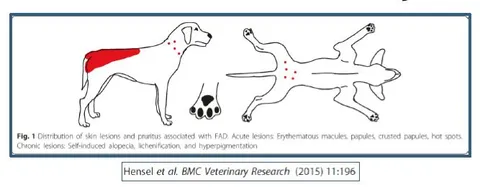
This particular distribution of lesions often makes the veterinarian suspect flea allergy first.
Atopic Dermatitis (Allergy to Environmental Factors)
If flea allergy is the most common, atopic dermatitis ranks second in frequency.
This is a chronic allergic disease in which the immune system reacts too strongly to substances that are constantly present in the environment.
Such allergens can include:
- pollen of trees, shrubs, grasses and weeds;
- house dust;
- dust mites;
- molds;
- fungal spores and other microscopic particles in the air.
Unlike people, in whom this type of allergy more often manifests as a runny nose and watery eyes, in dogs the primary “target organ” is the skin.
Why does atopy develop?
The exact cause of atopic dermatitis is not fully understood. Today it is believed that the disease develops under the influence of several factors at once.
The most important of these are:
- hereditary predisposition;
- characteristics of the immune system;
- condition of the skin barrier;
- environment.
Therefore atopic dermatitis is considered a disease with a pronounced genetic component. In some breeds it is significantly more common than in others, which is why dogs with confirmed atopy are not recommended for breeding.
At what age does atopy appear?
Most often the first symptoms occur between 6 months and 3 years of age.
Sometimes the disease develops a little later, and with age the symptoms can gradually become more severe.
In rare cases, allergies first appear in an adult dog. This is possible, for example, after moving to another region or country, where the animal encounters a completely new set of allergens.
Where does a dog itch with atopy?
Although atopic dermatitis cannot be diagnosed solely by the location of the itching, there are characteristic areas of involvement.
Most commonly affected are:
- muzzle;
- area around the eyes and lips;
- outer surface of the ears;
- armpits;
- groin;
- underside of the belly;
- paws, especially between the toes;
- carpal and hock joints.
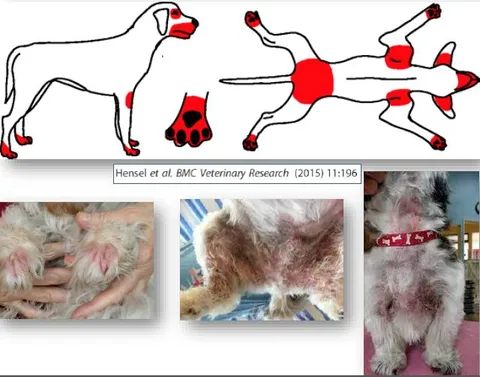
Many dogs don’t just scratch but constantly lick and chew their paws. Owners often notice reddish-brown staining of the coat—this is the result of constant exposure to saliva.
Not Just Itching
Sometimes atopic dermatitis doesn’t present so obviously.
One of the most common complications is chronic otitis externa.
In some dogs, repeated ear infections are the first or even the only sign of allergy.
Much more rarely (in less than 10% of dogs), signs from the upper respiratory tract may be seen:
- clear nasal discharge;
- sterile conjunctivitis;
- excessive tearing.
However, such manifestations are much less common than in people.
Food Allergy
Food allergy is the best known among owners, but it is far from the most common cause of skin itching.
In reality, it occurs much less frequently than flea allergy or atopic dermatitis.
Nevertheless, it is very important to rule out food allergy, because the treatment approach in this case is completely different.
What causes food allergy?
Most owners are sure that allergies are caused by colorants, preservatives or “chemicals” in the food.
In practice, this is far from the case.
In most cases, the immune system reacts to a protein contained in the food, and it can be a protein of any origin:
- beef;
- chicken;
- dairy products;
- fish;
- eggs;
- lamb;
- soy and many other ingredients.
So the allergy doesn’t develop because the food is cheap or expensive, but because the body of a particular dog has started to perceive a specific protein as a threat.
At what age does food allergy appear?
Unlike atopy, food allergy can first appear at any age.
It may develop:
- in a puppy;
- in a young dog;
- in an elderly animal that has eaten the same food for many years without any problems.
Therefore age alone does not allow this diagnosis to be ruled out.
How does food allergy present?
The greatest difficulty is that food allergy is almost indistinguishable from atopic dermatitis.
The dog may also itch on the:
- muzzle;
- ears;
- paws;
- belly;
- groin;
- armpits.
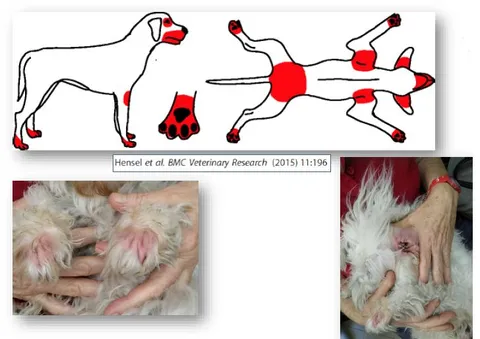
Chronic otitis is very common.
In about one in five dogs there are additional gastrointestinal signs:
- chronic or intermittent diarrhea;
- increased stool frequency;
- vomiting;
- increased gas formation;
- discomfort or pain in the abdomen.
However, it is important to remember that the absence of digestive problems does not rule out food allergy.
Can You Identify the Type of Allergy by Symptoms Alone?
This is one of the most frequent questions from owners.
Unfortunately—no.
Although flea allergy often affects rather characteristic body areas, atopic dermatitis and food allergy look almost identical.
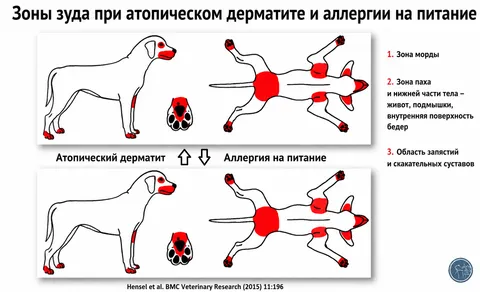
Even an experienced veterinary dermatologist cannot confidently say which allergy a dog has just by looking at it, so the diagnosis of allergic diseases is based not on guesswork but on the step-by-step exclusion of possible causes.
Sometimes this process takes several months, but only this approach allows the veterinarian to make the correct diagnosis and choose truly effective treatment.
How Does a Veterinarian Determine What a Dog Is Allergic To?
All three main allergies cause almost the same symptoms—primarily itching. However, the treatment for each of them is different.
- With flea allergy it is enough to completely prevent contact with parasites.
- With food allergy it is necessary to identify and remove the allergen from the diet.
- With atopic dermatitis, long-term and sometimes lifelong treatment is usually required.
Therefore the main task of the veterinarian is not just to reduce itching, but to determine its true cause.
Diagnosis is carried out in stages, consistently ruling out the most likely options.
First Stage—Ruling Out Flea Allergy
Since flea allergy dermatitis is the most common cause of allergic itching, investigation usually starts there.
Even if:
- you have never seen fleas on your dog;
- the pet lives indoors;
- the dog regularly receives antiparasitic treatment,
the veterinarian will still assess the likelihood of this allergy.
Why?
Because a single flea only needs one bite to trigger a severe allergic reaction.
How is the diagnosis confirmed?
There is no specific blood test or skin test to diagnose flea allergy. The diagnosis is made based on response to treatment.
The veterinarian prescribes:
- reliable flea control;
- environmental treatment if necessary;
- medications that reduce itching at the initial stage.
This is necessary because even after the cause has been removed, skin inflammation does not disappear instantly.
After some time, the antipruritic drugs are gradually discontinued, and if the itching does not return, it can be concluded that flea bites were indeed the cause of the disease.
This process can take several months, but once the diagnosis is established, controlling the condition is usually quite simple—regular flea prevention is generally sufficient.
Second Stage—Elimination Diet
If flea allergy has been ruled out, the next step is to look for food allergy.
Here owners are often surprised to learn that there are currently no tests capable of reliably confirming food allergy.
Although some laboratories offer blood, saliva or hair tests for food allergy, their results are not considered accurate enough for diagnosis.
To date, only one reliable diagnostic method is recognized worldwide—an elimination diet.
What is an elimination diet?
During diagnosis, the dog is gradually switched to a special therapeutic hypoallergenic diet.
It is very important to understand that this means not a food labeled “Hypoallergenic” from a regular pet store, but a veterinary therapeutic diet that has undergone appropriate studies and is specifically designed to diagnose food allergy.
There are two main types of such diets.
Diet with a Novel Protein Source
As the protein source, a product is used that the dog’s immune system has never encountered before.
In theory, this helps avoid an allergic reaction, but finding a truly novel protein today is becoming increasingly difficult.
Many dogs have already tried chicken, beef, turkey, fish, lamb, various treats and even exotic ingredients.
In addition, it is often impossible to know exactly what the dog has eaten in the past, especially if it came from a shelter or has already had several owners.
Studies have also shown that some regular pet foods may contain ingredients not listed on the label, which makes this type of diet less reliable.
Diet with Hydrolyzed Protein
In the second option, a common protein is used, which is broken down by a special technology into very small fragments.
These particles are so small that the immune system no longer recognizes them as an allergen, which is why hydrolyzed veterinary diets are now considered the most reliable tool for diagnosing food allergy.
Why Must the Diet Be Strict?
During the diagnostic diet, the dog must receive only the prescribed therapeutic food.
The following are not allowed:
- any treats;
- table scraps;
- sausage;
- cheese;
- cookies;
- chew treats;
- vitamin supplements with meat flavorings;
- any products not approved by the veterinarian.
Even a small piece of a forbidden food can nullify several weeks of diagnostic work, so the success of the trial depends entirely on the discipline of the whole family.
How Long Does the Diet Last?
A diagnostic diet usually continues for at least eight weeks; during this time the veterinarian evaluates whether the itching decreases.
If the dog’s condition improves significantly, this still does not mean a final diagnosis—now the next stage is needed, the so-called food challenge.
What Is a Food Challenge?
After the diagnostic diet is completed, and in agreement with the veterinarian, the dog is given its previous food again.
This is done deliberately: if the itching returns within about two weeks, and then disappears again after switching back to the therapeutic diet, the diagnosis of food allergy is considered confirmed.
The final diagnosis is based on the combination of three factors:
- improvement on the therapeutic diet;
- return of symptoms on the regular food;
- renewed improvement after resuming the hypoallergenic diet.
If the itching does not reappear after the dog returns to its usual food, food allergy is practically ruled out.
When Is the Diagnosis “Atopic Dermatitis” Made?
Only after the veterinarian has consistently ruled out the other two main causes of allergy:
- flea allergy;
- food allergy.
That is why it is almost impossible to diagnose “atopy” at a single appointment.
Sometimes owners feel that the investigation is taking too long. In reality, this is the only way to avoid making a mistake and prescribing lifelong treatment when the cause of itching is something else entirely.
How Is Atopic Dermatitis Treated?
If flea allergy and food allergy have been excluded, the veterinarian makes the diagnosis atopic dermatitis.
Unfortunately, this disease cannot be completely cured, but modern therapies allow its symptoms to be successfully controlled, so that most dogs can live full and comfortable lives.
The choice of treatment always depends on the animal’s age, disease severity, frequency of flare-ups and the presence of concurrent problems.
Is It Enough Just to Remove the Allergen?
Theoretically—yes.
If it is possible to completely avoid the dog’s contact with the allergen, the symptoms will disappear, but in practice this is extremely rare.
It is impossible to remove all plant pollen, dust or dust mites from the environment. Therefore, treatment is usually aimed not at eliminating the allergen, but at controlling the immune system’s response.
Immunotherapy
One of the most modern treatment methods is allergen-specific immunotherapy.
After allergy testing, the veterinarian compiles an individual set of allergens that trigger a reaction in this particular dog. These allergens are then introduced into the body according to a special protocol, gradually “teaching” the immune system to react to them more calmly.
Immunotherapy does not help every animal, but in many dogs it significantly reduces the severity of symptoms and decreases the need for other medications.
Drug Therapy
If it is impossible to avoid contact with allergens, the veterinarian may prescribe medications that reduce inflammation and itching.
Modern veterinary dermatology uses several groups of drugs, including:
- glucocorticosteroids;
- modern immunomodulatory drugs;
- monoclonal antibodies;
- in some cases, antihistamines.
Each of these methods has its own indications, advantages and possible side effects, so treatment must always be tailored to the individual dog. You must not change doses, discontinue drugs or use medications prescribed for another dog on your own.
It is important to understand that atopic dermatitis is a chronic disease. In most dogs, treatment continues for a long time and sometimes throughout life.
Why Do Skin and Ear Infections Develop?
Itching itself is only part of the problem.
By constantly scratching, the dog damages the natural protective skin barrier. Through these micro-injuries, bacteria and yeast fungi—which are normally present on the skin in small amounts and do not cause disease—can easily penetrate.
As a result, secondary infections develop.
That is why many allergic dogs simultaneously suffer from:
- bacterial skin infections;
- yeast dermatitis;
- chronic otitis externa.
Sometimes it is the secondary infection that causes the most severe symptoms and greatly intensifies the itching.
Why Shouldn’t Antibiotics Be Overused?
When a bacterial skin infection develops, owners often feel that the simplest solution is a course of antibiotics.
However, modern veterinary medicine recommends using systemic antibiotics only when they are truly necessary.
Frequent and unjustified use of antibiotics can lead to serious consequences:
- development of bacterial resistance to treatment;
- disruption of normal intestinal microflora;
- emergence of new, more resistant infections.
In addition, resistant bacteria can pose a risk not only to animals but also to people, especially those with weakened immune systems.
Therefore, in cases of superficial skin infections, veterinarians increasingly prefer topical treatment.
Depending on the test results, special medicated shampoos, antiseptic solutions, wipes, foams or other products that act directly on the affected skin areas may be used.
This approach allows effective control of the infection while reducing the need for systemic antibiotics.
A Few Common Myths
Myth 1. If I change the food, the allergy will go away.
Not always.
Most itchy dogs do not suffer from food allergy, so endlessly changing foods rarely helps.
Myth 2. If there are no fleas on the dog, it can’t be allergic to them.
That’s not true.
For a sensitive dog, just one bite is sometimes enough; the parasite may already have died, but the itching will persist for a long time.
Myth 3. A blood test will show which food the dog is allergic to.
Unfortunately, no.
To this day, the only widely accepted method of diagnosing food allergy remains a properly conducted elimination diet with a subsequent food challenge.
Myth 4. Atopic dermatitis cannot be controlled.
Modern veterinary dermatology has many effective treatments.
Although it is impossible to completely get rid of the disease, most dogs feel well and live normal lives with properly chosen therapy.
The Key Points to Remember
- Allergies in dogs rarely threaten life, but they almost always significantly impair its quality because of constant itching.
- The most common cause of allergic itching is flea allergy.
- Atopic dermatitis and food allergy look very similar, so they cannot be distinguished by symptoms alone.
- Allergy diagnosis is a step-by-step process of ruling out possible causes, which requires time and patience.
- The only reliable way to confirm food allergy is a properly conducted elimination diet followed by a food challenge.
- With atopic dermatitis, treatment is usually long-term, but modern methods allow effective control of the disease and help maintain a high quality of life for the dog.
Conclusion
If your dog constantly itches, licks its paws, often shakes its head or suffers from recurring ear infections, do not postpone a visit to the veterinarian. The sooner the cause of the itching is identified, the sooner the right treatment can be chosen and complications prevented.
Allergy is not a life sentence. With competent diagnostics, cooperation between the owner and the veterinarian, and careful adherence to all recommendations, most dogs with allergic diseases live long, active and happy lives.