🍽️ Series 1: “Dog Nutrition Without Myths”
Today you’ll learn:
- how ingredients differ from Nutrients;
- why your dog’s body doesn’t “see” chicken, rice, or apples;
- why cats must not be fed dog food;
- what amino acids, fatty acids, vitamins, and minerals are;
- why a complete diet is always about balance, not a list of trendy ingredients.
What you see — and what the body “sees”
When we read the food label, we see:
- chicken;
- rice;
- salmon;
- apples;
- blueberries;
- spinach.
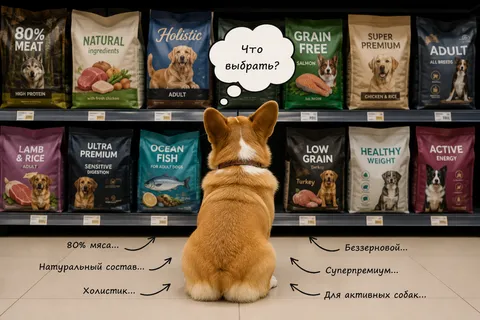
It feels like these very foods determine the quality of the diet.
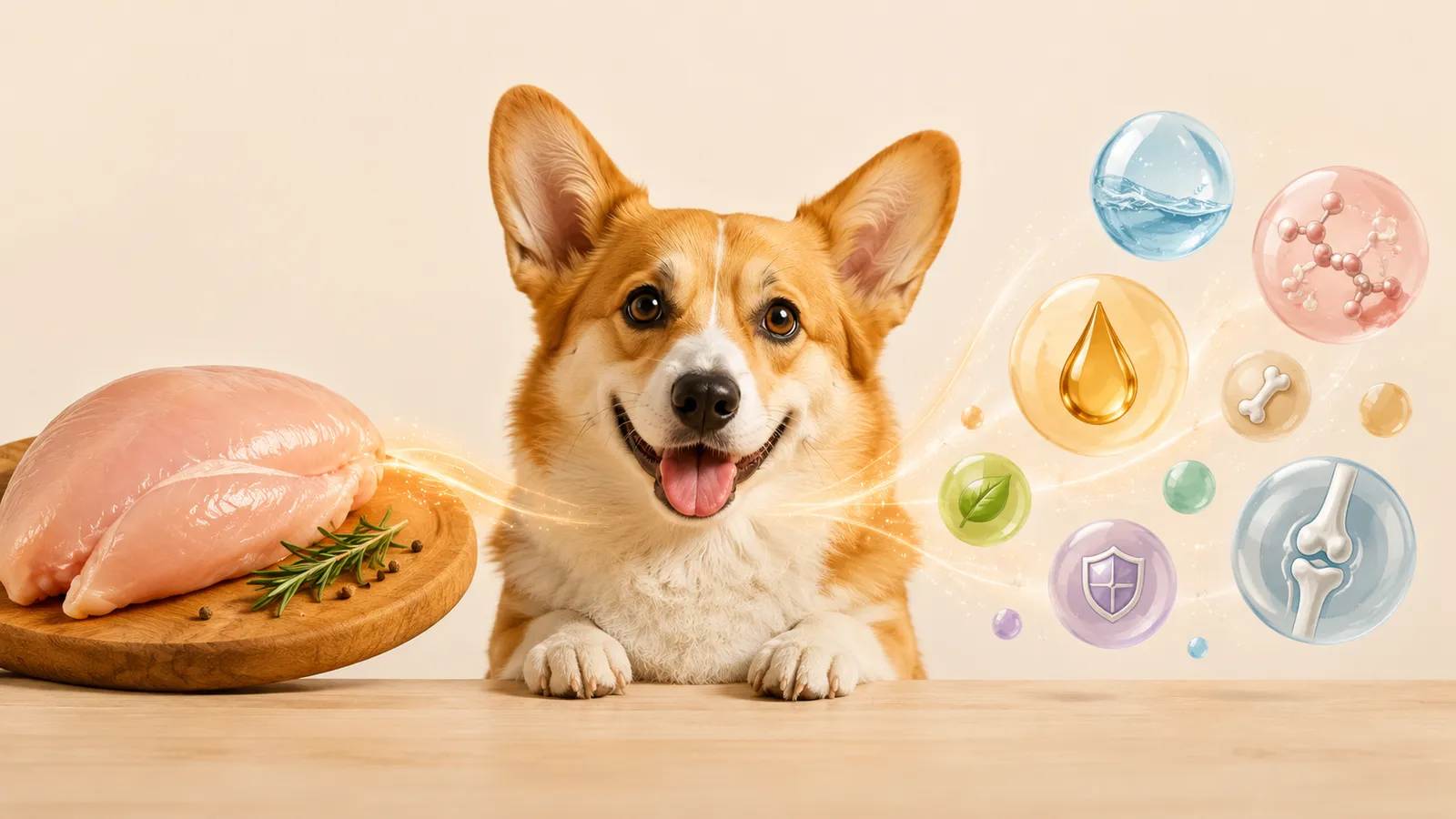
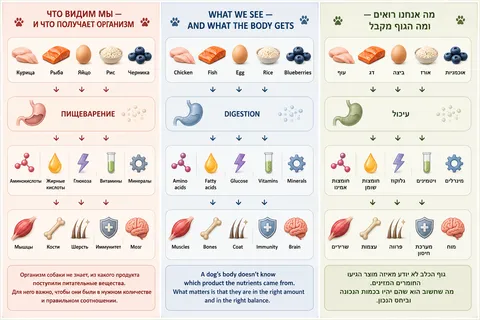
But a dog’s body perceives food completely differently: after digestion, chicken is no longer chicken, rice is no longer rice, and an apple is no longer an apple.
All ingredients are broken down into simpler substances that are then absorbed in the intestines. Those are what the body actually needs.
What are Nutrients?
Nutrients are components of food that the body needs for life, growth, and the normal function of all organs.
They include:
- proteins;
- fats;
- carbohydrates;
- vitamins;
- minerals;
- water.
These, not the attractive ingredient names, are what support your dog’s health.
Protein ≠ “chicken”
This is one of the key points.
The body cannot use a piece of chicken as-is. First, protein is broken down into amino acids.
These are what build:
- muscles;
- skin;
- coat;
- enzymes;
- hormones;
- immune cells.
If a dog receives all the required amino acids in the right amounts, the body doesn’t care whether they came from chicken, turkey, fish, or any other high‑quality protein source.
The same happens with fats
The body doesn’t use “chicken fat” or “fish oil” as such.
After digestion they are broken down into fatty acids, among which are the famous Omega‑3 and Omega‑6, needed for:
- skin health;
- coat quality;
- brain function;
- vision;
- immune function.
What matters is not the ingredient name, but the fatty acid profile it provides.
What about vitamins and minerals?
It’s the same story here: calcium remains calcium regardless of whether it came:
- from bone meal;
- from a mineral supplement;
- from another safe source.
The same applies to iron, zinc, copper, vitamins A, D, E, and other Nutrients.
For the body, what matters is which Nutrients it receives and in what amounts, not which ingredient they came from.
Why can’t cats be fed dog food?
Many households have both dogs and cats peacefully sharing a home. And sometimes, for various reasons, owners decide that if the food is “good quality,” it can be fed to both.
This is a huge mistake and a serious risk to a cat’s health!
There are substantial differences between dogs’ and cats’ nutritional needs, so you can’t evaluate a food by looking at ingredients alone.
Imagine two diets: both list chicken, rice, fish oil, vitamins, and minerals. At first glance they look almost identical — but one is formulated for dogs and the other for cats.
Why?
Because the cat is an obligate carnivore, an animal whose body has evolved to live on meat and other animal products only. There is virtually no plant food in a natural feline diet, so cats have completely different Nutrient needs.
For example, cats are critically dependent on taurine — an amino acid that plays an important role in the heart, retina, immune system, and reproductive system. A dog’s body can synthesize enough taurine on its own, but a cat’s body cannot. That’s why taurine is always added to cat food.
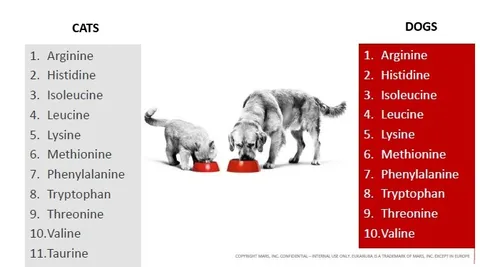
In addition, cats need:
- more protein;
- more fat;
- more vitamin A;
- more arachidonic acid;
- different ratios of many Nutrients.
That is why dog food cannot provide complete nutrition for a cat, even if the ingredient list looks very similar.
A dog occasionally eating cat food or a cat occasionally eating dog food is usually not a serious problem. But if a cat regularly eats dog food, over time it can develop serious health issues due to deficiencies of vital Nutrients.
This example illustrates the main takeaway from our article:
For the body, what matters is not which foods are listed on the package, but whether it receives all essential Nutrients in the right amounts.
So why do we need ingredients at all?
They are very important. Ingredients are where manufacturers get the necessary Nutrients.
Different combinations of foods can provide almost identical nutrient profiles, so two formulas with very different ingredient lists can meet a healthy dog’s needs equally well.
Why do veterinary nutritionists see it differently?
When a specialist evaluates a diet, they ask completely different questions.
Not “Is there any blueberry in here?”
But “Is the dog getting enough antioxidants?”
Not “Is there chicken in here?”
But “Are there enough essential amino acids in the diet?”
Not “Is there salmon oil?”
But “Is the dog getting enough Omega‑3 fatty acids?”
That’s why a professional assessment of a diet differs so much from how owners usually choose food.
Key points to remember
A beautiful ingredient list doesn’t automatically mean a perfectly balanced diet.
Your dog’s body uses:
- amino acids;
- fatty acids;
- vitamins;
- minerals;
- energy.
It’s the balance of these that determines diet quality.
🦴 Myth of the week
“The more ‘healthy’ ingredients there are on the label, the better the food.”
In reality, a long list of attractive components doesn’t tell you whether your dog is getting everything it needs.
Far more important is which Nutrients — and how much of them — the finished diet contains.
🔜 What’s next?
➡️ Article 5. Is It True That the More Meat, the Better?
In the next article we’ll tackle one of the most popular pet food myths.
You’ll learn:
- why a high percentage of meat by itself guarantees nothing;
- whether more protein is always better for a dog;
- how much protein a dog actually needs;
- and why protein quality matters more than quantity.