Many people think a pedigree is just a document, “a piece of paper” they have to overpay for when buying a purebred dog. In reality, issuing a pedigree in Israel costs only 170 shekels. The real value lies not in the document itself, but in the entire system of breeding work, oversight and responsibility that stands behind it. Let’s look at why official purebred breeding exists at all, what happens long before a puppy is born, and why a good breeder is responsible not only for the dogs’ health, but also for their future.
Why Are There So Many Myths Around Pedigrees?
When it comes to buying a purebred dog, one of the most common questions sounds something like this:
“Why pay for a pedigree? Isn’t it just a piece of paper?”
This question is perfectly understandable, because the future owner only sees a cute puppy and the document that comes with it.
But hardly anyone sees what happened long before this puppy was born, which is why any conversation about a pedigree should start not with the document, but with a different question:
Why does the system of official purebred breeding exist in the first place?
Where Did Pedigrees Come From?
Dog breeds did not appear by themselves.
For many centuries, people deliberately bred dogs for specific tasks. Some helped herd livestock, others hunted, others guarded the home, pulled loads or rescued people.
To preserve the necessary qualities, it was important to understand each dog’s origin and know which parents it came from.
That is why as early as the 19th century the first stud books began to appear, recording information about dogs’ ancestry. Later, cynological organizations were created; they began to keep official registers, develop breed standards and establish unified rules for breeding work.
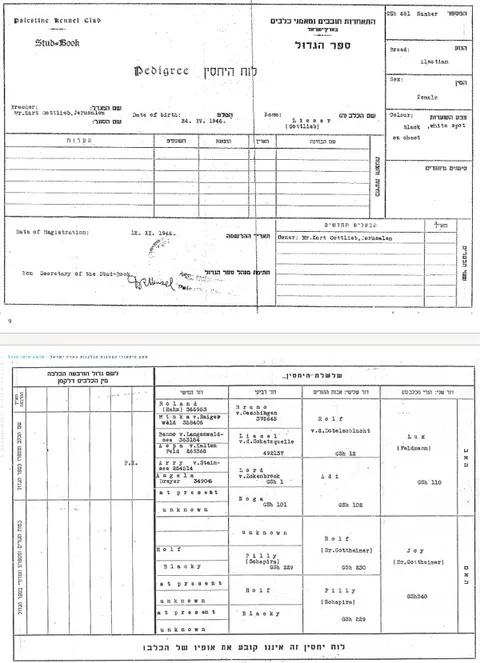
A modern pedigree is, essentially, an extract from this long‑term record‑keeping system. It does not exist on its own, but is the result of the work of stud books, cynological organizations and breeders who, over generations, preserve the history of each line’s origin.
Their task was never to make a dog “more expensive” or “more prestigious”.
They were created as a record‑keeping tool that makes it possible to preserve breeds, control the origin of dogs and carry out responsible breeding work over many generations.
What Is the Purpose of Official Purebred Breeding?
Many people mistakenly believe that the job of cynological organizations is to issue pedigrees and hold shows, whereas in reality this is only a small part of their work.
The main goal of responsible breeding is to produce healthy, physically and mentally sound dogs that match their breed’s characteristics, can live a long, full life and bring joy to their owners.
That is why official breeding rules are aimed not only at preserving breed type, but also at caring for the health of future generations of dogs and the welfare of breeding animals.
To achieve this, there are unified requirements for breeding work: rules for breeding approval, registration of ancestry, puppy identification, keeping stud books and other control mechanisms.
Responsible breeding is impossible without knowledge, honesty and cooperation between breeders, veterinary professionals and cynological organizations. That is why breeding work is built not around a single successful mating, but around a long‑term goal: to make the next generation of dogs even healthier and better off.
A good breeder thinks not only about the puppies that will be born today. They also think about the dogs that will appear in five, ten or twenty years.
What Does a Pedigree Confirm?
A pedigree is an official document that confirms the dog’s origin and its registration in the breeding record system.
It allows you to trace the dog’s ancestry several generations back, learn about its forebears and make sure its birth has been registered in accordance with the rules of the cynological organization.
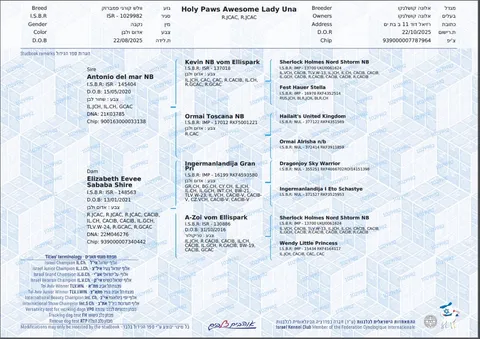
But in itself a pedigree is only a small part of a much more complex system.
Its value lies not in a few sheets of paper, but in what stands behind them: stud books, registration of sires, dams and litters, unified breeding rules and the ability to trace each dog’s origin.
That is why, when talking about a pedigree, it is more accurate to look not at the document itself, but at the entire system of responsible breeding of which it is a part.
In Israel, issuing a pedigree costs only 170 shekels, so the high price of a puppy has nothing to do with the cost of the document itself.
Everything Starts Long Before the Puppies Are Born
A responsible breeder’s work does not begin when the puppies are born, or even when the bitch becomes pregnant.
It starts long before that.
Every mating is the result of lengthy analysis and preparation. The breeder studies the future parents’ pedigrees, genetic test results, evaluates health, temperament, conformation, degree of relatedness and possible hereditary risks.
The main goal is not just to get puppies.
The main goal is to get healthy, mentally stable and breed‑typical offspring.
After Birth, the Work Is Only Beginning
The first weeks of a puppy’s life are among the most critical stages.
The breeder watches the mother and puppies around the clock, monitors their development, provides proper nutrition and veterinary care.
Later come vaccinations, microchipping, paperwork, and introducing the puppies to the outside world, people, new sounds and different everyday situations.
It is during this period that the foundations of the dog’s future behaviour are laid.
Most of this work remains invisible to the future owner, but it largely determines how easily the puppy will adapt to its new life.
A Responsible Breeder Chooses More Than Just the Parents
When the puppies grow up a bit, another very important stage begins: finding the right family.
Many people are surprised that a good breeder asks so many questions.
- Who will live with the dog?
- Are there children or elderly people in the family?
- Are there other animals?
- What kind of lifestyle does the family lead?
- Why was this particular breed chosen?
- What previous experience with dogs does the family have?
This is not an attempt to control future owners, and certainly not an exam, but a desire to understand in which family a particular puppy will really thrive.
Sometimes the Breeder Knows Their Puppies Better Than It Seems
Most people choose a puppy with their heart, and that is perfectly natural.
But the breeder observes the litter every day during the first two months of life. They know who is bolder, who is more cautious, who adapts easily to new conditions and who is more attached to familiar surroundings, who loves being the centre of attention and who feels better in a quieter environment.
That is why a responsible breeder often recommends to a family not the puppy they first liked in the photo, but the one whose temperament best matches the future owners’ lifestyle.
After all, the perfect family for one puppy may be far from ideal for another.
Why Are Puppies From Official Breeders More Expensive?
Sometimes you may hear:
“Why pay more? You can buy the same puppy without papers.”
But if a pedigree costs only 170 shekels to issue, it becomes obvious that the difference in price has nothing to do with the document.
It is made up of many things that remain invisible to the future owner:
- health testing of breeding stock;
- genetic tests;
- breeding work;
- proper rearing of the litter;
- veterinary care;
- quality nutrition;
- vaccinations and microchipping;
- socialization of the puppies;
- the breeder’s time, knowledge and experience.
When a person buys a responsibly raised puppy, they are not paying for a document — they are paying for the huge amount of work that was done long before the puppy arrived in their home.
And What Is “Pirate Breeding”?
In Israel, the term “pirate breeding” is sometimes used.
This refers to breeding outside the official system of breeding control, producing so‑called “pseudo‑purebred” dogs.
It is important to understand that the problem here is not the lack of the document itself, because the document can be issued for a relatively small amount of money.
What matters much more is that in such breeding, the entire system behind official registration is often missing: control of ancestry, adherence to breeding rules, mandatory testing and the breeder’s responsibility to the cynological organization.
Of course, one cannot claim that every registered breeder is perfect, or that any unregistered breeding is necessarily irresponsible. However, the official system creates transparent rules and control mechanisms that may simply not exist outside it.
A Pedigree Is Only the Tip of the Iceberg
A pedigree is just a few sheets of paper, but behind them are months of preparation, years of experience and enormous responsibility.
Therefore, when choosing a puppy, you should look not only at the document; it is much more important to understand who stands behind this document.
After all, the future owner is not entrusting the breeder with issuing a pedigree — they are entrusting them with the decision to bring a new member of their family into the world.
In the next article we will talk about why even the healthiest and best‑raised puppy is far from suitable for every family; how a responsible breeder helps future owners make the right choice, and why sometimes the best decision may be an honest refusal to sell a puppy.