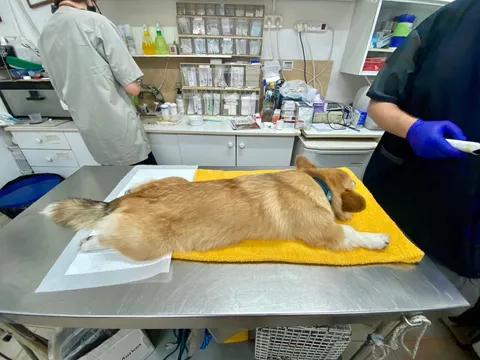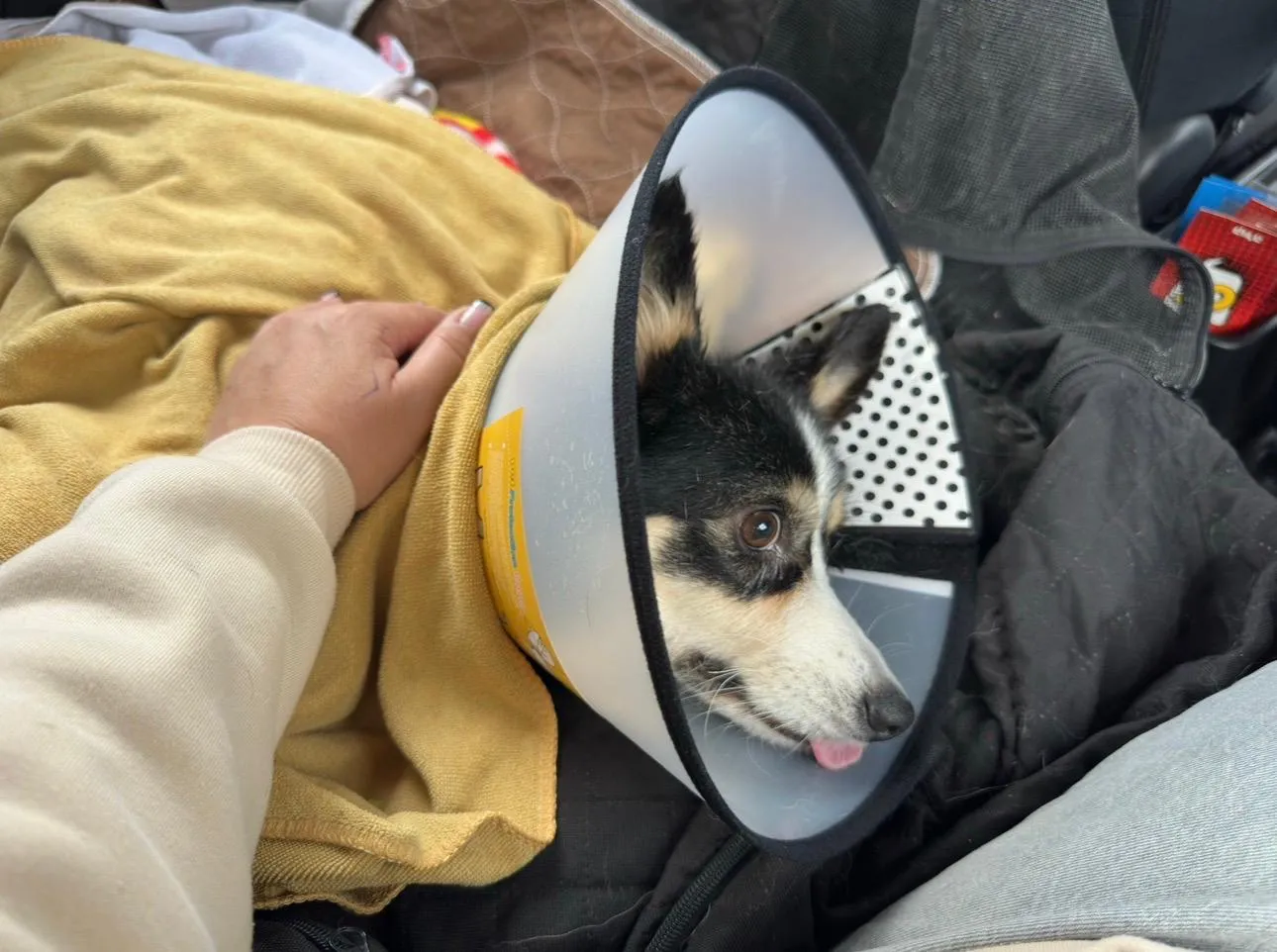
Your dog cut a paw, overheated on a walk, grabbed something suspicious off the ground or had a run‑in with a snake — it’s easy to panic in a situation like that. But the owner’s first actions can sometimes make a real difference.
First aid does not replace veterinary treatment. Its job is not to make a diagnosis or cure the dog at home, but to keep the condition from getting worse, win some time and get the dog safely to a vet.
It helps to know the basic rules in advance and keep a canine first-aid kit at home, because the moment when your dog is lying in front of you feeling very unwell is the worst possible time to start googling what to do.
Start by assessing the situation
Before you start dealing with a wound, looking for a thermometer or rummaging through the first-aid kit, look at the dog as a whole.
Check:
- whether the dog is conscious;
- whether it is breathing normally;
- whether there is any severe bleeding;
- what colour the gums are — normal pink, very pale, bluish or unusually bright red;
- whether the dog can stand and move;
- whether it is reacting to you as usual.
If there has been a serious injury, a snake bite, possible poisoning or heatstroke, it’s best to call a veterinary clinic right away. While one person gives first aid, another, if possible, can contact the vet and get the car ready.
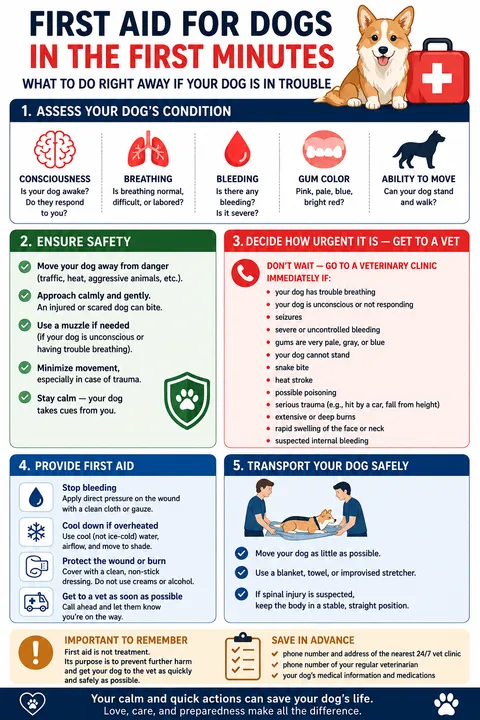
When you must not wait
Immediate veterinary care is needed if:
- the dog is having trouble breathing;
- it has lost consciousness or is not responding normally;
- seizures have started;
- the bleeding is heavy or will not stop;
- the gums are very pale, grey or bluish;
- the dog cannot stand up;
- the dog was hit by a car, had a serious fall or other major trauma;
- there is suspicion of internal bleeding;
- the dog was bitten by a snake;
- there are signs of heatstroke;
- the dog may have eaten poison, medication, a toxic plant or a dangerous food item;
- there is rapidly increasing swelling of the muzzle or neck;
- there has been a serious burn.
Sometimes after an injury a dog can look surprisingly normal. That does not guarantee that everything is fine: adrenaline can mask pain and weakness for a while, and internal damage is not always visible from the outside.
Remember your own safety
Even the gentlest dog may bite its owner out of severe pain and fear.
Approach calmly, avoid sudden movements and do not pin the dog down unless absolutely necessary.
A muzzle may be useful when transporting an injured dog, but it must not be used if the dog is having trouble breathing, is vomiting, overheated, has an injury to the muzzle or is unconscious.
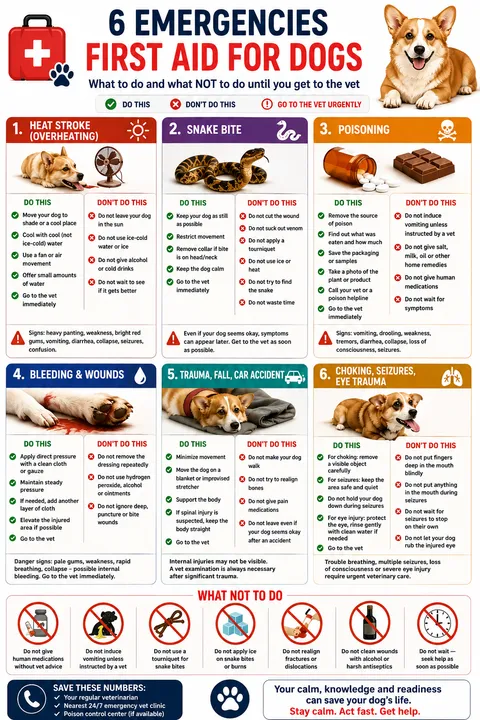
Heatstroke
For dogs living in Israel this is one of the most common emergency situations.
Heatstroke is not just “the dog got too hot”. When body temperature rises dangerously high, internal organs, the clotting system and the central nervous system begin to suffer. The condition can quickly become life‑threatening.
Possible signs
- very rapid, laboured breathing;
- heavy drooling;
- weakness;
- unsteady gait;
- restlessness followed by unusual lethargy;
- bright red or, on the contrary, pale gums;
- vomiting or diarrhoea;
- confusion;
- collapse;
- seizures.
What to do ✅
Move the dog into the shade or an air‑conditioned room and start cooling.
Use cool, but not ice‑cold water. You can wet the dog’s body and at the same time provide air movement with a fan or air conditioner.
If the dog is conscious and able to swallow normally, you can offer water, but do not force it to drink and do not pour water into the mouth.
At the same time, arrange transport to a vet.
What not to do ❌
Do not immerse an overheated dog in ice‑cold water and do not pack it in ice. Cooling that is too aggressive and constriction of the superficial blood vessels can interfere with normal heat loss.
And above all, do not cancel the trip to the clinic just because the dog seems better after ten minutes.
After severe overheating the dog’s outward condition can improve before it becomes clear how badly the body has been affected.
You can read more about heat, hot asphalt and summer walks in our article “Corgis in the Israeli climate”.
Snake bite
In Israel, a dog’s encounter with a snake is a very real danger, especially on walks outside the city, near fields, wasteland and natural areas.
The owner often does not see the actual bite.
You should be alert to sudden severe pain, rapidly developing swelling, puncture marks, weakness, unusual breathing or sudden deterioration after a walk.
Dogs are often bitten on the muzzle because they try to investigate the snake with their nose.
What to do ✅
Restrict the dog’s movement as much as possible.
If you can carry it to the car, it’s better not to make it walk on its own. The calmer the dog, the better.
If the bite is on the head or neck and marked swelling is starting, remove the collar.
And go to a veterinary clinic immediately.
If you were able to safely photograph the snake from a distance, the photo may help, but you do not need to catch or kill the snake just to identify the species.
What not to do ❌
Do not:
- cut the bite site;
- suck out the venom;
- apply a tourniquet;
- massage the bite site;
- apply ice;
- cauterise the wound;
- waste time on home treatment.
If you suspect a venomous snake bite, the most important things an owner can do are keep the dog calm and get it to a vet as quickly as possible.
You can read more about snakes and other dangerous animals in Israel in the article “Animals in Israel that are dangerous for dogs”.
Poisoning
The word “poisoning” can mean very different situations: the dog ate human medicine, rat poison, chocolate, grapes, household chemicals, a poisonous plant or some unknown find off the street.
This is why there is no universal “antidote” you can keep at home.
What to do ✅
First of all, stop any further contact with the substance.
Try to find out:
- what the dog ate or drank;
- the approximate amount;
- when it happened;
- the composition and concentration of this product or medication.
Keep the packaging. If it’s a plant, take a photo or bring a sample if you can do so safely.
Call your vet and follow their instructions.
Do not wait for symptoms to appear if you know for sure that your dog has eaten a potentially dangerous substance. Some types of poisoning are treated much more successfully before obvious signs develop.
Do not induce vomiting on your own ❌
Advice like “give peroxide immediately and make the dog vomit” is still common on the internet.
But vomiting is not helpful for every kind of poisoning and in some cases can make things much worse — for example if a caustic substance was swallowed or there is a risk that the stomach contents will enter the airways.
Vomiting should only be induced when a vet has recommended it for that specific dog and that specific substance.
Do not use salt, oil, milk or other home remedies on your own, and do not give your dog human medicines “just in case”.
On our website we have separate materials about foods that are dangerous for dogs, poisonous plants and other substances your pet may encounter at home or on a walk.
Bleeding and wounds
A small scratch and a deep bleeding wound require completely different approaches. If the bleeding is heavy, the first task is to stop it.
What to do ✅
Place a sterile gauze pad or clean cloth over the wound and press firmly. The pressure must be constant.
Do not lift the pad every few seconds to see whether the bleeding has stopped: this can break up the clot that is forming.
If the first layer is completely soaked with blood, place another layer on top without removing the previous one.
Even after you have stopped heavy bleeding, a vet still needs to examine the dog if the wound is deep, large, dirty, the result of a bite, or the edges are gaping.
What if there is no blood on the outside?
After a road accident, a fall or a hard blow, internal bleeding is possible.
Signs may include:
- increasing weakness;
- very pale gums;
- rapid breathing;
- cold limbs;
- a painful or enlarging abdomen;
- collapse.
There is no effective first aid for this at home — the dog must be taken to a clinic as quickly as possible.
Fracture, fall, road accident and other trauma
After serious trauma the main rule is as little unnecessary movement as possible.
Do not try to put a dislocation back in place or “set” a bone on your own.
If you suspect a fracture or spinal injury, move the dog with extreme care.
A large dog is easier to carry by two people on a sturdy blanket, using it as an improvised stretcher. If you suspect spinal trauma, it is especially important to avoid twisting and bending the body.
Do not make the dog get up and walk just to check “whether it can walk”.
And even if after being hit by a car the dog gets up, shakes itself and seems more or less normal, a veterinary exam is still necessary.
Burn
Burns can be thermal, chemical or electrical.
With a typical thermal burn ✅
Remove the source of heat and cool the affected area with cool water.
After cooling, you can gently cover the area with a clean non‑stick dressing and take the dog to a vet.
Do not use ❌
- ice directly on the burn;
- oil;
- greasy creams;
- toothpaste;
- alcohol;
- random ointments from your human medicine cabinet.
With a chemical burn you must stop contact with the substance and call a vet. If the chemical is on the coat or skin, it is important to prevent the dog from licking it and to avoid exposing yourself. Keep the product’s packaging.
With electric shock first make sure the power source is turned off. Do not grab the dog with your hands while it may still be live.
Even after a burn that looks minor on the surface, a veterinary exam is necessary: the actual damage can be much more serious than it appears.
Insect bite and acute allergic reaction
A small swollen area after an insect bite usually does not look catastrophic in itself.
A rapidly developing systemic allergic reaction is a very different situation.
Go to a clinic urgently if:
- the muzzle is swelling rapidly;
- the tongue or throat area is enlarging;
- the dog is having trouble breathing;
- there is sudden severe weakness;
- repeated vomiting or diarrhoea starts;
- the dog collapses or loses consciousness.
Do not try to choose an antihistamine and calculate the dose based on online advice. If your dog has had severe allergic reactions before, it is better to discuss in advance with your vet which medication to keep at home and how to use it.
Dog choking: foreign body in the airways
A dog that is coughing is usually still able to move air. It is much more dangerous when it is trying to inhale but cannot, panics, gasps for air, the mucous membranes start turning blue and then the dog weakens.
If the object is clearly visible in the mouth and easy to grasp, carefully remove it.
But do not blindly push your fingers deep into the throat: you can push the object further down, and a frightened dog can bite badly.
If the airways really are obstructed, the situation requires immediate action and a subsequent veterinary exam, even if you have managed to remove the object.
Seizures
Watching a seizure is frightening, and the natural reaction of many owners is to try to hold the dog.
You don’t need to do that.
During a seizure
- move away objects the dog could hit itself on;
- do not hold it down by force;
- do not try to pry the mouth open;
- do not put anything into the dog’s mouth;
- dim the lights and reduce noise;
- check the time.
The dog will not swallow its tongue, and trying to put your hand in its mouth during a seizure can lead to serious bites.
If possible, record what is happening on video — the recording can help your vet understand the nature of the seizure.
After a seizure the dog may be disoriented for some time, see poorly, pace restlessly or behave oddly.
A prolonged seizure, several seizures in a row, or seizures in a dog that has never had them before all require urgent veterinary care.
Eye injury
With eye injuries it is better to err on the side of caution.
You should seek urgent examination if there is:
- marked squinting;
- inability to open the eye;
- marked pain;
- blood;
- cloudiness;
- a visible wound;
- a foreign body;
- sudden change in the eye’s size or shape.
Do not allow the dog to rub the eye with its paw — an Elizabethan collar may be useful if needed.
Do not try to remove an object that is stuck in or has penetrated the eye tissues yourself.
If an irritating chemical substance has entered the eye, it must be flushed gently and thoroughly with clean water or saline, and you should contact a vet.
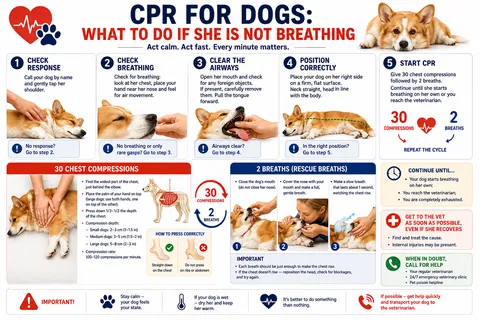
What to do if the dog is unconscious and not breathing
This is the most serious situation.
If the dog is not responding, quickly check its breathing first and make sure there is no clearly visible object in the mouth blocking the airway.
If the dog is not breathing and there are no signs of circulation, cardiopulmonary resuscitation is required.
The exact CPR technique depends, among other things, on the size and build of the dog, so it is far more useful to learn it once in advance than to try to figure out a long set of instructions for the first time in the middle of an emergency.
We recommend that owners take a veterinary first-aid course or at least familiarise themselves with CPR techniques in advance.
How to transport an injured dog
If the dog is able to walk without marked pain and you do not suspect serious trauma, help it calmly make its way to the car.
If it cannot move or you suspect a fracture, spinal injury or internal trauma, carry it carefully.
For a large dog you can use:
- a sturdy blanket;
- a large towel;
- a rigid board or other suitable surface.
If possible, call the clinic in advance and explain what happened and what condition the dog is in. This way the staff can prepare for your arrival.
The dog owner’s first-aid kit
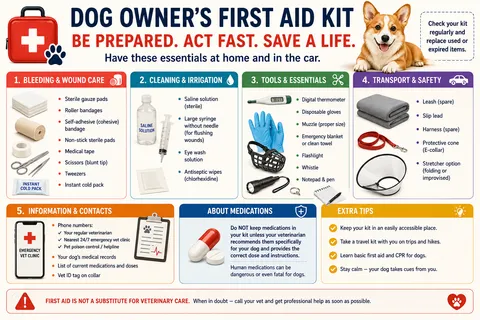
Your kit does not need to turn into a mini veterinary pharmacy with dozens of drugs. It is much more important to have simple items on hand that will help you stop bleeding, flush a wound, protect the injured area and get the dog safely to a vet.
What to keep in the kit
For wounds and bandaging:
- sterile gauze pads;
- regular bandages;
- self‑adhering elastic bandage;
- non‑stick sterile dressings;
- medical tape;
- saline solution;
- a large needle‑free syringe for flushing.
Tools:
- disposable gloves;
- scissors with blunt tips;
- tweezers;
- an electronic thermometer;
- a small torch.
For transport and emergencies:
- a clean towel or small blanket;
- a spare leash;
- a muzzle that fits your dog;
- an Elizabethan collar;
- a cold pack.
If you often travel far from home with your dog or go hiking, it makes sense to assemble a separate compact travel first‑aid kit.
What about medications?
We are deliberately not giving a universal list of medications.
Some drugs that are completely routine for humans are toxic for dogs. Others can be used, but the dose depends on the dog’s weight, condition, concurrent diseases and the specific situation.
The best option is to ask your own vet to compile an individual list of medications for your dog and write down the exact doses and situations in which they may be used.
What else should be in your “first-aid kit”
The most useful thing in an emergency is sometimes not in the box with bandages but in your phone.
Save in advance:
- the phone number of your own vet;
- the phone number of the nearest 24/7 veterinary clinic;
- its address and directions;
- your dog’s details and information on any regular medications.
If you are travelling with your dog, look up an emergency clinic at your destination in advance.
Spending five minutes on this at home is much easier than searching for a vet in an unfamiliar city at night with a sick dog in your arms.
What you must not do when giving first aid to a dog ❌
A few rules are worth remembering separately.
Do not induce vomiting unless a vet has told you to.
Do not give your dog human painkillers.
Do not apply a tourniquet for a snake bite and do not try to suck out the venom.
Do not use ice to cool a dog with heatstroke.
Do not apply ice directly to a burn.
Do not try to set fractures and dislocations yourself.
Do not pour alcohol or other aggressive substances into deep wounds.
Do not blindly push your fingers deep into the mouth of a choking dog.
Do not put anything in the dog’s mouth during a seizure.
Do not force an injured dog to walk just to see how badly it is hurt.
And perhaps most importantly:
do not wait for things to get worse if you already know that something potentially dangerous has happened.
With a snake bite, possible poisoning, heatstroke, serious trauma or breathing problems, it is better to get to a clinic and be told that it is not as bad as it looked than to waste time that could have been used for treatment.
First aid starts before the emergency
You cannot completely protect your dog from injuries, bites, poisoning and other mishaps, but you can be prepared for them.
Put together a simple first-aid kit. Save the phone number of a 24/7 clinic. Learn which plants and animals are dangerous in your region. Do not allow your dog to pick up food from the ground. Learn to recognise overheating and signs of serious deterioration.
Above all, remember the line between first aid and treatment.
In an emergency, the owner’s job is to stay calm, do no harm and get the dog into the hands of a veterinarian as quickly as possible.
Emergency contacts in Israel ‼️:
Beit Dagan - University Veterinary Hospital - 03-9688588 or *8818 (24/7)
"Chavat Daat" Veterinary Hospital Network:
- Rehovot - 08-9390738
- Haifa - 04-8342887
- Kfar Sava - 09-7431117
- Kiriyat-Motzkin - 077-9926870
- Beer-Sheva - 08-6421848
"VET HOLIM" veterinary clinics (serving the Jerusalem region and Ein Gedi) - 02-9922628 Emergency Number (24/7) - 054-5613377
Veterinary Hospital "Kfar Hayarok" (Ramat Hasharon) - 03-6495050 / 054-7776747