In Israel, a dog is not just a pet, but an animal whose keeping is quite thoroughly regulated by law. It must be microchipped; the owner must obtain a license, vaccinate the dog against rabies on time, and follow the walking rules. There are additional requirements for dogs classified as dangerous, and a special rabies‑observation procedure is triggered after a dog bite.
At the same time, there is no single “dog law” that neatly gathers all the rules into one statute.
The main statute is the Law for Regulating Supervision of Dogs — חוק להסדרת הפיקוח על כלבים, תשס"ג–2002. In addition, there are regulations enacted under this law, the Rabies Ordinance — פקודת הכלבת, the Animal Welfare Law — חוק צער בעלי חיים, municipal bylaws, and provisions of civil law.
Some practical rules — for example, the fine for not picking up dog waste or the areas where off‑leash walking is permitted — may differ between cities and regional councils.
Microchip: the dog’s mandatory “passport”
Every dog older than three months must be identified by an electronic microchip.
The chip carries a unique number that links the animal to information in the National Dog Registry — המרכז הארצי לרישום כלבים. The database stores information about the dog, its owner, its license and rabies vaccinations.
The chip itself is not a GPS tracker and does not allow you to locate a lost dog. It can only be read with a special scanner — for example, at a veterinary clinic or by the municipal veterinary service.
This makes the chip particularly important if the dog is lost: a found dog can be identified and the registered owner can be contacted.
But there is an important nuance: the chip is only useful if the data in the registry are up to date.
If the owner’s phone number or address changes, or if the dog is sold or transferred to another person, the registration must be updated. When ownership changes, the registration must be transferred.
This matters for breeders as well: handing a puppy to a new family should not end with “the chip is already in place.” You need to make sure the new owner’s details are properly entered into the system.
License for keeping a dog
Any dog older than three months must have a valid license — רישיון להחזקת כלב.

This is not just proof of vaccination.
To obtain and renew the license, the statutory conditions must be met: in particular, the dog must be registered and microchipped, have the required rabies vaccination, and the owner must pay the prescribed fee.
The license is valid for one year
The changes in the rabies vaccination rules sometimes cause confusion.
A rabies vaccine can now be valid for two years, but the license for keeping a dog is still annual.

In other words, a perfectly normal situation may arise: this year the dog does not need a new rabies shot, but the license still has to be renewed and paid for.
Municipal veterinary services specifically draw owners’ attention to this distinction.
The license fee depends, among other things, on whether the dog is spayed/neutered. Fees for intact dogs are significantly higher. The law also allows exemptions from this surcharge in certain cases — for example, on medical grounds and for some registered purebred dogs if specific conditions are met.
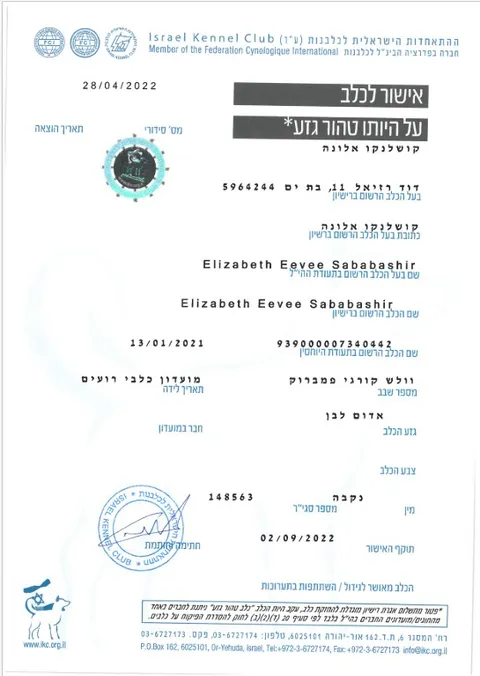
For example, owners of a purebred dog registered with the IKC receive a discount if they provide a certificate of purebred status (אישור טהור גזע). This certificate can be downloaded from the IKC website in the owner’s account.
It is best to check the current license fee right before paying, as fees are indexed.
Rabies vaccination: no longer every year
This is one of the most significant changes in recent years.
Until 2024, owners were used to vaccinating their dogs against rabies every year. As of 1 April 2024, the schedule has changed.
A dog that has not been vaccinated before, or whose vaccination history cannot be confirmed, must receive:
a first vaccination at approximately 2.5–3 months of age;
then a second, booster shot 1–3 months later.
After these two initial vaccinations, subsequent rabies shots are given once every two years.
If a dog older than three months has never been vaccinated, the first shot is given after it comes to the owner, and the booster follows in 1–3 months.
Thus:
**license — annually;
rabies — once every two years after the initial series.**
Is off‑leash walking allowed?
As a rule, a dog outside the owner’s property must be under control and on a leash.
The regulations state that for an ordinary dog, the leash must not be longer than 5 meters, and both the leash and the way it is held must allow the person to control the dog at all times and prevent it from escaping or causing harm to others.
The phrase “she’s friendly and wouldn’t hurt anyone” is no legal substitute for a leash.
Off‑leash walking is allowed in designated areas — such as dog parks — and in other places where local rules permit it. Specific municipalities may impose additional requirements. For example, the rules for using beaches, parks, and public spaces are also set in local bylaws.
What if the dog lives in a yard?
The owner must prevent the dog from leaving the property on its own.
The rules also require a warning sign "זהירות כלב" — “Beware of dog” at the entrance to a yard where a dog is kept.
In other words, having a private yard does not mean the dog may freely leave it and roam the street.
Do you have to pick up after your dog?
Yes.
The obligation to pick up dog waste in public places is usually set in municipal bylaws, and violations may be fined.
Fines and some details differ between municipalities, so there is no point in quoting a single nationwide amount here.
The practical rule is much simpler: a poop bag is as essential on a walk as a leash.
What counts as a “dangerous dog” under Israeli law
The term כלב מסוכן — “dangerous dog” has a specific legal meaning, and it does not necessarily mean a dog that looks aggressive.
This category includes, in particular:
- a dog older than three months that has bitten a person and caused injury;
- a dog of a breed defined as dangerous in the law;
- certain mixes of such breeds if they show the relevant physical and behavioral traits.
The list includes: American Staffordshire Terrier (Amstaff), Bull Terrier, Dogo Argentino, Japanese Tosa, Staffordshire Bull Terrier, Pit Bull Terrier, Fila Brasileiro, and Rottweiler.
It is also important to mention the American Bully. The Israeli Veterinary Services regard it as a line derived from crossing breeds from the dangerous‑breed list, so the rules for dangerous dogs apply to these dogs as well.
Dangerous dogs are subject to much stricter rules
In particular, the owner or permanent keeper must be over 18 years old.
In public, such a dog must be handled by a person over 18 who is able to control it. A leash no longer than 2 meters and a muzzle are required. A headcollar such as a Halti is not considered a muzzle, because it does not prevent the dog from opening its mouth and biting.
The yard must be fenced and locked in a way that prevents the dog from getting out on its own, and a warning sign must be posted at the entrance.
If a person under 18 is near a dangerous dog and is not its owner, additional muzzle requirements apply — including at home.
Dangerous dogs older than six months must be spayed/neutered, and transferring such a dog to another owner is also restricted.
What happens if a dog bites a person
This is one of those situations where an owner should not decide on their own that “it’s just a scratch, so nothing needs to be done.”
A bite triggers the rabies‑control provisions.
The owner must report the incident and present the animal in accordance with the prescribed procedure — within 24 hours of learning about the incident.
The biting animal is then placed under 10 days of observation in quarantine. The purpose of the observation is not to punish the dog, but to assess whether it could have been shedding rabies virus at the time of the bite. If the dog remains healthy by the end of this period, this rules out transmission of rabies to the person in that bite incident.
Is municipal quarantine always mandatory after a bite?
Not anymore.
Following legislative changes, Israel introduced the option of home observation — תצפית בית.
The decision is made by the municipal veterinarian, and both the dog and the circumstances of the incident must meet certain criteria, such as:
- no clinical signs on examination that raise suspicion of rabies;
- prior to the bite, the dog had not been in an area officially declared rabies‑infected;
- there was no known contact with an animal suspected of rabies;
- at the time of the bite, the dog had a valid license;
- in the previous two years, the dog had not repeatedly been recorded as roaming freely;
- the owner contacted the municipal veterinary service in a timely manner.
And this is where an annual license suddenly stops looking like a mere formality.
If there is no valid license at the time of the bite, the owner may lose the option of keeping the dog at home during the observation period.
If you are the one who was bitten
Even if the dog is familiar, lives in a home, and, according to the owner, is vaccinated, you should not decide on your own whether rabies post‑exposure prophylaxis is needed.
The wound should be thoroughly washed with soap and water right away for about 15 minutes, treated with an antiseptic, and examined by a medical professional. Further steps and the need for rabies prophylaxis are determined by the medical services.
This is especially important in Israel, where rabies continues to be detected in wild and domestic animals.
Who is liable if a dog harms a person?
Israeli law is fairly strict here: under Section 41 א פקודת הנזיקין — the Civil Wrongs Ordinance, if a dog causes bodily harm to a person, its owner or the person who keeps it on a permanent basis must compensate the damage.
For such liability to arise, the injured party does not have to prove negligence by the owner.
In other words, arguments like “She’s never bitten anyone before” or “I couldn’t have known she would react that way” do not in themselves relieve the owner of liability.
But the law does provide several specific defenses
They relate to situations where the harm resulted from:
1. provocation of the dog by the injured person;
2. an attack by the injured person on the dog’s owner or certain members of the owner’s family;
3. unlawful entry by the injured person onto the owner’s property.
This is an important difference from the everyday notion that an owner is liable only when they “failed to watch the dog properly.”
What if the dog was not with me at the time?
Handing a dog over to someone else temporarily does not automatically relieve the owner of liability.
For example, the dog may be in boarding, with a dog sitter, or staying with friends, while the owner is abroad. If the dog causes bodily harm to a person, the mere fact that the owner was not physically present and could not control the animal at that moment does not rule out claims against the owner.
At the same time, depending on the circumstances, liability may also arise for the person or organization to whom the dog was entrusted, so the question of who ultimately bears responsibility for a particular loss, and to what extent, may be decided separately.
What if the dog has several owners?
Joint ownership does not mean that only the person the dog lives with, or who was handling it at the time, is liable.
If a dog legally belongs to several owners, claims can be brought against the owners regardless of which of them is more involved in day‑to‑day care.
This is especially important to remember when ownership is formally shared — for example, when both the breeder and the new owner remain listed in the papers. A co‑ownership entry is not just a formality or a matter of show and breeding rights: it can also have legal consequences.
Third‑party liability insurance — צד ג׳
Because a dog owner can be held civilly liable for damage caused by the dog, it makes sense to consider third‑party liability insurance — ביטוח צד ג׳.
Such coverage may be included, for example, in a home or apartment insurance policy, or arranged as part of another insurance product (for example, in a health‑insurance policy). Depending on the policy terms, it may cover the owner’s liability if the dog bites someone, knocks a person over, or otherwise causes bodily injury or property damage.
For dog owners this is particularly important because the potential claim amount is not limited to the cost of medical care. It may also include loss of earnings, temporary or permanent loss of working capacity, the cost of assistance and rehabilitation, and compensation for non‑pecuniary damage.
So dog owners should check whether their insurance includes צד ג׳ coverage and whether it extends to damage caused by the dog. If there is no such coverage, it is worth asking the insurance company whether it can be added.
It is essential to read the specific policy terms: insurers may set exclusions, coverage limits or special conditions for certain dogs or types of incidents. It is also important to check the policy to see who is listed as the insured, which dogs and family members are covered, whether coverage applies when the dog is temporarily staying with someone else, and how the policy works in cases of co‑ownership.
What if the dog just scared someone?
Liability is not limited to the classic “dog bite” scenario.
Harm can occur without an actual bite — for example, a person runs from a dog, falls, and is injured.
But here, the specific circumstances of the incident and the legal basis for the claim matter much more, so the rule “the owner automatically pays for any harm” would be an oversimplification.
The main practical takeaway is different: the owner must control the dog so that it does not create a danger for others.
What happens if a dog runs away
A dog roaming on its own may be picked up by the municipal service.
In this situation, the chip makes it possible to identify the owner, but having a chip does not make free roaming legal.
Fines may be imposed for violating the keeping rules, and getting the dog back from a municipal shelter may require paying the costs associated with capture and boarding. The exact amounts depend on the circumstances and the municipality.
In addition, free‑roaming incidents can have consequences owners rarely think about: as we have already seen, repeated captures or documented uncontrolled roaming can affect the possibility of home observation after a bite.
Selling or transferring a dog to another person
When a dog changes owners, handing over the veterinary passport alone is not enough.
You must formally arrange transfer of ownership and update the data in the National Dog Registry.
As long as the former owner is still listed in the database, this may cause problems if the dog is lost, when obtaining a license, in veterinary procedures, and in legal disputes. For this reason, when buying a puppy or an adult dog, you should check not only that it is microchipped, but also that the registration has truly been transferred.
The Animal Welfare Law also applies to ordinary owners
The Israeli חוק צער בעלי חיים (הגנה על בעלי חיים) prohibits cruelty and causing an animal unnecessary suffering.
This is not limited to obvious physical abuse.
Keeping an animal means providing for its basic needs: appropriate housing conditions, water, food, necessary care and protection from suffering. So, legally speaking, the phrase “it’s my dog, so I can keep it however I want” is not correct.
The owner has rights in relation to the animal, but also bears duties toward it.
A short checklist for dog owners in Israel
For most owners, all this legislation can be condensed into a few practical rules:
✓ Microchip your dog and check that the registry data are correct.
✓ Once the dog reaches the required age, obtain a license.
✓ Renew the license every year.
✓ Follow the current rabies vaccination schedule: two initial shots, then once every two years.
✓ Do not let your dog roam freely where this is not allowed.
✓ Use a leash and maintain physical control of your dog.
✓ Pick up after your dog.
✓ Update the registration data after moving, changing your phone number, or transferring ownership.
✓ If your dog bites a person, do not hide the incident — promptly contact the municipal veterinary service.
✓ Remember that an owner may be civilly liable for damage caused by their dog even without proven negligence.
✓ If your dog is legally classified as dangerous, follow the special requirements for leash, muzzle, housing and sterilization.
✓ Check whether you have צד ג׳ insurance and whether it covers damage caused by your dog to third parties.
The law is the minimum standard
Most of these requirements were not created just to make owners’ lives harder.
A microchip helps return a lost dog. Vaccination protects both the animal and people from a deadly infection. A leash prevents traffic accidents, fights and bites. Registration makes it easy to identify the owner, and post‑bite observation rules help avoid unnecessary risk to humans and, where appropriate, prevent a pet dog from being sent to municipal quarantine.
There is another reason to know these rules in advance: people usually think about the law only after something has already happened: the dog is lost, has run away, has bitten someone, has been bitten itself, or has ended up in a municipal shelter.
It is much easier to handle the paperwork once and understand your obligations than to struggle with the legal framework when the situation is already an emergency.
Note: legislation, municipal bylaws, and the amounts of fees and fines may change, so you should check current amounts and specific administrative procedures on your local authority’s website or with your municipal veterinarian.
Key information sources:
Law for Regulating Supervision of Dogs
"קבלת הרשאה למתן חיסונים נגד כלבת לכלבים ולבעלי חיים אחרים | משרד החקלאות וביטחון המזון"
"חוק להסדרת הפיקוח על כלבים, תשס"ג-2002"
"תקנות להסדרת הפיקוח על כלבים – ויקיטקסט"