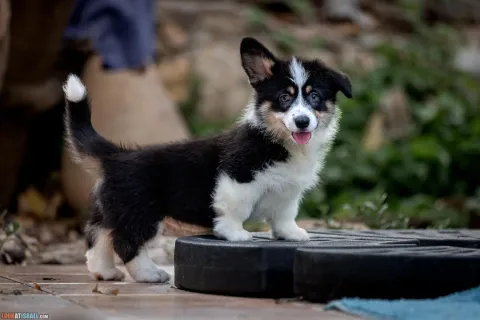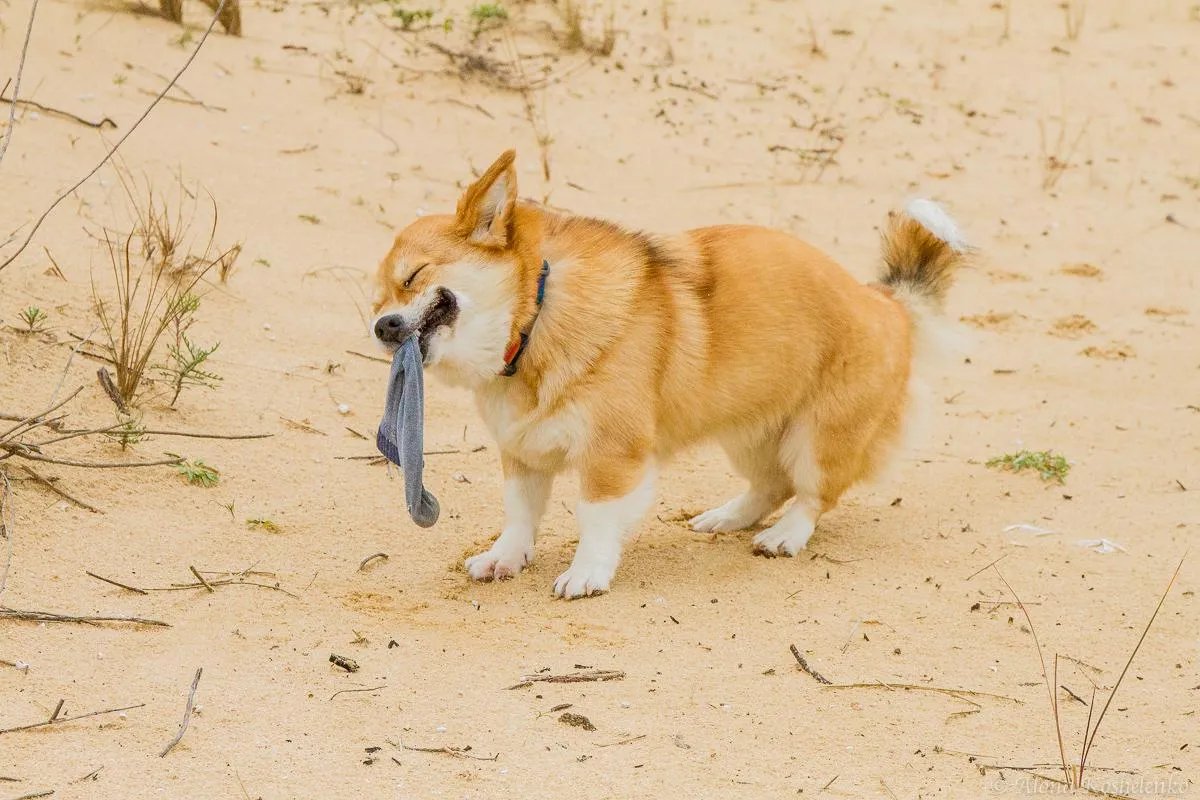
You’re walking down the street with your corgi. You look away for a second — and he’s already chewing on something.
— What did you find?
The corgi starts chewing faster.
— Drop it!
The corgi gulps frantically.
A familiar scene for a huge number of dog owners.
Picking things up from the ground is more than just an annoying habit. In a city, a dog can find spoiled food, bones, medication, nicotine products, unknown chemicals, poisoned bait, or objects that can get stuck in the esophagus or intestines. In Israel, there’s also leftover food near dumpsters and picnic spots, dead animals, and other finds that are absolutely not intended for a dog’s stomach.
At the same time, a dog doesn’t scavenge because it’s “badly behaved”. For a dog, exploring the world with its nose and mouth is completely natural.
Why dogs eat things they find on walks
For a human, an old piece of pita lying by a dumpster is trash. For a dog, it can be a wonderfully exciting discovery.
A dog’s perception of the world is tightly bound to smells. Things we don’t even notice, a dog can detect from a distance — and food smells are especially valuable.
On top of that, searching for food is natural behavior. No one served breakfast and dinner on schedule to the ancestors of domestic dogs, so any opportunity to get high‑calorie food had to be used immediately. From that point of view, the “Found food → ate food” strategy is perfectly reasonable for a dog.
And if the found piece turned out to be tasty, the behavior also gets excellent reinforcement. The dog picked something up once — got a reward. Then again. After a while, it starts actively looking for such opportunities.
Are corgis really more “vacuum‑cleaner‑like” than others?
There’s no special “corgi scavenging gene”, and not every corgi tries to eat everything it sees on the sidewalk.
But the breed does have several traits that can make the problem especially noticeable.
Many corgis are very food‑motivated, and food is a strong reinforcer for them. They’re also active, curious, and quick to learn. Unfortunately, they don’t only learn what we deliberately teach.
If a corgi has discovered several times that a particular dumpster always has culinary treasures lying beside it, chances are good that on the next walk he’ll head straight there.
And their short legs give them another small advantage: the ground is very close.
A puppy puts literally everything into its mouth
For puppies, exploring objects with their mouths is especially pronounced.
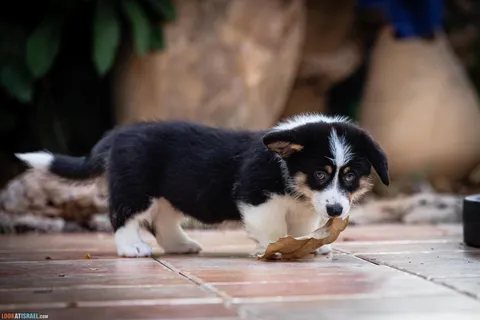
Leaves, twigs, pebbles, scraps of paper, cigarette butts, bits of plastic — the puppy is still figuring out what this world is made of.
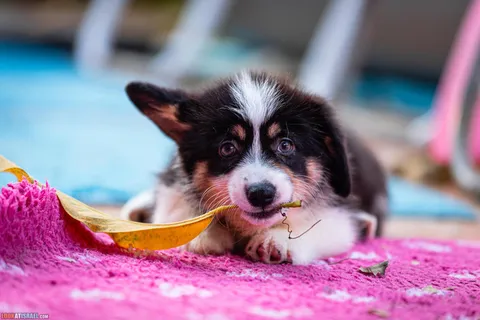
You don’t need to scream and pry every safe leaf or stick out of the puppy’s mouth. Constant battles over every single item can unexpectedly create a different problem: the puppy will realize that whenever a human appears, they grab the treasure.
Then a new strategy appears: “I need to swallow it faster before they take it away.”
It’s much more useful to teach your dog from the beginning to calmly give up what it’s found.
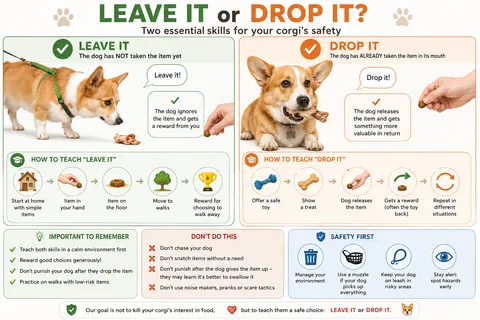
“Leave it” and “give” are two different skills
They’re often mixed up, even though they refer to two completely different situations.
“Leave it” (“Drop it”, “No”, “Don’t”)
The dog has not yet picked up the item.
It sees a piece of food on the ground, you ask it to leave it, the dog turns away from the find and gets a reward from you.
“Give”
The item is already in the mouth. The dog’s task is to release it voluntarily.
In real life, you need both cues, and in a dangerous situation a well‑trained “give” can sometimes be your last line of defense.
How to teach “leave it”
It’s best to start at home, not next to a delicious chicken bone on the sidewalk.
Take a piece of food in your closed hand. The dog will likely sniff, lick, or try to get to the treat; your task is not to let that happen.
The moment the dog moves away from your hand — even for a second — mark the correct action and give a different treat.
Gradually, you make the exercise harder:
closed hand → open hand → treat on the floor under control → object on the floor → exercises on walks.
The point of the skill is not to repeat “no” a hundred times.
The dog learns a different rule: it’s rewarding to leave something when the person asks.
It’s very important to increase difficulty gradually. A dog that can easily ignore a piece of kibble in the kitchen is by no means obliged to immediately walk past a meat‑smelling bone in the park.
How to teach “give”
Here, trading is especially useful:
Give the dog a safe toy. Show a treat. When the dog releases the toy, mark the behavior, give the treat — and quite often it’s helpful to give the toy back.
This way the dog learns something important: “give” doesn’t mean “they’ll take away everything good forever now”.
Over time you stop showing the treat in advance, and the cue starts working on its own.
You should practice it with lots of safe objects and in a calm environment long before the day you really need it.
Why you shouldn’t chase your dog
Imagine: the corgi grabs a napkin.
The owner lunges toward him.
The corgi darts away.
The owner chases him.
The corgi is thrilled: what a great game!
And if the owner usually also takes away anything the dog finds, there’s an extra motivation to run off or swallow the trophy faster.
That’s why in safe situations it’s better to use the opportunity to practice trading instead of turning it into a chase.
Of course, if the dog has grabbed something potentially dangerous, safety is more important than training theory. Sometimes you really do have to get the object out immediately. But routinely prying your dog’s jaws open for every scrap of paper is a poor training strategy.
Don’t scold your dog after it has given something up
This is one of the most unfortunate mistakes.
The dog has picked something up, the owner calls it. It comes over and gives up the item — and gets scolded.
From the human point of view, the punishment is aimed at the misbehavior: “you shouldn’t have picked it up”.
From a learning perspective, the sequence looks different:
came to the owner → gave up the prize → something unpleasant happened.
Next time, the dog may decide that coming over and giving up the find is a terrible deal.
If your dog has voluntarily spat out something dangerous, that’s an excellent reason to reward generously — even if a second earlier you were ready to strangle it from sheer terror.
Can you make picking things up feel scary?
Friends of ours have a corgi who used to actively scavenge on walks. They were once advised to try a fairly common old‑school method: whenever the dog tried to eat something off the ground, they threw a tin can with coins nearby. The can clattered loudly, the dog got scared.
In their case, the method “worked”: the dog formed an association between the attempt to pick something up and the unpleasant sudden noise, and he stopped “vacuuming”.
This is an example of an aversive training method: an unwanted action leads to an unpleasant consequence, so the likelihood of it being repeated decreases.
Yes, such methods really can work, but these days a can with coins is no longer considered the best way to solve the problem — and not only for humane reasons.
We can’t fully control what the dog will associate the fright with.
Instead of deciding “I must not take food off the ground”, the dog might learn, for example, that:
- scary things sometimes happen out of the blue near the owner;
- a particular place is dangerous;
- sudden metallic sounds are dangerous;
- it’s dangerous to approach found food when a human is around.
With a sensitive dog, this can create noise phobias or extra anxiety. And a particularly clever dog may reach a different conclusion: scavenging is fine — you just have to do it when the owner isn’t looking.
That’s why it’s now preferable to teach alternative behavior: saw something → left it → got a reward from the human.
Don’t turn the whole walk into endless “No!”
If the owner only notices the danger when the corgi already has it in his mouth, the dog ends up hearing constant bans.
It’s much more effective to learn to notice potential “prey” before your dog does: you see food ahead — you increase distance, ask for “leave it”, redirect attention, and reward.
Over time, you can get a very pleasant behavior pattern: the dog sees food on the ground and looks to the owner by itself.
This is more than just forbidding. The dog knows what to do instead of scavenging.
Don’t forget to reward good behavior
There’s a funny kind of unfairness here: when a corgi grabs a chicken bone from the ground, the owner reacts instantly, but when he walks past ten pieces of trash without touching any of them, no one even notices.
For training, it helps to flip this ratio.
Notice the moments when your dog:
- looks at food and walks past it;
- sniffs something but doesn’t pick it up;
- comes away when called off a find;
- redirects its attention to you on its own;
- spits something out when you ask.
That’s the behavior you want to reinforce actively.
Managing the environment is not a failure
Some owners believe that a “properly trained dog” should be able to walk calmly through scattered food and not touch anything.
In reality, training takes time, and the consequences of a single mistake can be very serious.
So while the skill isn’t solid yet, it’s perfectly reasonable to keep your dog on leash in dirty areas, avoid trash sites, watch the ground carefully, and not let the dog freely investigate suspicious objects.
This isn’t a substitute for training — it’s insurance while training is in progress.
When a muzzle is needed
If a dog really swallows everything in sight and the owner physically can’t keep up, a properly fitted basket muzzle can save the dog’s life.
It’s not a punishment and not a sign of a “bad dog”.
There are models and additional inserts specifically designed to make it harder to grab food from the ground. At the same time, the muzzle should allow the dog to open its mouth freely, pant with its tongue out, and drink.
Dogs should be introduced to a muzzle gradually, using positive associations: the dog pokes its nose into the muzzle on its own, gets a treat, and the wearing time is increased little by little.
Don’t put a muzzle on for the very first time right before a long walk and expect the dog to simply accept it.
What’s especially dangerous to eat
In most cases, a swallowed piece of bread will at worst lead to an annoyed owner, but it’s impossible to tell in advance what’s hidden in every little pile of “something” on the ground.
You should be especially cautious about:
- Bones. Cooked bones can splinter, injure the digestive tract, or cause an obstruction.
- Spoiled food. Beyond simple digestive upset, there’s a risk of bacterial intoxication and other serious poisonings.
- Medications and narcotic substances. Even a tiny amount of some human drugs can be dangerous for a dog.
- Nicotine. Cigarettes, butts, and nicotine products are potentially toxic.
- Chewing gum and sugar‑free foods. Some of them contain xylitol, which is extremely dangerous for dogs.
- Unknown baits. You can’t tell by sight what’s inside a piece of meat or other food you find on the ground.
- Dead animals and carcasses. Apart from infections and parasites, there’s a risk of poisoning — the animal may itself have died from contact with a toxic substance.
- Inedible objects. Stones, bits of toys, fabric, plastic, corn cobs, and other items can cause a blockage in the gastrointestinal tract.
In Israel, it’s especially wise to be vigilant near trash sites, parks, picnic and barbecue areas, where after weekends and holidays huge amounts of food waste may be lying around.
The dog ate something. What now?
Rule number one — try to figure out what it ate, how much, and when.
If any of the substance or the packaging is left, take it with you or photograph it.
If you suspect poison, medication, nicotine, a toxic food, a chemical, or a dangerous foreign object, contact a veterinary clinic right away.
Don’t wait for symptoms to appear: with some toxins, time is critical.
And don’t try to make your dog vomit without a vet’s instructions. Depending on what was swallowed, vomiting can be not just useless, but dangerous.
When scavenging is a reason to see a vet
If a dog has always been interested in food on the street, it’s usually a behavioral problem.
But you should pay attention to sudden changes in behavior. For example, a dog that used to walk calmly has started obsessively searching for and eating everything.
It’s especially important to discuss this with your vet if at the same time you notice:
- constant strong hunger;
- weight loss or a clear change in weight;
- vomiting or diarrhea;
- changes in stool;
- increased thirst;
- lethargy;
- eating inedible objects — dirt, stones, fabric, plastic, etc.
Marked eating of inedible items is called pica. The causes may be behavioral or medical, so just “training it out” is not enough in this situation.
What to do with a four‑legged “vacuum cleaner”: a practical plan
If your corgi is hoovering up everything, don’t try to solve the problem with a single stern “no”.
Start with the basics.
1. Teach “leave it/drop it/no/don’t” at home.
First with low‑value items, gradually making things harder.
2. Separately teach “give”.
The dog needs to know that giving something to a human is safe and rewarding.
3. Use trades.
Especially with a puppy that’s just learning to interact with people.
4. Reward voluntary refusal.
Walked past food — good. Chose to look at you instead of the find — even better.
5. Don’t chase your dog or fight over every single trophy.
6. Bring high‑value treats on walks.
Plain kibble may lose to found shawarma by a landslide.
7. Manage the environment.
While the skill is unreliable, a leash and vigilance remain key to safety.
8. If the risk is high, use a basket muzzle.
You can keep training without exposing your dog to daily danger.
9. Do deliberate training sessions.
Don’t wait for random trash encounters. You can create safe training scenarios yourself, gradually making them more like real‑life walks.
10. Don’t count on 100% reliability.
Even a very well‑trained dog is still a dog. A truly tempting find may one day outweigh the learned rule.
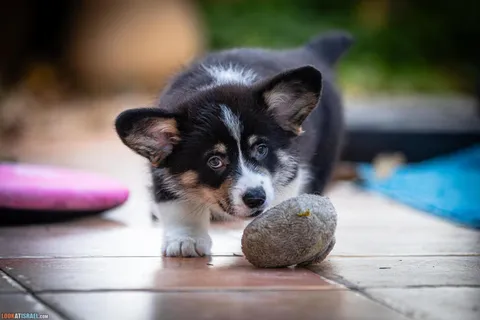
Our goal is not to convince a corgi that food is no longer interesting
That would be a hopeless project.
The training goal is much more realistic: to teach your dog not to grab finds automatically, to calmly leave them when asked, and to give up whatever still ends up in its mouth without a battle.
And here’s the pleasant irony.
The very love of food that makes your corgi vacuum the sidewalk so enthusiastically also becomes one of your best training tools. If you structure the sessions well, the dog will gradually discover that sometimes it’s more profitable to walk past that suspicious scrap and look at the owner than to be the first to gulp it down.
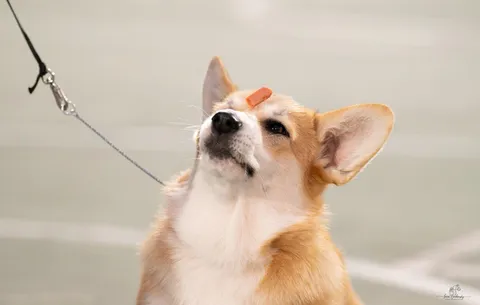
Until then, our task is simple: train, spot questionable “delicacies” just a bit earlier than the corgi does, and remember that a leash, a good trading skill, and a properly fitted muzzle sometimes protect a dog’s health far more reliably than the angriest “NO!”.