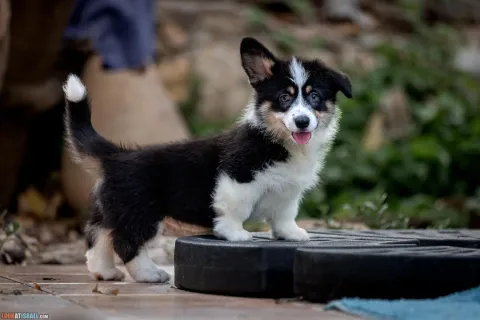
Many Corgi puppies nip their owners’ heels, especially during play. This isn’t a sign of aggression but an expression of their inherited herding instinct. Let’s look at why this happens and how to guide this behavior correctly.
Why Corgis in particular?
Future owners are often surprised: “Our puppy keeps grabbing our legs. Especially the kids’. Is he angry?”
In most cases the answer is very simple: the Corgi is doing exactly what his ancestors were bred to do hundreds of years ago.
This doesn’t mean you should encourage this behavior, but understanding where it comes from is very important.
Where does this instinct come from?
Pembroke and Cardigan Welsh Corgis are true herding dogs whose job was to drive cattle over long distances.
But how can a small dog control a huge cow?
The answer is simple — by working from below.
The Corgi would quickly dash up to the animal’s hind legs, give a quick nip to the hock or heel and instantly spring out of the way. The cow took a step forward, and the dog repeated this again and again.
Thanks to their short stature, Corgis could easily dodge a retaliatory kick.
What today looks like “nipping at heels” used to be a professional skill without which the dog simply couldn’t do its job.

Why does the puppy do this at home?
Modern Corgis rarely see cows or sheep, but genetics haven’t gone anywhere.
When a puppy sees a quickly moving object, the brain launches an age‑old program:
- something is moving;
- it needs to be stopped;
- it needs to be directed;
- so — chase and nip at the heel.
That’s why a puppy most often starts nipping at:
- running children;
- people walking quickly around the house;
- guests;
- other dogs during play;
- cyclists or joggers on walks (if the instinct is especially strong).
For the puppy this looks like a fun game.
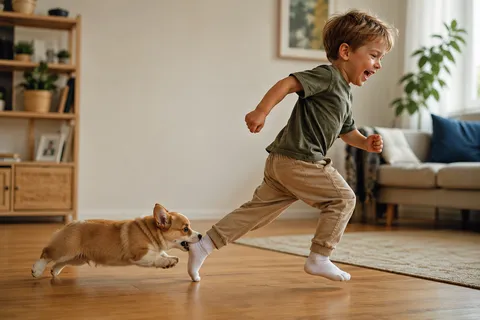
Why do children become the main "prey"?
Because children behave exactly like a fleeing object is supposed to behave.
They:
- run;
- change direction sharply;
- wave their arms around;
- laugh loudly;
- squeal;
- start running even faster after being nipped.
For the puppy this is a clear signal:
“The herd is scattering — I have to gather it!”
That’s why most Corgis nip children much more often than adults.
This doesn’t mean the dog doesn’t like the child; on the contrary — he is trying to do exactly what his instinct is telling him.
Why is it not enough to just forbid it?
A very common mistake is constantly repeating “No!”
Or even worse — punishing the puppy.
The problem is that you can’t just switch an instinct off.
Imagine a Border Collie that is forbidden to look at moving objects, or a Labrador that is not allowed to retrieve toys, or a Beagle that is forbidden to use its nose.
These are inborn breed traits.
The same applies to Corgis.
Our task is not to get rid of the instinct, but to teach the dog to express it in an acceptable way.
What is the right thing to do?
The most important rule is: don’t turn your legs into a toy.
If the puppy grabs at your heels:
✔ calmly come to a stop;
✔ stop moving;
✔ redirect his attention to a toy;
✔ offer a tug toy or a ball;
✔ praise when the puppy switches over.
It is very important not to start running, laughing or playing with your legs.
This will only reinforce the unwanted behavior, because the puppy will interpret it as: “Perfect! The game goes on!”
Will a Corgi outgrow heel‑nipping?
This is one of the most common questions puppy owners ask.
The good news is that in most Corgis the intensity of this behavior really does decrease with age.
As the dog matures, its nervous system becomes more stable, the puppy learns to control its emotions and gradually understands the rules of family life. If owners calmly and consistently redirect the puppy’s energy to toys, activities and training, by around 8–12 months heel‑nipping usually becomes much less frequent or disappears altogether.
However, it’s important to understand that the instinct itself does not disappear, only its uncontrolled expression.
An adult Corgi can still try to nip a running child, a cyclist or another quickly moving target if the situation strongly triggers the herding instinct. That’s why training remains important even after the “puppy period” is over.
If the puppy is constantly allowed to play with feet, people laugh about it, run away from him, or never work on behavior at all, the habit can become fixed and persist into adulthood.
That’s why owners often say two completely opposite things:
- “Our Corgi stopped nipping on his own by the time he turned one.”
and
- “Ours is already three, and he still grabs everyone’s heels.”
Most often the difference is not in the dog itself, but in which rules it learned in the first months of life.
The more mental work — the fewer nips
Interestingly, many owners try to solve the problem by making walks longer.
But tired legs don’t always mean a tired mind.
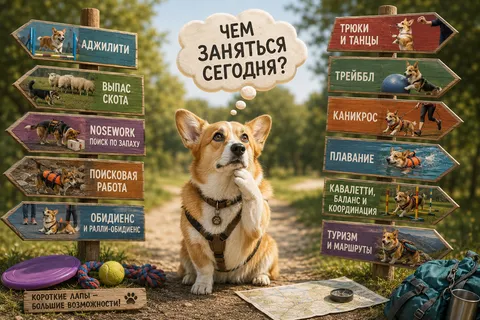
Corgis calm down much faster after:
- scenting/search games;
- enrichment mats;
- puzzle toys;
- learning new cues;
- nose work sessions;
- basic herding‑style exercises or treibball.
When a dog regularly gets to use both its brain and its natural instincts, the need to “gather the herd” at home on its own usually becomes much weaker.
Typical owner mistakes
❌ Yelling at the puppy.
❌ Smacking for nipping.
❌ Playing with hands or feet.
❌ Allowing children to run away from the puppy.
❌ Riling the dog up with chasing games right before bedtime.
❌ Assuming it will “go away on its own” without any training.
When should you see a trainer?
Normal puppy nipping is different from true aggression.
You should consult a specialist if the dog:
- bites down hard with no attempt to play;
- guards resources;
- growls when someone tries to move them away;
- cannot switch off even after training sessions;
- becomes more and more over‑aroused with age.
In most young Corgis, heel‑nipping is easily corrected with proper training and has nothing to do with aggression.
The main thing to remember
A Corgi doesn’t nip at heels because it wants to cause harm.
It does it because for hundreds of years its ancestors controlled livestock exactly this way.
Understanding breed traits helps the owner work with the dog’s nature instead of against it, and direct that energy into the right channels.
That’s why the best strategy is not to forbid the instinct itself, but to give it a safe and controlled outlet.