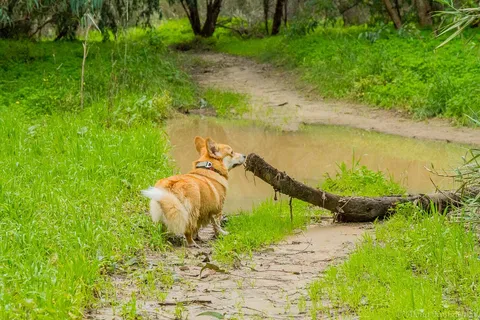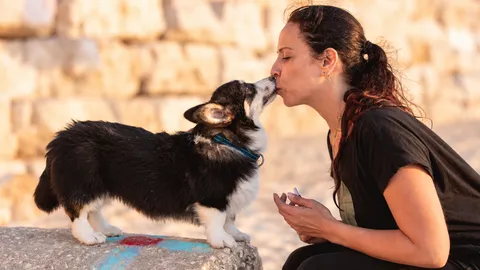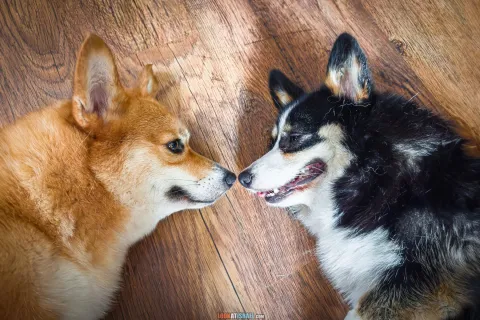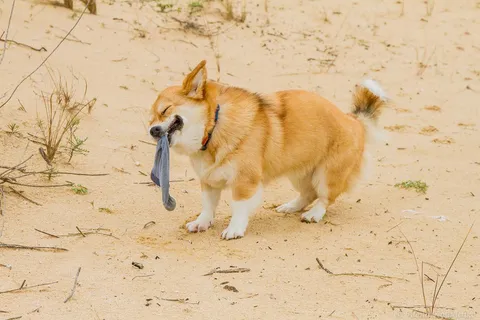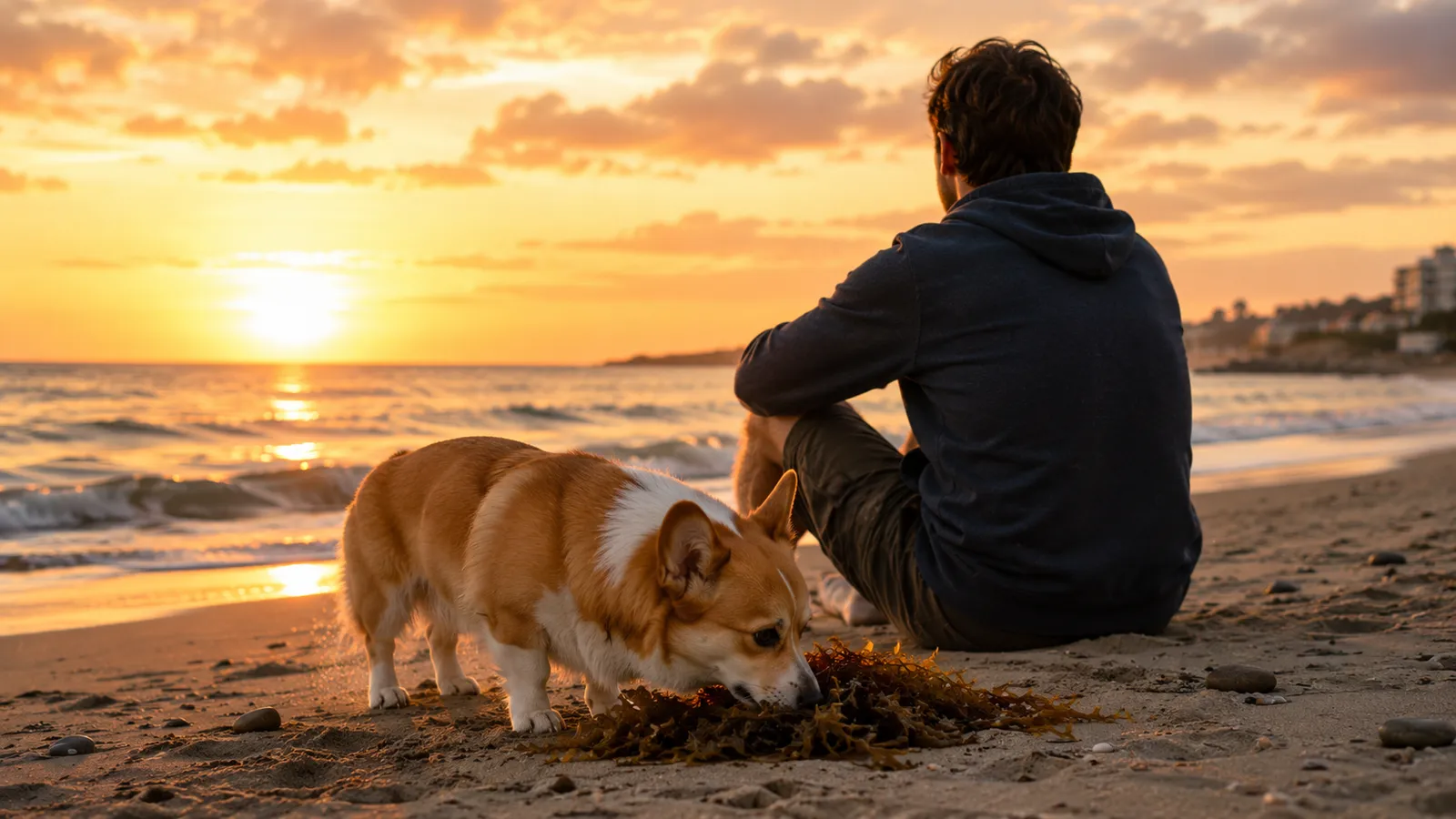
Why can a dog walk right past a person it hasn’t seen for years, yet recognize them instantly by scent? Why does a dirty puddle annoy us, while for a dog it’s a real “newspaper” full of fresh news? Why does a person admire a beautiful sunset while the dog is completely absorbed in the smell of the grass? The answer lies in the concept of Umwelt — the inner perceptual world of every living being. Once you understand it, many canine behavior quirks become much easier to explain.
We live in different worlds
Imagine you’re walking your dog along a familiar route.
You notice:
- a beautiful sunset;
- new buildings;
- shop signs;
- people on the street;
- an unusual car.
And what does your dog notice? Something completely different.
The dog pays attention to:
- who walked here a few minutes ago;
- where a cat ran by;
- which female is in heat;
- what mood another dog was in;
- who got scared;
- who is sick;
- where food was lying.
You’re walking down the same street, but in reality each of you exists in a completely different world.
What is Umwelt?
German biologist Jakob von Uexküll introduced the concept of Umwelt, which can be translated as “the surrounding world as it is perceived by a particular living being”.
It’s important to understand:
Umwelt is not the environment in and of itself, it is the part of it that matters specifically to a given species.
Every animal seems to live inside its own “interface”: the world is the same, but each species perceives it differently.
Why does a dog experience the world differently from us?
When people say that a dog lives in another world, it’s not just a figure of speech – its brain really does receive information differently from ours.
We humans are used to thinking of our eyes as the main sense organ. It’s vision that gives us most of the information about the world around us.
For a dog it’s different – the main sense organ is the nose, hearing comes second, and only then vision.
That’s why a dog experiences the world very differently from a human. For a dog, the environment is first of all a world of smells, then of sounds, and only after that of images. This shapes virtually all of its behavior.
A world of smells
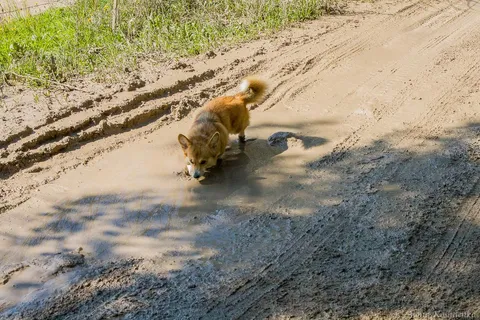
If for a person a walk is about beautiful views, for a dog it’s a huge library of smells.
Experts estimate that humans have about 5–6 million olfactory receptors.
Most dogs have from 60 to 250 million, and some breeds — for example, the Bloodhound — around 300 million. In addition, the part of the cerebral cortex responsible for processing smells is about 10 times more developed in dogs than in humans.
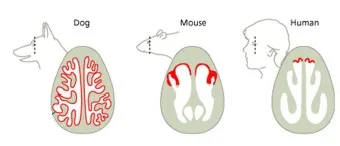
But it’s not just about the number of receptors. A dog’s nose is built quite differently.
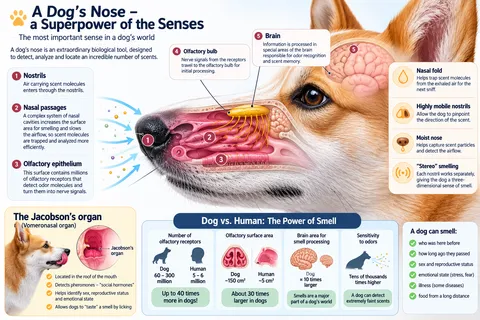
A complex system of nasal passages greatly increases the surface area of the olfactory epithelium, and a moist nose helps trap odor molecules. The mobile nostrils can independently determine the direction from which a smell comes, so a dog literally senses it in 3D — almost like a person pinpoints the source of a sound with two ears.
This is why a dog can follow a track, distinguish the smells of individual animals and understand from which side they came.
It can literally “taste” smells
Dogs have another amazing feature.
In addition to regular olfaction, they use the vomeronasal organ, or Jacobson’s organ.
It is located in the upper part of the oral cavity and primarily analyzes pheromones — chemical signals that carry information about the sex, physiological state and reproductive status of other animals. In humans, this organ is considered non-functional.

Sometimes you can see a dog not only sniffing an object but also lightly licking it.
From the outside it looks odd, but in fact the dog is getting extra information, literally “tasting” the smell.
Vision isn’t the main sense, but it’s perfectly adapted for hunting
Many people are surprised to learn that dogs see the world quite differently from humans.
First, they do not see the world in black and white — that’s a widespread myth, but they do distinguish far fewer colors.
Humans have three types of color receptors (cones), whereas dogs have only two. They see blue and yellow shades best, while red and green appear very similar to each other. That’s why a bright red ball on green grass is nowhere near as visible to a dog as it is to us.
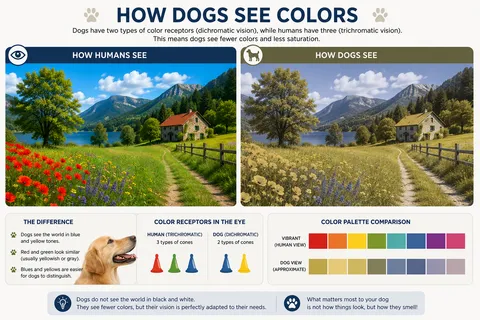
At the same time, dogs have visual abilities that matter more for a predator: they’re much better at noticing movement, especially in their peripheral vision.
Even if a stationary object is far away, a dog can spot a moving one much earlier than a human. This is why herding dogs easily notice a sheep starting to drift away from the flock, and gundogs react quickly to fleeing game.
Another advantage is excellent twilight vision.
Dogs’ eyes have a special reflective layer — the tapetum lucidum. It amplifies dim light and helps them navigate better in poor lighting. It’s also the reason dogs’ eyes glow in the dark when hit by a flashlight or car headlights.
Taste matters far less to a dog
People often assume that dogs choose food by taste just like we do, but in reality it’s quite different.
Humans have about 10,000 taste receptors.
Dogs have around 1,500. But they do have receptors that humans lack, for example ones sensitive to certain proteins and even to water.
A dog evaluates food primarily by smell, not by taste, which is why slightly warmed or moistened food often seems much more appealing: it becomes more aromatic.
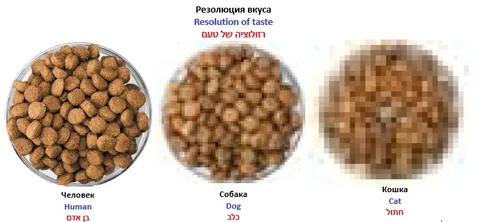
We often choose food with our eyes: judging its color, shape and pretty plating. A dog does almost the opposite. It barely cares what the food looks like; what matters is how it smells. So when we buy kibble “with lamb”, “with salmon” or “with duck”, we’re often thinking more like humans than like dogs. For the dog, the intensity and attractiveness of the smell and the texture of the food are much more important than what’s printed on the bag.
That’s why your dog sniffs for so long
Many owners hurry their dogs along: “What are you sniffing again?”
To a human this looks like a pointless delay, but for a dog it’s roughly the same as us opening the news or checking messages in the morning.
Sniffing isn’t a whim; it’s one of the most important ways to gather information about the environment.
So being able to sniff calmly on a walk is not just a pleasure but a key part of a dog’s natural behavior.
Why your dog doesn’t stare into your eyes all the time
Humans are used to getting information through eye contact; for us, a direct gaze often means attention, respect or interest.
For dogs it’s different: prolonged direct eye contact can be perceived as pressure or even a threat, so many dogs prefer to periodically look away, glance to the side or read the whole body language instead of focusing only on a person’s face.
We often get it wrong because we judge by our own standards
People tend to explain animal behavior through their own experience.
For example: “He’s deliberately ignoring me.”
But in that moment the dog may be completely focused on another dog’s scent.
Or: “She’s being stubborn.”
In reality, the dog might have heard a new sound, smelled another animal, or noticed movement in tall grass.
This doesn’t mean she decided to disobey her owner; it just means that something appeared in her Umwelt that currently has a higher priority.
Even emotions are perceived differently by dogs
We often express emotions with words.
Dogs react much more strongly to:
- tone of voice;
- muscle tension;
- body posture;
- speed of movement;
- scent, which changes under the influence of stress hormones.
Sometimes a person feels completely calm, but the dog already understands that the owner is nervous.
What does this change in training?
Understanding Umwelt helps you look at training differently.
Instead of asking: “Why is my dog not listening to me?”
it’s more useful to ask: “What is my dog perceiving right now? Where is her attention?”
If there are too many interesting smells, new sounds or other dogs around, training becomes harder not because the dog is stubborn, but because her brain is busy processing information that is far more important to her.
That’s why training usually starts in a calm environment, with distractions added gradually.
Learn to look at the world through the nose now and then
We’ll never be able to fully feel the world the way a dog does, but we can try to shift our usual perspective.
Sometimes, instead of hurrying your dog along, it’s worth giving her a few minutes to calmly explore her surroundings.
Because while we’re just walking down the street, she’s reading an entire book written in smells.
The key thing to remember
A dog doesn’t perceive the world worse than a human; she perceives it differently.
Realizing this helps you move away from typical human labels like “stubborn”, “naughty” or “doing it out of spite” and start looking at your dog’s behavior from her own point of view.
This is exactly what the idea of Umwelt is about — to understand an animal, you need at least sometimes to try to see the world through its eyes… or, more accurately, to sense it with its nose.
We suggest a small experiment:
On your next walk, try not to tug your dog forward even once. Don’t rush her. Just watch where she stops, what she sniffs, what she pays attention to and what she ignores. You may, for the first time, see not your usual street, but the world your dog actually lives in.