🍽️ Episode 1: “Dog Nutrition Without Myths”
Today you’ll learn:
- why dogs need proteins, fats and carbohydrates;
- which of them is the main source of energy;
- whether carbohydrates are really harmful;
- why you can’t judge a diet by a single component;
- how all three nutrients work together.
Why you can’t look at protein alone
After the previous article, it might seem that protein is the main indicator of a food’s quality.
But that’s not the case.
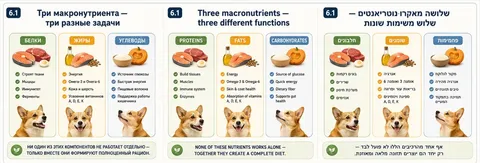
A dog’s body functions as a complex system where every nutritional component has its own job:
- Proteins build tissues.
- Fats provide the body with energy and take part in many vital processes.
- Carbohydrates help cover the body’s energy needs.
A complete diet is impossible without the right balance of all three components.
Proteins – the building blocks of the body
We’ve already talked in detail about proteins in the previous article.
Here’s a quick reminder.
Proteins are essential for:
- growth;
- tissue repair;
- immune system function;
- hormone and enzyme synthesis;
- skin and coat health.
The body uses amino acids to build almost all of its tissues.
Fats are not the enemy
The word “fat” often has negative associations, but fats are actually the most concentrated source of energy.
Besides that, they are necessary for:
- absorption of vitamins A, D, E and K;
- skin health;
- coat quality;
- proper nervous system function;
- synthesis of certain hormones;
- maintaining cell membranes.
Fats also supply essential Omega-3 and Omega-6 fatty acids, so they must never be completely removed from the diet.
Does a dog really need carbohydrates?
This is one of the most hotly debated questions.
Yes, dogs can get energy from proteins and fats, but this does not mean that carbohydrates are harmful.
After digestion, carbohydrates are converted into glucose – an important energy source for many of the body’s cells. In addition, some carbohydrates are a source of dietary fiber, which is necessary for normal intestinal function, so in a complete diet, carbohydrates can play an important physiological role.
Why you can’t say that one nutrient is more important than another
Imagine building a house:
Proteins are the bricks.
Fats are the energy source for the construction machinery.
Carbohydrates are the fuel for the workers’ day‑to‑day work.
If you remove any of these, construction will become much less efficient.
A dog’s body works the same way: all three components complement each other.
What happens when the balance is disturbed?
A deficiency of any of the main nutrients can eventually lead to problems:
- A protein deficiency affects growth, muscle mass and immunity.
- A fat deficiency shows up in poor skin and coat condition and disrupts absorption of fat-soluble vitamins.
- A lack of energy, regardless of its source, leads to weight loss and a general decline in condition.
On the other hand, an excess of energy – whether it comes from proteins, fats or carbohydrates – promotes excess weight gain.
Veterinary nutritionists don’t assess isolated components but the overall balance of the diet.
There are no “good” and “bad” nutrients
Online you’ll often see claims like:
- “Fats are harmful.”
- “Carbohydrates are just fillers.”
- “The main thing is as much protein as possible.”
In reality, things are much more complex: each nutrient has its own functions.
The question is not whether a food contains proteins, fats or carbohydrates, but how much of each it contains and in what proportions.
What to remember
A complete diet is always about balance.
- Proteins supply the body with amino acids.
- Fats supply energy and essential fatty acids.
- Carbohydrates provide readily available energy and dietary fiber.
The combination of all these components is what makes a diet complete.

🦴 Myth of the week
“Dogs only need proteins and fats, and carbohydrates are just useless filler.”
In fact, a good complete food is not judged by the presence or absence of carbohydrates, but by how well it supplies the body with all the necessary nutrients and energy.
🔜 What’s next?
➡️ Article 7. Does Your Dog Need Vitamins?
In the next article we’ll cover:
- why dogs need vitamins and minerals;
- why both deficiency and excess are equally dangerous;
- whether you can add vitamin supplements on your own;
- and why extra supplements sometimes do more harm than good.