🍽️ Series 1: “Dog Nutrition Without Myths”
Today you’ll learn:
- why a dog needs protein;
- how animal and plant proteins differ;
- what protein quality is;
- whether a high meat percentage always means good food;
- why the needs of a puppy and an adult dog differ.
Why does everyone talk about meat?
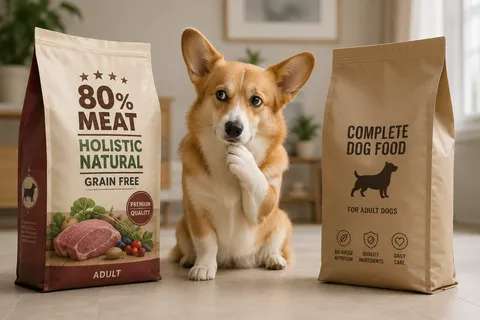
If you look at advertising for modern dog foods, you might get the impression that there is only one quality indicator: meat percentage.
80%
85%
90%.
And the higher the number, the better the food is supposed to be.
But a dog’s body is much more complex than that – it doesn’t need just a big piece of meat; it needs amino acids, and it must receive them in the right amount, proper balance, and with good digestibility.
Veterinary nutritionists assess not the amount of meat by itself, but how well the diet can provide the dog with all the essential amino acids.
Why does a dog need protein at all?
Protein is one of the most important components of nutrition.
It is required for:
- puppy growth;
- maintaining muscle mass;
- tissue repair;
- immune function;
- production of enzymes and hormones;
- skin and coat health.
Virtually every cell in the body needs protein, but that does not mean that the more protein, the better.
Protein is not just meat
We tend to think that protein = meat, but that’s not quite true.
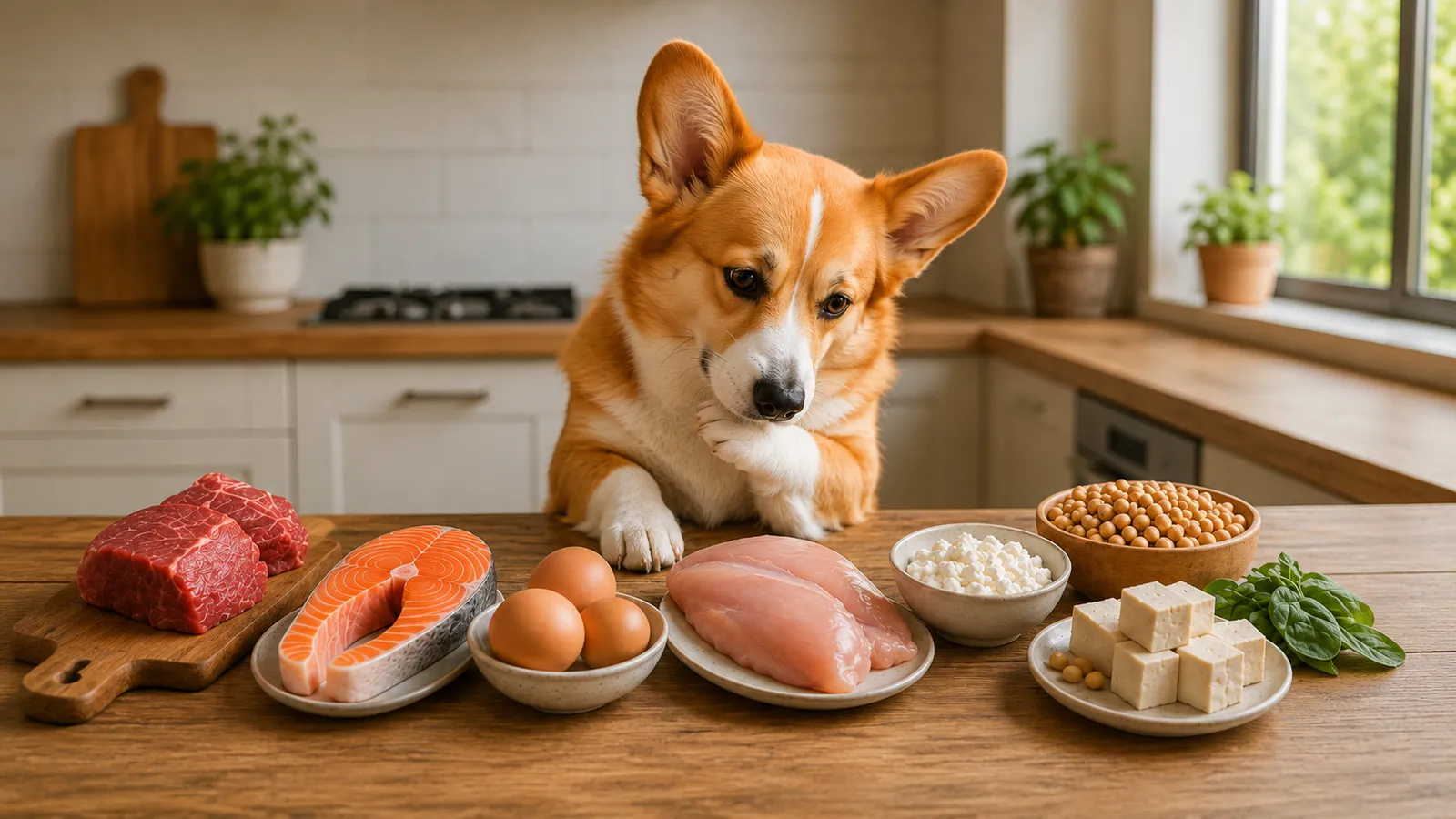
Protein can come from different sources:
- meat;
- fish;
- eggs;
- dairy products;
- certain plant ingredients.
After digestion, the body does not distinguish which food the amino acids originally came from.
What matters much more is:
- how well that protein is digested;
- whether it contains all the essential amino acids;
- whether the dog is getting enough of it.
Animal or plant protein?
This is another issue surrounded by numerous myths.
You often hear: “Plant protein is useless; real protein only comes from animal sources.”
In fact, it’s more complicated.
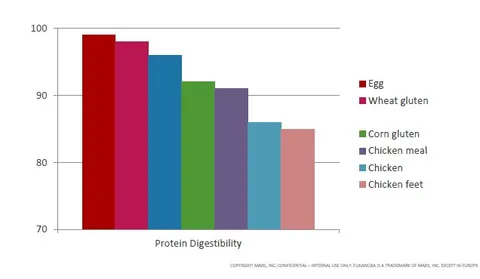
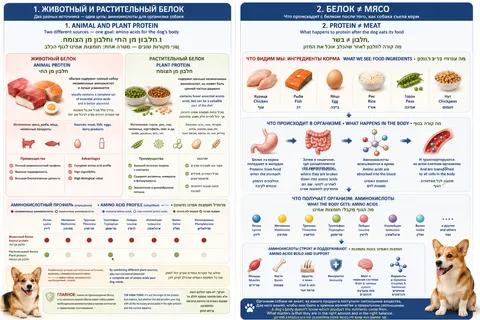
Proteins differ not only in origin, but also in:
- amino acid composition;
- digestibility;
- biological value.
In general, animal proteins usually contain a more complete set of essential amino acids and are better digested by dogs.
However, this does not mean that plant proteins are useless.
Modern complete diets often combine animal and plant protein sources in such a way that they complement each other and supply the body with all the necessary amino acids.
That’s why veterinary nutritionists evaluate not a single ingredient, but the amino acid profile of the entire diet.
What is protein quality?
Not all proteins are the same.
They differ in:
- amino acid composition;
- digestibility;
- biological value.
Imagine two foods: one has more protein, the other slightly less.
But if the second food’s protein is better digested and contains the full set of essential amino acids, it may actually be more beneficial for the dog. Veterinary nutritionists talk not only about the quantity of protein, but also about its quality.
Why do both quality and quantity matter?
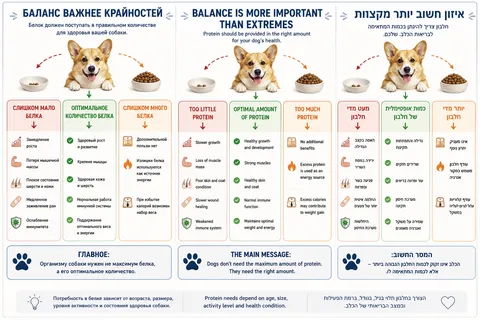
Both a deficiency and an excess of protein can be undesirable. The goal of a complete diet is to provide exactly the amount of protein that matches the dog’s age, size, activity level, and health status.
When protein is insufficient
With a prolonged protein deficiency, the body begins to use its own reserves.
This can lead to:
- slowed growth in puppies;
- loss of muscle mass;
- weight loss;
- deterioration of skin and coat condition;
- slower wound healing;
- weakened immune system.
And if there’s too much protein?
For a healthy adult dog, an excess of high-quality protein by itself is usually not dangerous. The body uses the amino acids it needs and processes the surplus.
However, a higher protein content does not bring extra benefits once the body’s needs are fully met.
Moreover, if the diet provides more energy than the dog uses, excess calories – whether from protein, fat, or carbohydrates – can lead to weight gain.
So a good diet is not one with the maximum possible protein content, but one with an optimal protein level.
Is a high meat percentage always good?
Not necessarily.
First, the number on the package does not always reflect how much animal protein the dog actually gets.
Second, different manufacturers may calculate the meat percentage differently.
Most importantly, even a large amount of meat does not guarantee that the diet is complete and balanced.
If the balance of calcium, phosphorus, vitamins, fatty acids, or other Nutrients is off, such a diet cannot be called ideal.
Do puppies need as much protein as possible?
A growing body really does need more protein than an adult dog, but this does not mean that the higher the protein content in the food, the better.
For proper puppy development, it’s far more important that the diet is complete and balanced.
Excessively rapid growth caused by an overly high caloric density, as well as imbalances in calcium and phosphorus, can lead to serious skeletal and joint problems, especially in large-breed puppies. That’s why veterinary professionals recommend using complete diets formulated specifically for puppies of the appropriate age and size, rather than striving for the highest possible protein content.
Do all dogs need the same amount of protein?
No.
Requirements depend on age, lifestyle, and health.
For example:
- growing puppies need more protein than adult dogs;
- sport and working dogs need more protein than sedentary pets;
- pregnant and lactating bitches also need more protein;
- in some diseases, a veterinarian may recommend special diets with adjusted protein content.
There is no single number that suits every dog.
Key points to remember
A high meat percentage is not, by itself, a quality marker.
When choosing food, it is much more important to understand:
- whether the dog is getting all essential amino acids;
- how well the protein is digested;
- whether the amount of protein matches that particular dog’s needs;
- whether the diet as a whole is balanced.
This is why veterinary nutritionists assess not the meat percentage, but the quality of the entire diet.
🦴 Myth of the week
“The more meat in the food, the better it is.”
A high meat percentage alone does not guarantee a quality diet.
For a dog’s health, a full set of essential amino acids, good protein digestibility, and overall balance of all Nutrients are far more important.
🔜 What’s next?
➡️ Article 6. Proteins, Fats, and Carbohydrates: Who Does What?
In the next article, we’ll take a closer look at the three main sources of energy and building materials for the body.
You’ll find out:
- why fats are no less important than proteins;
- whether carbohydrates are really harmful for dogs;
- how these three components work together;
- and why cutting one of them out rarely makes a diet better.