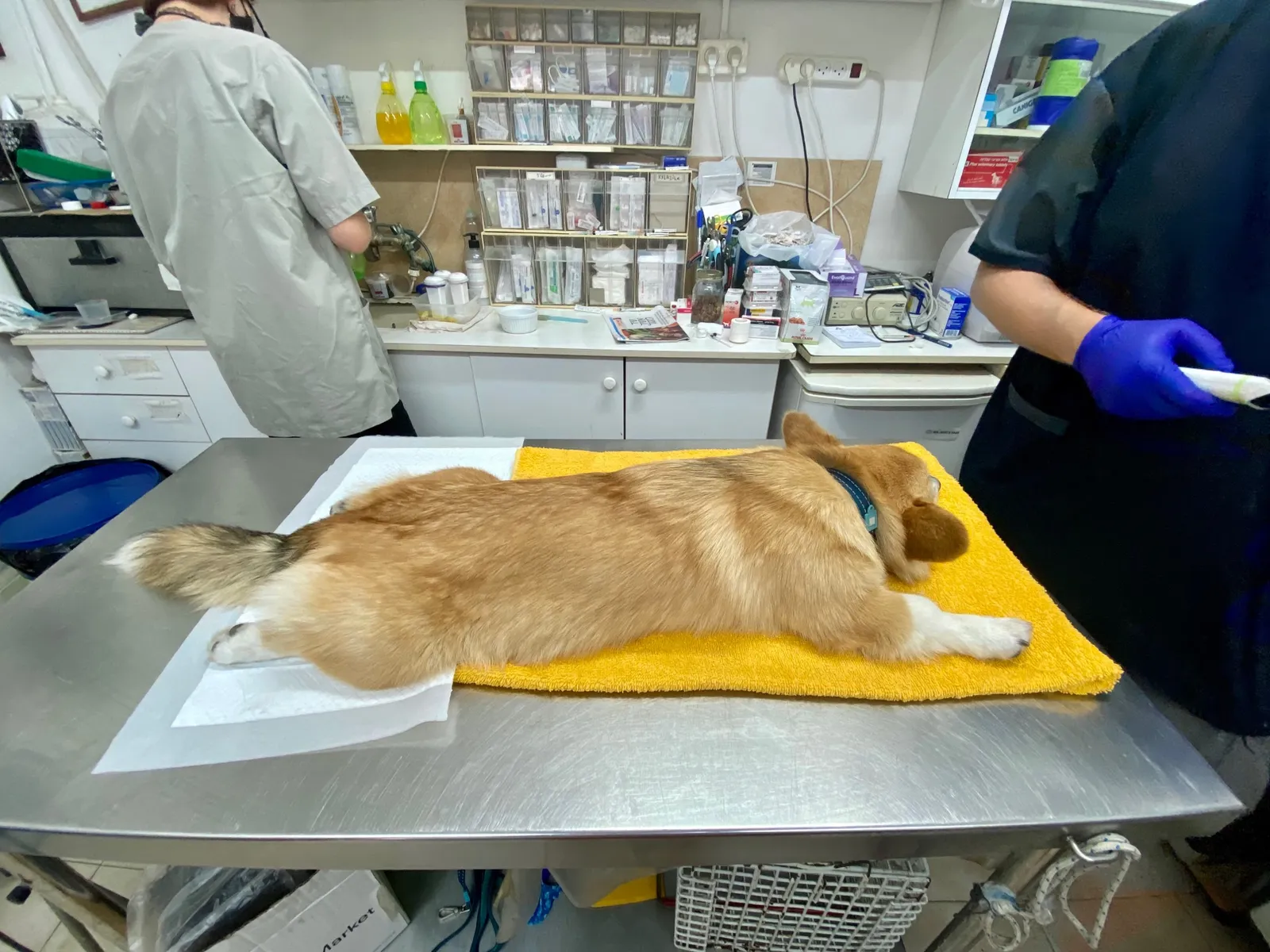
Important: This article is intended as a general guide and does not replace a veterinary examination. If your dog's condition worsens rapidly or causes concern, seek veterinary attention as soon as possible.
When in Doubt, Don't Wait
Not every episode of vomiting or diarrhea is an emergency. In many cases, a healthy dog can simply be monitored at home. However, some symptoms may indicate a serious medical condition where every minute matters.
Trauma and Injuries
Falls, road accidents, dog fights, or any significant trauma require careful evaluation.
Protect Yourself First!
Even the friendliest dog may bite when frightened or in severe pain. Approach your dog calmly and avoid sudden movements.
If You Suspect a Spinal Injury
If your dog cannot stand, is dragging its limbs, or appears to have severe back pain, keep movement to an absolute minimum.
If possible, transport your dog on a rigid surface, such as a board, keeping the spine as straight as possible. If immobilization causes panic or excessive struggling, do not force it—your priority is to get your dog safely to a veterinary clinic.
If There Is Bleeding
- Apply firm pressure directly to the wound using a clean cloth.
- If possible, apply a pressure bandage.
- Do not repeatedly remove the bandage to check the wound. If blood soaks through, simply place additional layers on top.
Once the bleeding is controlled as much as possible, head to the veterinary clinic immediately.
Vomiting and Diarrhea
Digestive upset is common and does not always require emergency care.
When You Can Monitor at Home
A single episode of vomiting or one soft stool in an otherwise healthy, bright, and active dog is usually not an emergency.
Continue to monitor your dog's appetite, energy level, and hydration.
When Veterinary Care Is Needed
Repeated or persistent vomiting can quickly lead to dehydration and should be evaluated as soon as possible.
Severe diarrhea may also cause dehydration. If your dog remains alert, continues drinking water, and otherwise feels well, the situation is usually less urgent, but veterinary advice should still be sought.
Blood in Vomit or Stool
The presence of blood is always a warning sign.
Bloody vomiting or bloody diarrhea requires prompt veterinary attention.
Neurological Signs
Any sudden neurological abnormality should be treated as an emergency.
Sudden Paralysis or Weakness
Even partial paralysis or sudden weakness in the hind limbs may indicate a serious spinal or neurological problem that requires immediate treatment.
Loss of Balance
If your dog:
- tilts its head,
- walks in circles,
- appears unsteady,
- has rapid involuntary eye movements (nystagmus),
these signs may indicate disease affecting the inner ear or the brain.
Seizures
Any seizure warrants immediate veterinary evaluation, even if your dog appears to recover afterward.
Poisoning
If you suspect your dog has been poisoned, do not try to induce vomiting at home.
Some toxins cause even greater damage when they pass through the esophagus a second time.
If possible:
- bring the original packaging of the suspected toxin;
- or take a photo of the product;
- or bring a sample if it can be done safely.
This information can greatly assist your veterinarian in selecting the appropriate treatment.
You can also contact the National Poison Information Center (Israel) at +972 4-854-1900 for immediate advice while heading to the veterinary clinic.
Sudden Swelling After a Bite or Sting
Rapid swelling of the face, lips, eyelids, or other body parts may be caused by:
- an allergic reaction;
- an insect sting;
- a spider bite;
- a snake bite.
If it is safe to do so, take a photo of the insect or animal responsible—or bring it with you if possible. This may help your veterinarian identify the cause and begin the most appropriate treatment more quickly.
Difficulty Breathing
Breathing problems are among the most serious veterinary emergencies.
Possible causes include:
- heart disease;
- lung disease;
- fluid around the lungs;
- air in the chest cavity;
- severe allergic reactions;
- and other life-threatening conditions.
Warning Signs
Seek emergency veterinary care immediately if your dog has:
- blue, gray, or purple gums or tongue;
- rapid or labored breathing;
- its neck stretched forward and elbows held away from the body in an effort to breathe;
- severe shortness of breath, even while resting.
Heatstroke
Heatstroke develops rapidly and can become fatal within a very short time.
If you suspect heatstroke:
- move your dog to a cool area immediately;
- begin cooling the entire body with cool (not ice-cold) water;
- offer drinking water only if your dog is fully conscious;
- monitor body temperature if possible.
Even if your dog seems to improve, seek emergency veterinary care immediately. Internal damage caused by heatstroke may continue to develop for several hours after the initial event.
The Golden Rule
Not every symptom requires an emergency visit, but one simple rule can help:
If your dog's condition is rapidly worsening, it is having difficulty breathing, cannot stand, is experiencing seizures, has severe bleeding, or you suspect poisoning, do not wait to see if it improves on its own.
In many emergencies, the first few hours make the difference between a full recovery and a life-threatening situation.
If you are unsure whether your dog's condition is serious, it is always safer to have your veterinarian examine your pet rather than lose valuable time.
Emergency Contacts in Israel:
Beit Dagan - University Veterinary Hospital - 03-9688588 or *8818 (24/7)
"Chavat Daat" Veterinary Hospital Network:
- Rehovot - 08-9390738
- Haifa - 04-8342887
- Kfar Sava - 09-7431117
- Kiriyat-Motzkin - 077-9926870
- Beer-Sheva - 08-6421848
"VET HOLIM" veterinary clinics (serving the Jerusalem region and Ein Gedi) - 02-9922628 Emergency Number (24/7) - 054-5613377
Veterinary Hospital "Kfar Hayarok" (Ramat Hasharon) - 03-6495050 / 054-7776747