A pedigree is not just a pretty certificate with the names of ancestors. It’s more like a family passport for your dog, where you can learn about achievements, health, origins, and even assess the breeder’s work. Let’s figure out how to read a pedigree and what all those mysterious abbreviations actually mean.
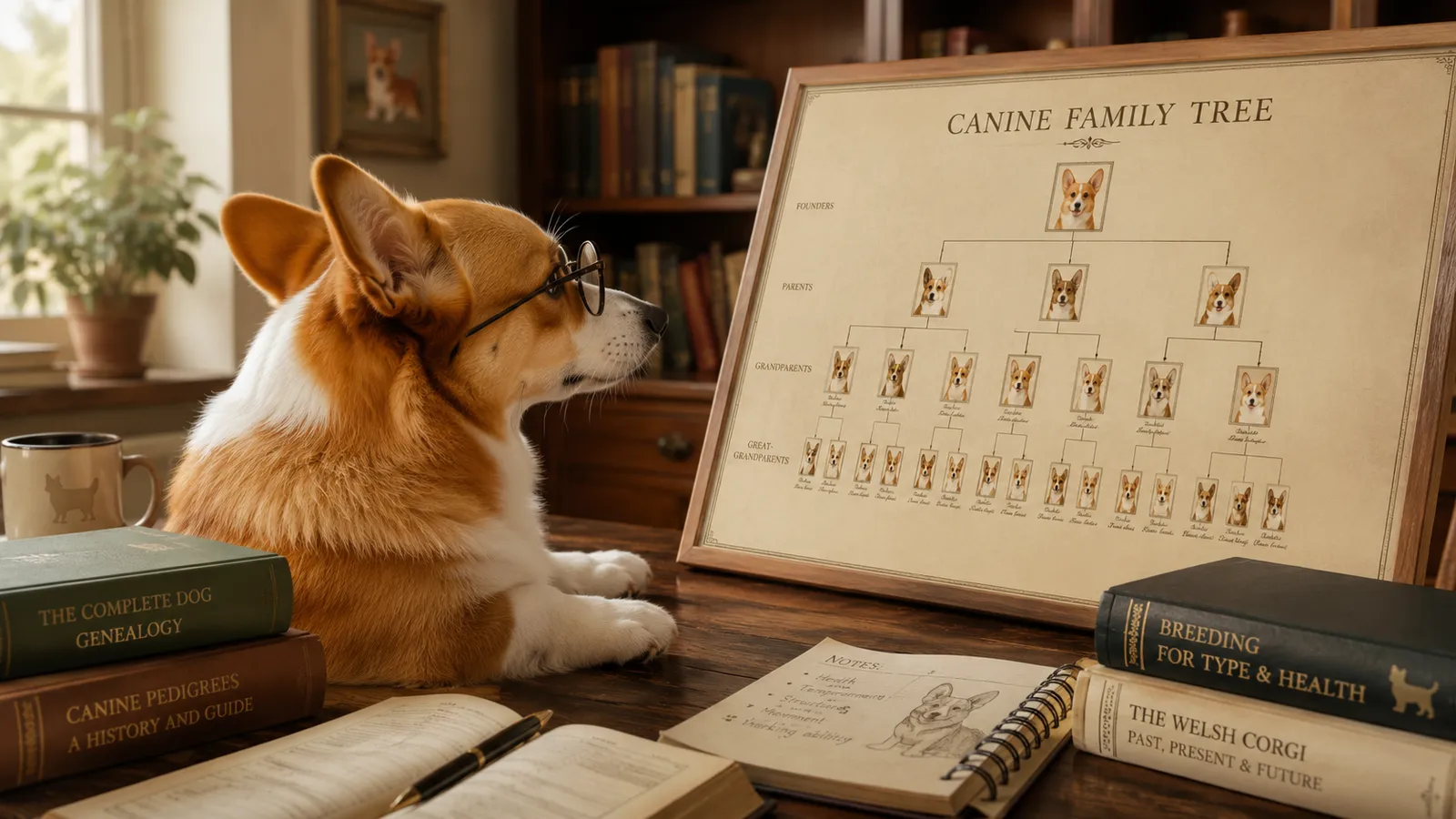
A pedigree is a family tree
In the previous article “Responsible Dog Ownership. A Pedigree Is Much More Than Just a Document” we started talking about pedigrees; in this article we’ll go a bit deeper into the subject.
Many people receive a pedigree for the first time together with their puppy, glance at it briefly and then file it away with the rest of the documents.

Which is a pity.
Because a pedigree is a document that can tell you a lot more about a dog than it might seem at first glance.
From a pedigree you can learn:
- the puppy’s origins;
- his parents, grandparents and great-grandparents;
- show achievements of his ancestors;
- genetic test results;
- working qualities of some dogs;
- how thoughtfully breeding has been carried out.
Of course, not everything is reflected directly in the pedigree itself. Sometimes breeders additionally publish extended pedigrees with test results, photos and descriptions of producers, but even the standard document already contains a great deal of useful information.
What do the titles mean?
Next to the names of many dogs you may see a string of mysterious letters.
For example:
- IL.CH
- JCH
- INT CH
- C.I.B.
- GCH
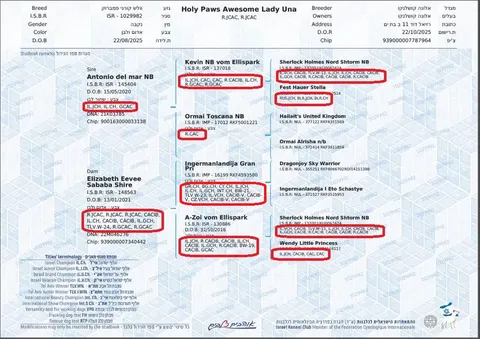
These are show titles.
They indicate that the dog has repeatedly won at shows and has been found to conform to the breed standard.
The higher the title, the more wins were required to obtain it.
For example:
- JCH — Junior Champion of a country.
- CH — Champion of a country.
- GCH — Grand Champion.
- C.I.B. — FCI International Beauty Champion.
It’s important to understand one thing: a title does not mean that a dog is perfect. Every dog has its virtues and its faults.
A title only means that various judges have repeatedly considered this dog a worthy representative of its breed.
We talk more about shows and titles in the article “Dog Shows: What Are They For?”.
Genetic tests are the most valuable part of the pedigree
Modern responsible breeding has long since stopped relying only on a pretty appearance.
Today much more attention is paid to health, so next to a dog’s name you may see the results of various tests.
For example:
DM N/N
or
vWD Clear
or
EIC Carrier
What does this mean?
Every breed has hereditary diseases that can be tested for using DNA tests.
Results are usually of three types:
- Clear (N/N) — the dog is free from the mutation.
- Carrier (N/Mut) — the dog carries the mutation but is not clinically affected.
- Affected (Mut/Mut) — the dog is affected or has a high risk of developing the disease.
It’s very important to understand: a carrier is not a “bad dog”.
In many breeds carriers continue to be used in breeding, provided they are only mated to partners that are “clear” of the unwanted genes. This approach makes it possible to preserve the breed’s genetic diversity while preventing the birth of affected puppies.
That’s why a responsible breeder studies not only the dogs’ conformation, but also the results of all necessary health tests.
An important note
In an official FCI pedigree (including KSU, RKF, IKC and most kennel organizations) the results of genetic tests are usually not listed. You will only find the dogs’ names, registration numbers, coat colours (not always), breeder and owners.
You can see the results of genetic checks in a document often referred to as an “extended pedigree” (Extended Pedigree); breeders prepare it themselves or use databases such as Pedigree Database, Breed Archive, PawPeds, etc.
What is inbreeding?
This is probably the most frightening word for future owners, although in itself it is neither good nor bad.
Inbreeding is the mating of dogs that have common ancestors.
For example:
- grandfather × granddaughter;
- cousins;
- a common great‑grandparent appearing in several generations.
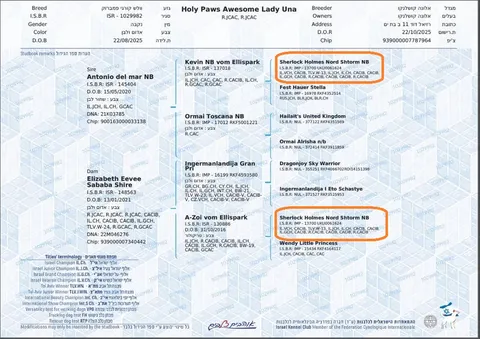
Why is this done?
To fix certain traits:
- temperament;
- health;
- conformation;
- working abilities.
But there is an important condition.
Inbreeding is a very powerful tool. It fixes virtues and faults equally well, so it should only be used by experienced breeders who know several generations of dogs very well.
The mere fact that there is inbreeding in a pedigree does not in itself say anything about the quality of the breeding program.
It is much more important to understand:
- which particular dog it is linebred on;
- why it was used;
- what result was obtained.
Who are producers?
Sometimes you might hear the phrase: “This is a very strong producer,” and it has nothing to do with how many puppies a given dog sires or whelps.
In cynology, a producer is a breeding dog that is used in a breeding program, but not every breeding dog is called a good producer.
Truly valued are dogs that consistently pass on their best qualities to their offspring.
For example:
- correct temperament;
- a beautiful head;
- strong bone;
- excellent movement;
- a stable psyche;
- good health.
Sometimes a dog is not an outstanding show star itself, but its children and grandchildren become champions all over the world.
And vice versa — a magnificent champion may turn out to be a rather mediocre producer.
Knowing all this, experienced breeders study not only the dog itself, but also its progeny.
Why do good breeders know pedigrees by heart?
When a person opens a pedigree for the first time, they see dozens of unfamiliar names.
A breeder sees something completely different.
Behind each name there are:
- photos;
- show results;
- temperament traits;
- health information;
- quality of progeny;
- the strengths and weaknesses of each line.
That’s why, for an experienced breeder, choosing a pair for a mating is rarely random.
A good breeder doesn’t just put together two pretty dogs; they try to choose a combination where one partner’s virtues will compensate for the other’s faults, and the likelihood of producing healthy puppies will be as high as possible.
What the pedigree doesn’t show
Even the most detailed pedigree cannot tell you absolutely everything about a dog.
It shows origin, the names of ancestors and sometimes titles, health screening and genetic test results, but many important things lie outside the official document.
For example, a pedigree usually does not say:
- what the dog was like in everyday life;
- how easy it was to train;
- whether it was anxious, reactive or overly excitable;
- how many puppies it had in its litters;
- whether there were problems with conception, pregnancy or whelping;
- how good a mother the bitch was;
- how long dogs in this line lived;
- which diseases appeared in old age;
- how consistently a producer passed on its qualities to its offspring.
A pedigree also doesn’t show how the puppies were raised, what conditions they spent their first weeks in, and how much attention the breeder paid to their socialization.
Even show titles don’t give the full picture. A dog can be very successful in the ring but fail to pass on its best qualities to its children. And conversely, a dog that is not very eye‑catching in appearance may become a valuable producer whose offspring are healthy, breed‑typical and successful.
That’s why responsible breeding cannot be built on paperwork alone.
Experienced breeders collect information about entire families of dogs: they stay in touch with owners of relatives, follow the progeny, remember temperament traits, details of pregnancies and whelpings, causes of death and age at which dogs passed away.
Some of this information is never officially published and is passed down within the breed community from one generation of breeders to the next.
So a pedigree is an important starting point, but not a ready‑made answer to all questions. To truly understand what lies behind the names of ancestors, you need to know the history of the dogs, the lines and the progeny they have produced.
A pedigree is not a diploma and not a guarantee
You will sometimes hear two opposite statements:
“A pedigree means nothing.”
or
“If there’s a pedigree, it means the dog is perfect.”
Both extremes are wrong.
A pedigree doesn’t guarantee future show wins and doesn’t automatically make a dog healthy or ideal, but it does provide something you can’t get any other way — information.
It allows you to trace the dog’s origins, assess the breeder’s work, see the achievements and health of the ancestors, understand which lines stand behind the puppy and how thoughtfully this combination was planned.
That is why experienced breeders study pedigrees as carefully as a doctor studies a patient’s medical history, because the future of every new litter begins long before the puppies are born — with a proper understanding of the past.