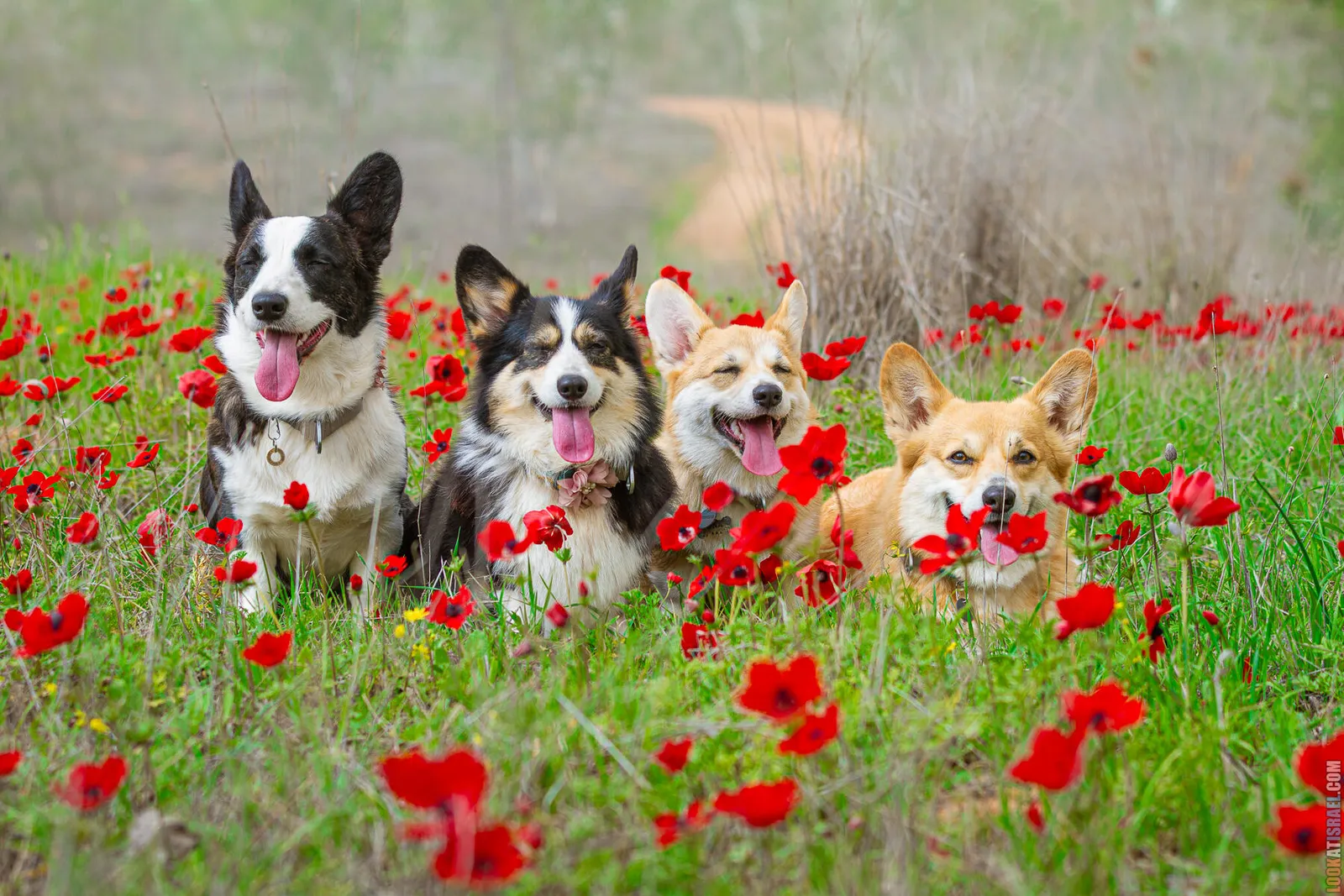
A dog in Israel basically lives in “can’t leave the house for half a year” mode. In summer the asphalt heats up so much you could cook shakshuka on it. But from November to April this is the best country in the world for walks: everything is green and blooming, the air is cool and pleasant, and it’s easy to find a wonderful route not far from home.
Over the years we’ve collected about ten routes where you can safely let your dog off leash and they can run to their heart’s content. We and our dogs have covered all of these places ourselves. This isn’t just “found a route on the internet”, but trails we actually walked, got soaked on, sank into mud on, and pulled burrs out of coats after.
A special note about corgis: this breed has short legs and a long back, so far from every route will suit them. You also always need to consider the dog’s age, health, fitness and endurance. That’s why we rated every route in this article in paw‑steps.
Difficulty scale in corgi paws:
- 🐾 Flat, there’s shade, there’s water. We walk without breaking a sweat.
- 🐾🐾 A bit of up and down, three to four kilometers. Normal for a healthy adult dog.
- 🐾🐾🐾 Sand, distance, or no shade at all. Bring water, no excuses.
- 🐾🐾🐾🐾 Elevation gain, rocks, steps. For young and sporty dogs.
- 🐾🐾🐾🐾🐾 The last kilometer the dog is being carried. You won’t find routes like this here, because a walk should be a pleasure, not a punishment for everyone.
🚨 First the boring but important part: where you can’t take a dog
A quarter of Israel’s territory is national parks and nature reserves. The rules in reserves and parks differ, which confuses a lot of people. Let’s clarify:
- Under the Israel Nature and Parks Authority rules, in most national parks, including paid ones, dogs are allowed in – but they must be on a leash and muzzled, and you need to follow the rules of that specific park.
- In most paid nature reserves dogs are not allowed at all; in others dogs are not allowed on hiking trails.
There are specific places where even a guide dog won’t be admitted, like Ein Avdat and Ein Gedi.
The rules change from time to time and are listed separately for each park. So before you head out, open the list on the Israel Nature and Parks Authority website, find the park you need and read its rules for visiting with a dog. It’ll take a couple of minutes, but can save you a ruined day.
There’s a logic to these restrictions that people often don’t think about: a nature reserve is not a park and not a vacant lot. Wild animals live there, and to them your dog is an alien predator. Such a meeting can end badly both for the wild animal and for your dog. Even the sweetest corgi will chase anything that runs, so the requirement to keep your dog leashed isn’t just a park ranger’s whim, but a matter of animal safety.
🚨 Safety on the trail
Before you clip on the leash and load your dog into the car, go over the safety checklist. Israeli nature is beautiful but tricky:
1. Heat and climate: Make sure the air temperature is suitable for active walking. Read our article “Corgis in Israel’s climate: heat, walks and coat care”.
2. Flora and fauna: Watch your step and your surroundings! Read up on dangerous plants in Israel, snakes, spiders and insects, and encounters with porcupines and jackals.
3. Protection from uninvited guests: Before you head into the fields, double‑check your parasite prevention. All about protection is in our articles on parasites and ticks in Israel and on choosing Bravecto, NexGard and other treatments.
4. First‑aid kit and symptoms: Always keep this memo handy: “When you can’t wait: symptoms that mean your dog needs to see a vet urgently”.
Before a walk we always recommend:
- taking enough water for both you and your dog;
- avoiding long walks during the hottest hours of the day;
- using a long line where it’s unsafe to let the dog off leash;
- remembering that even the best‑trained dog must respect other trail users and the local environment.
Even the simplest route will be much more enjoyable if you prepare in advance.
🚨 What to pack in your backpack
- Water – for you and your dog – and a collapsible bowl. A corgi can drink from your bottle, but it gets messy.
- A short leash in addition to a long one. Useful on narrow paths and in areas with shepherds and flocks.
- Tick remover tweezers. After the walk, you need to check your dog all over, especially ears, groin, and between the toes. We have a separate deep‑dive on ticks and fleas in Israel, and about the treatments themselves here.
- Treats, but in moderation. On a walk your dog is more willing to work for food than at home, so it’s very easy to overfeed them. We’ve already written about hidden calories in treats. And don’t share your sandwich with your dog without thinking – far from all human food is safe for your pet.
- Poop bags. Yes, even out in an empty field.
And remember about your dog’s response to cues: if your dog won’t come when called in a field that smells of jackal, you must not let them off leash. This isn’t about obedience for obedience’s sake, it’s about safety. We talked about this in detail in “Do corgis need training”.
Got the water and treats packed? Then let’s hit the trails!
How we choose routes
Welsh corgis are active, hardy and curious dogs. They’re happy to walk several kilometers, explore new smells and accompany their owner on almost any trip.
But that long back and short legs still call for a sensible approach to route choice. We try to avoid places where you have to scramble for a long time over big rocks, climb steep scree, or constantly jump over obstacles.
That’s why we can confidently recommend all the routes below for most healthy adult corgis. We’ve walked each one with our own dogs, so we’re sharing not ad copy, but our own experience.
🌸 Route 1: Lupin Hill (Tel Sokho)
📍 Area: Shfela
🐾🐾 Difficulty: Easy/medium
💧 Water: No
🌳 Shade: Little
📏 Route length: long option 3.5 km, can be shortened
🌼 Best time: February–March
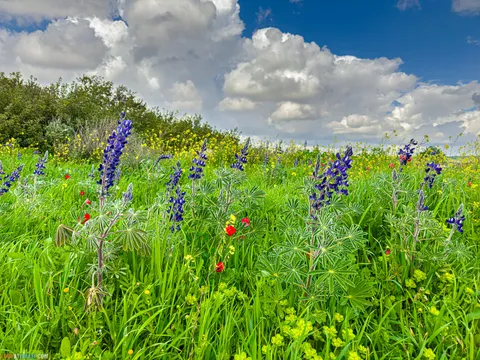
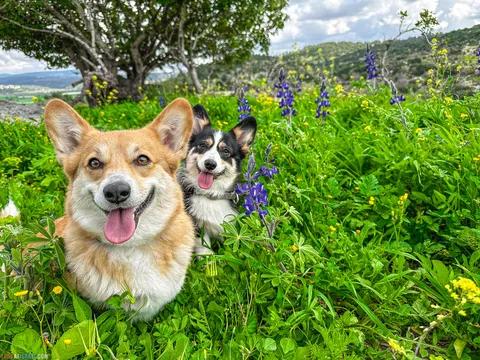
In February Givat Turmusim hill blooms so spectacularly it’s impossible to describe in words. A lot of people come here in this season, but there’s plenty of space for everyone, so it’s unlikely to feel crowded (especially on weekdays).
Here’s a small life hack: everyone will go straight up from the parking lot to the flowers, but you should do the opposite. Walk further along the same road you drove in on. At first there’ll be plenty of people on the road, then fewer and fewer, and then you’ll be walking completely alone. After about two kilometers you’ll reach a junction with blue trail blazes and turn left. There’s a gentle ascent, some trees, and the entire way back to the car will be along a carpet of lupines and anemones.
The bonus of this longer loop is that by the time you reach the flowers, the dogs will already be tired out and will calmly sit for photos. Two rocket‑powered corgs who wouldn’t let themselves be photographed in the first hundred meters were posing like models at the end.
👉 Waze pin, a short lazy option and the bloom map: see in the blog
🏛 Route 2: The Wheel of Spirits on the Golan
📍 Area: Golan Heights
🐾🐾🐾 Difficulty: Medium
💧 Water: Seasonal
🌳 Shade: Full sun
📏 Route length: circular, about 7 km, around three hours at an easy pace
🌼 Best time: February–April
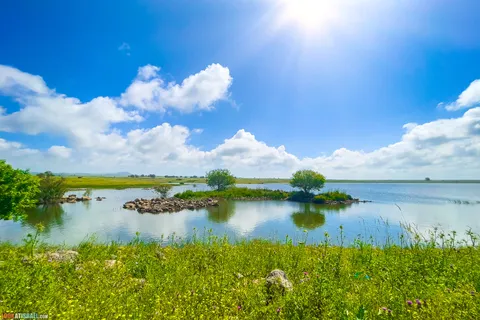
Seven kilometers sounds like a lot, but they’re very easy kilometers: no ascents, no descents; just a flat dirt road and a path. The only climb is right after road 808, and it’s worth taking: from the hilltop you can see the Daliot reservoir. In winter and spring it’s especially beautiful.
The route starts at the Daliot junction parking lot, two kilometers south of the entrance to Gamla National Park. From there, follow the Golan Trail northeast.
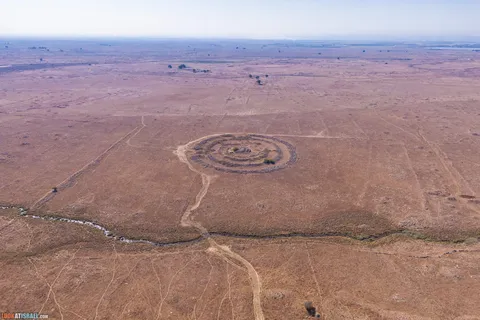
The goal is “Rujum el Hiri”, the Wheel of Spirits: a massive structure of concentric stone circles whose purpose archaeologists still argue about. From the ground it’s honestly not very impressive, but from the air…
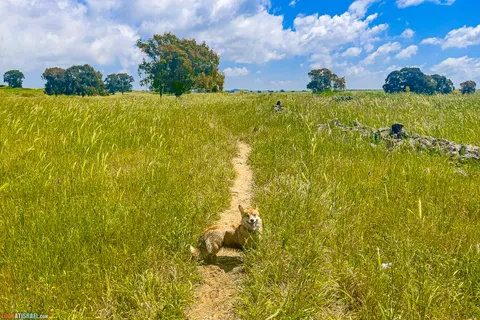
Now about dogs and mud. There’s a little stream along the way that brought our dogs endless joy. Not a single puddle, swampy patch or mud hole was left unvisited. In winter and after rain this same stream will probably wash out the trail, and then you’ll be just as dirty as your dog. As an alternative, you can walk there and back along the jeep track.
You’ll also almost certainly meet a herd of horses – be careful! Once such a herd lured our friends’ dog away, and the owner had to search for him in the hills for several hours.
And on the Golan Trail during holidays there can be as many people as on the Ayalon highway at rush hour.
But when everything else in the country has already faded and burned out, you can still find red poppies in green grass here.
👉 Waze to the Daliot parking, Golan Trail markings and an aerial view of the Wheel: all in the blog
🌿 Route 3: The blooming hills of Modi’in
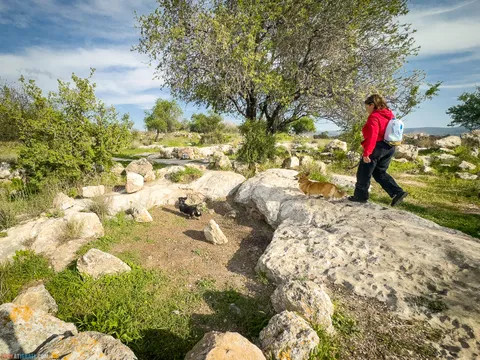
📍 Area: Modi’in
🐾🐾 Difficulty: Easy/medium
💧 Water: No
🌳 Shade: Partial
📏 Route length: circular, 3 km (can easily be shortened), total elevation gain just 75 meters.
🌼 Best time: February–April
The official city website calls these hills “the Tuscan landscape of Israel”. That’s, of course, quite self‑confident, but in March not entirely undeserved.
Parking is by Kikar HaShoter (כיכר השוטר/ת), there’s plenty of space. After parking, first cross the little bridge with a rope gate – and don’t forget to close it behind you. Right after the bridge the dogs get hit by the smell of freedom, and off they go…
Further along the route history is “scattered” around you: after about 300 meters you’ll reach the ruins of the Byzantine church of Hurvat Hadat, with only stones and column fragments remaining. A mosaic floor was found there with a line from the Psalms about the soul that longs for God like a deer longs for streams of water. Dogs can’t read, so they’ll most likely just dash past cheerfully.
You’ll also come across Be’erit well, about ten meters deep and three meters in diameter, left from an Arab village captured in 1948 during Operation Dani. And before the Arabs there was yet another settlement here, which left behind water cisterns and caves, some of which you can climb into.
When you reach a very twisted pine tree, you’ll know you’re at the ruins of Kanuba. The name roughly translates as “ruins of cauliflower”, and we won’t even try to explain that. From the top you can see the Binyamin region, the Jerusalem hills, the Ayalon Valley and the longest viaduct in the country; in good weather you can see the entire Gush Dan area including Tel Aviv.
We set out with the goal of exhausting the dogs to 100 points on a ten‑point scale. Judging by how they were bouncing on the way back, we failed.
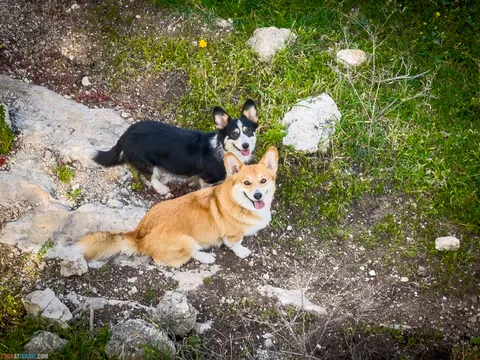
👉 Starting point, trail markings and all the archaeology along the way: read in the blog
🌳 Route 4: The hills of Nes Tziona
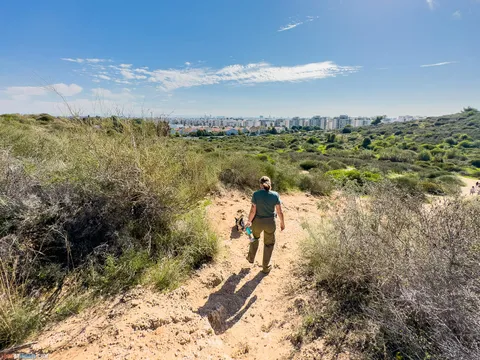
📍 Area: Iris Hill in Nes Tziona
🐾🐾 Difficulty: Easy/medium
💧 Water: No
🌳 Shade: Little
📏 Route length: 3.5 km (but you can easily walk a lot more).
🌼 Best time: February–April
This is a route you can walk endlessly, and it’ll be different every time. The reason is simple: there are so many paths that in several years we still haven’t explored them all. You drive up, park, and head wherever your eyes (or paws) take you.
Officially this is the “Nes Tziona Hills” National Park, but locals call it Givat HaKurkar, after the rock the hills are made of – kurkar. It’s a soft sandstone quarried along the whole coastline. It can be light brown or yellowish and is mostly used as cladding stone.
Dogs have a blast here: soft ground under their paws, lots of space, and almost no people (except during the season when the Argaman iris blooms in several spots on the hills). In the far part of the park we didn’t meet a single person the entire walk.
Points of interest: a tree house that the corgis didn’t manage to reach, an armchair on top of a hill that someone thoughtfully dragged up there, and a memorial to terror victims in a small grove. There are also scattered stones that look like building remains, but we don’t know anything about them.
In the northern part of the park there’s a grove where it’s easy to find a quiet picnic spot.
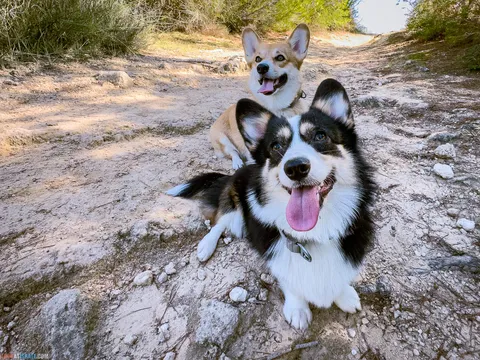
👉 Waze, our version of the loop and what to do with endless forks in the trail: read in the blog
🏺 Route 5: Tel Gezer — in the footsteps of kings and ancient civilizations
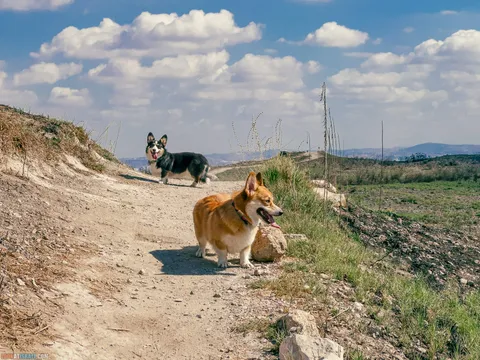
📍 Area: Shfela
🐾🐾 Difficulty: Medium
💧 Water: No
🌳 Shade: Little
📏 Route length: 1.7–2.7 km (1.7 km inside the park, plus up to 1 km each way from the parking).
🌼 Best time: December–April; possible year‑round, but in summer and autumn only close to sunset.
In July 2022 a fire broke out in Tel Gezer National Park. It took twenty firefighting crews to put it out, and it revealed what tall grass had been hiding for decades: parts of the ancient city, layers of pottery shards right under your feet, Solomon’s Gate in all its glory. Every path in the park became visible like on a map.
The main attraction of the park is the huge standing stones, thanks to which Tel Gezer is sometimes called the “Israeli Stonehenge”. Long ago this place was used for religious rituals.
There’s little shade in the park, and in October you really feel it. Eevee, more experienced in traveling, first read all the information boards, then found a shady spot and sat down to conserve energy while Kaya ran around like she’d never been off leash before. By the middle of the route she also realized that if you can lie down in the shade, you should lie down in the shade.
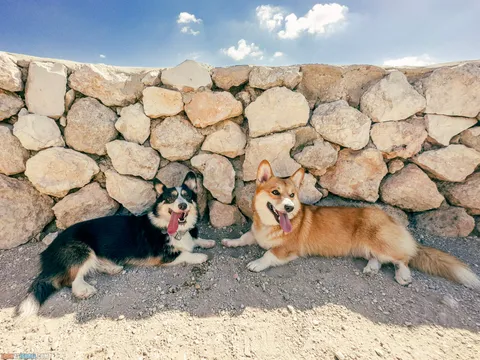
In spring it looks completely different. We came back to Tel Gezer in March, when there was fresh water in Ein Vered spring, perfectly suitable for a dip, which both dogs happily took advantage of.
👉 How to get there via Karmei Yosef and not get stuck in the fields: all details in the blog
🌊 Route 6: Hof HaSharon – sea breeze and high cliffs
📍 Area: Mediterranean coast, Netanya area
🐾🐾 Difficulty: Easy
💧 Water: Half the route runs along the seashore
🌳 Shade: Partial
📏 Route length: the basic loop is short, but you can easily walk for an hour, two, or all six.
🌼 Best time: Any time it’s not hot.
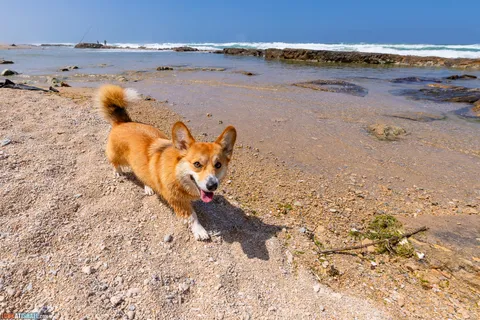
A perfect summer option. Half the route runs along the sea, half with a sea view. But fair warning: you may encounter completely naked people here. The local wild beach is very popular with nudists.
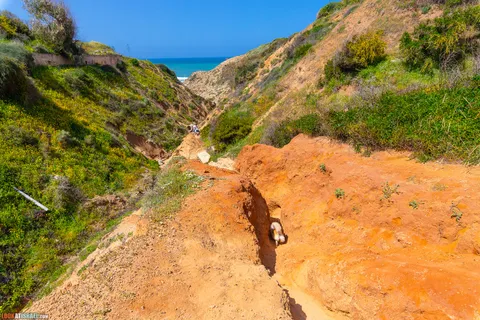
You start by descending to the sea, and it’s not a simple descent but in the style of classic canyon hikes. Don’t be scared – it’s actually the seasonal bed of an unnamed stream that carries rainwater down to the sea.
In any case, five minutes later you’ll be by the water. Turn right, where you’ll find wide open space, the sound of waves, and a minimum of people.
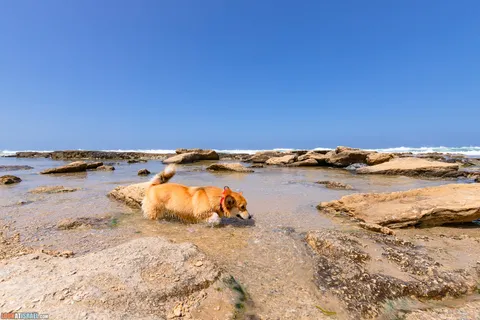
The main advantage of this spot for short‑legged dogs is the rocks that form mini pools. A corgi can splash there without the risk of being knocked over and dragged out to sea, which matters a lot because short‑legged dogs and surf are a bad combo. (We have a separate article about swimming as exercise for corgis.)
Three precautions:
- Don’t sit too close to the cliff edge – it has an unpleasant habit of collapsing.
- Make sure your dog doesn’t get tangled in abandoned fishing nets, which can still have sharp hooks in them.
- In jellyfish season keep an extra close eye on your dog – you never know how close your corgi will decide to get to a jellyfish...
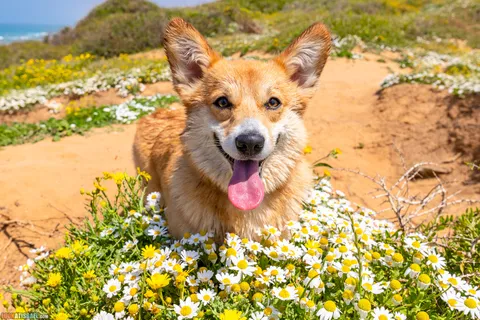
The seaside section is short – under a kilometer. Then you go up along a path, turn right, and you’ll find yourself in Hof HaSharon Park with lots of diverging trails. Something is in bloom there year‑round, but of course it’s prettiest in spring.
👉 Two parking options and how to time it right for sunset: route in the blog
🏖 Route 7: Nabi Rubin
📍 Area: Rishon LeZion / Soreq / Palmachim
🐾🐾🐾 Difficulty: Medium
💧 Water: A small part of the route can run along the river (but dogs are not allowed in it).
🌳 Shade: There is some, but only on parts of the route.
📏 Route length: circular, about 3 km or more; it’s up to you.
🌼 Best time: Winter–spring.
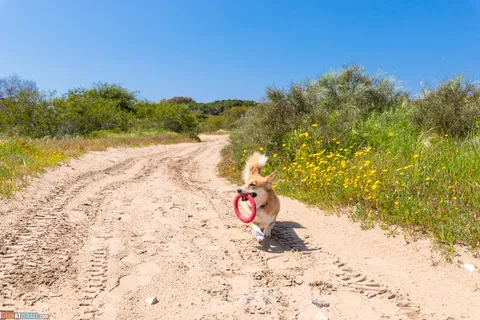
The walk starts at the “Nahal Soreq” parking lot.
Right after the gate you’ll see a junction and three roads. Straight and left are the short loop; right is the longer one.
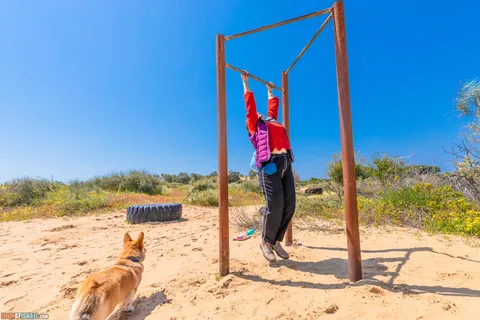
If you decide to go right, follow these landmarks: first an outdoor “gym”, then green trail blazes (they’re not very obvious, so pay attention).
If you start coming across ruins, you’re on the right track. Sooner or later you’ll reach a low stone wall, and behind it lies the main goal of the walk – the “mausoleum”.
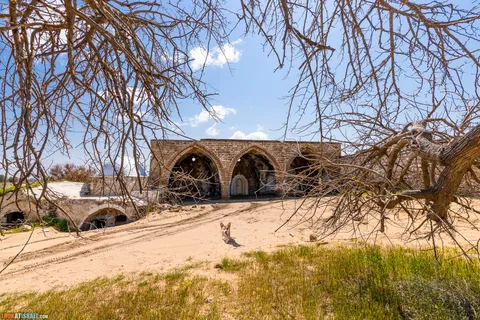
According to legend, this is the tomb of Reuben, the eldest of Jacob’s twelve sons. Nearby grows the only tree on this part of the route where you can sit in the shade.
Important!
- There’s absolutely no shade on the first part of the route, except for that one tree. In summer come here only very early in the morning, and bring water for both yourself and your dog.
- On weekdays this area may be used as a military training ground; in that case soldiers will be standing at the gate and won’t let you in.
- After rain the sand is firm and easy to walk on, but in the dry season it becomes loose and heavy, and walking is harder for both you and your dog – but also much better exercise. (Speaking of exercise: why corgis need regular physical activity at all.)
- In the dry season there can be sharp grass seeds in the sand, so watch your dog carefully. If they suddenly start lifting a paw or limping, immediately feel the paw pad thoroughly and remove any burrs.
👉 Grave coordinates and route map: details in the blog
🌊 Route 8: The Soreq River and Palmachim Beach
📍 Area: Rishon LeZion / Soreq / Palmachim
🐾🐾🐾 Difficulty: Medium
💧 Water: River and sea
🌳 Shade: Little
📏 Route length: circular, about 5–5.6 km, depending on you. You can easily rack up 10.
🌼 Best time: Winter–spring.
This is the route that started the whole series – it was here, after Eevee joined us, that we realized we’d have to look for dog‑friendly places carefully and systematically.
The walk starts just beyond the parking lot, in a shady grove where you can have a picnic or even camp overnight. But sitting around doing nothing isn’t our style, so you can let your dog off leash and start walking.
You go under the bridge, past the white Mekorot water tank, and reach a second grove. There’s a junction: a paved path goes right, a sandy one goes left. You want left.
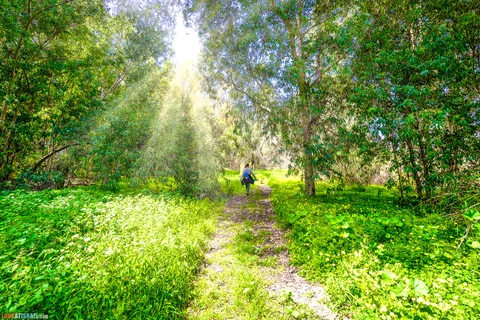
If you come here in season, you’ll have the Argaman irises blooming right along the trail, practically all to yourself.
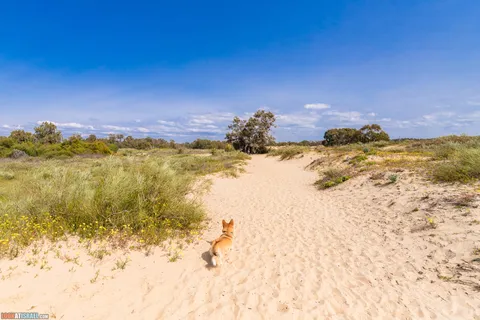
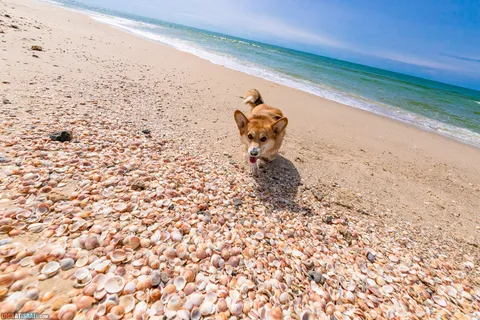
Along the way you’ll see a big dune where both you and your dog can run wild. Then you come out onto a wide empty beach, where our dogs love to run at the water’s edge and dig around in seashells.
It’s better to head back along a different route, following the stream – there’s shade and the soothing rustle of eucalyptus.
You can come here in summer too, but you need to arrive very early – at sunrise.
👉 Parking, turns and a full list of Israel’s wild iris species: see in the blog
🌷 Route 9: Corgiris – irises, oranges and two very muddy corgis 🐾🐾
📍 Area: Rishon LeZion / Soreq / Argaman Iris Reserve
🐾🐾 Difficulty: Easy/medium (depending on the length of the loop you choose)
💧 Water: No
🌳 Shade: Little
📏 Route length: as you wish
🌼 Best time: Winter–spring.
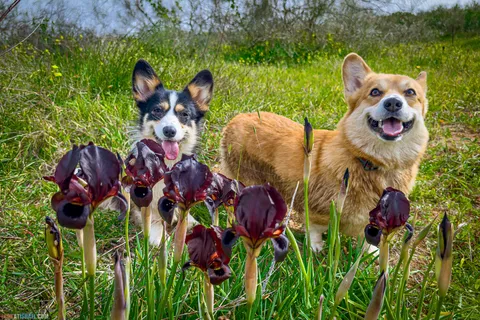
You really need to do this route in February and not any other time. Argaman irises bloom for a short period, and citrus fruit are ripening at exactly the same time.
The road to the iris reserve is sandy. A regular car can get through, but with difficulty. We left the car at the start of the route and went on foot; it had rained for several days beforehand, so right at the beginning we had to carry the dogs in our arms across a big puddle. The dogs thanked us for our care and took off ahead toward the next puddle, which was much dirtier. And then there was another one. And another. And another. Each more picturesque than the last.
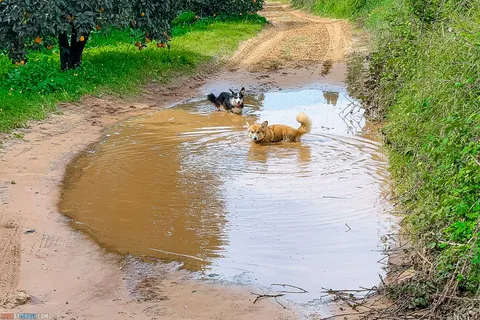
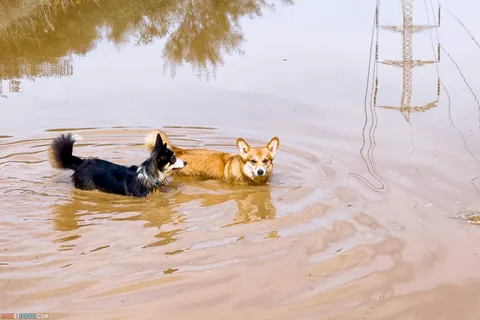
Before long both dogs had acquired a new color pattern we called “Welsh corgi piglet delighted”.
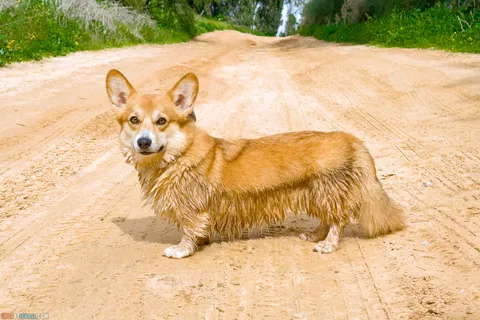
At this time of year irises bloom all around, and in the orchards oranges, mandarins and lemons are ripening.
Bottom line: if you’re not ready to wash your dog in four‑handed mode, wait until the puddles dry up. But by then the irises will be gone too.
👉 Where to park by Givat Humra and what it looked like: full story in the blog
🏛 Route 10: Caesar Trail (Shvil HaKeisar) — Roman road and forest shade of the Judean Hills
📍 Area: Jerusalem Hills
🐾🐾🐾🐾 Difficulty: Moderately hard
💧 Water: No
🌳 Shade: Plenty
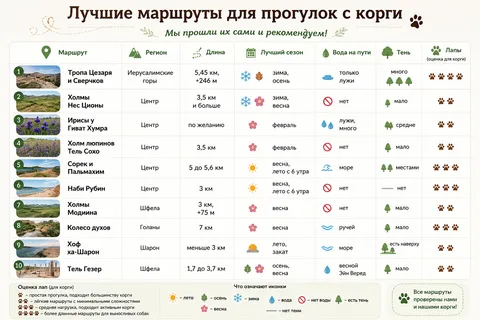
📏 Route length: circular. Our loop was 5.45 km with 246 meters of elevation gain
🌼 Best time: Winter–spring.
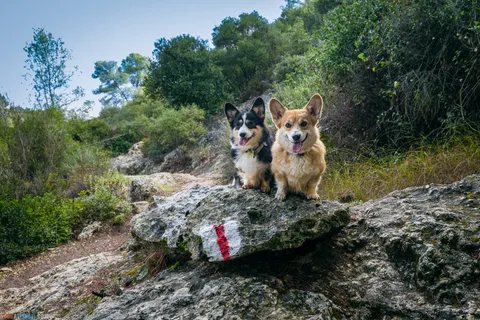
In our opinion, this is the most beautiful route in the whole collection. It’s also the most demanding physically: five and a half kilometers and almost 250 meters up. For a corgi this is work, not just a stroll.
The trail is named after Emperor Hadrian (Caesar Hadrian). His name was found on one of the columns lying along the route, and that was enough to dub it Caesar Trail. Whether Hadrian himself ever walked here nobody knows, but it’s certain that a Roman road from Jerusalem to Beit Guvrin passed here, and some of its steps are carved directly into the rock. They’re still there, and you can walk on them. The dogs, however, didn’t appreciate the historical value of the steps.
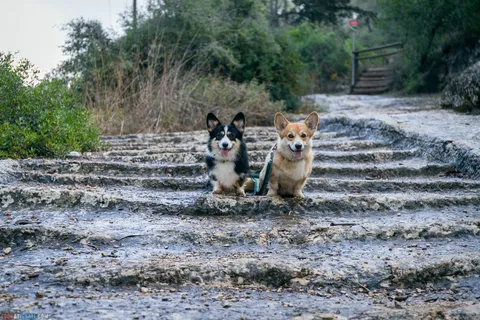
We walked there in December under grey clouds, and it turned out to be perfect: cyclamens, daffodils, a damp forest and complete silence.
In the Svarchuk (Crickets) Gorge at one point all you could hear was a single lonely bird, and the wet forest around made it feel like we weren’t in Israel at all, but somewhere in Europe.
Along the way you’ll pass the ruins of a forester’s house; it’s believed to have been built during the British Mandate, although the style looks more Ottoman. If you climb inside (and you almost certainly will), watch your step: there’s a cave below.
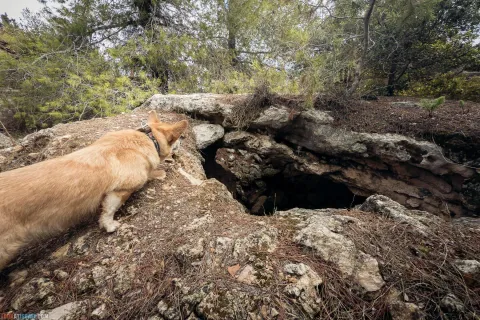
The only water you’ll find on this route is puddles after rain. There’s shade almost everywhere, so the route is suitable for spring and late autumn.
👉 How to find the trailhead, where to turn off to the forester’s house and GPX file: step‑by‑step in the blog
Cheat sheet
After the walk
Check your dog all over: ticks, burrs, and hitch‑hiking thistles stuck in the coat. Examine the paw pads, especially if you walked on rocks or hot sand.
And remember the symptoms that mean you must go to the vet immediately, not “tomorrow morning”: heavy breathing that doesn’t ease in the cool, lethargy, refusal to drink, limping on one leg after jumping. The list of things you must not wait with.
Israel is incredibly beautiful when you explore it with a dog
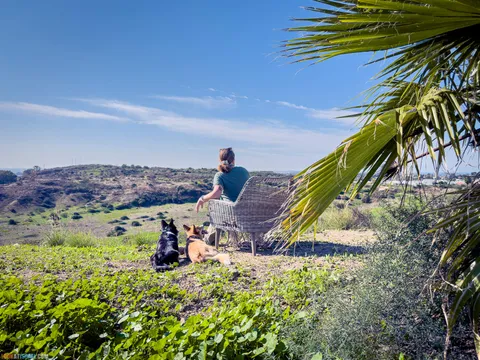
In recent years we’ve realized that the best walks aren’t necessarily long treks for dozens of kilometers. Sometimes a couple of hours among blooming hills, sea breeze or ancient ruins is enough to bring huge joy and give your dog new experiences.
We’ll definitely keep adding new routes to this collection after we test them together with our corgis. We hope it helps you discover new corners of Israel and makes your shared walks even more exciting.