Patience Is a Skill, Not an Innate Ability
Perhaps the most important thing every owner needs to understand is that a puppy is not born knowing how to hold it. A young puppy’s bladder is simply not physically capable of holding urine for as long as an adult dog’s, so expecting a two-month-old puppy to wait until the next walk is unrealistic.
This is not disobedience, stubbornness, or an attempt to “get back at you” — it is simply physiology.
With each month of development, a puppy becomes a little better at controlling its needs. The owner’s main task is not to fight the puppy, but to help it develop the right habit.
When Your Puppy Will Almost Certainly Need to Go
There are several situations when the likelihood of an “accident” is particularly high.
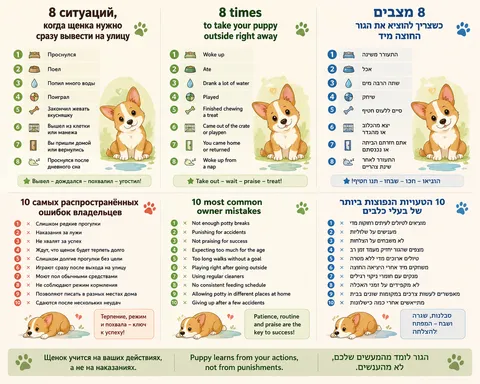
Be sure to take your puppy outside:
- immediately after waking up;
- a few minutes after eating;
- after active play;
- after spending a while chewing a treat;
- after intense excitement or joy;
- before bedtime;
- immediately after coming out of a crate or playpen.
If you wait until your puppy starts searching for a spot or circling, it may already be too late.
Our experience:
When our dogs were very young puppies, we tried to “catch” the moment they woke up, immediately picked them up, and carried them outside. There were a couple of “accidents” when a puppy relieved itself right on us while we were running down the stairs, but those were isolated incidents. With time, the puppy was able to wait calmly until we carried it outside and put it down on the ground.
Routine Is Your Best Helper
Puppies learn patterns very quickly. If feeding, sleeping, walks, and play happen at roughly the same times each day, their bodies also begin to follow a schedule.
During the first few weeks, it is better to take your puppy outside one extra time than to hope it can hold it a little longer. Several short, successful potty trips are much more useful than one very long walk.
Praise at the Right Moment
When your puppy relieves itself outside, be sure to praise it.
Ideally, use all three:
- warm, calm verbal praise;
- affection;
- a small treat.
Timing is extremely important: reward your puppy within one or two seconds after it finishes. Only then can the puppy clearly associate the reward with what it has just done. If you first walk home, take off the leash, pour some water, and only then offer a treat, that connection has already been lost.
Why Punishment Doesn’t Work
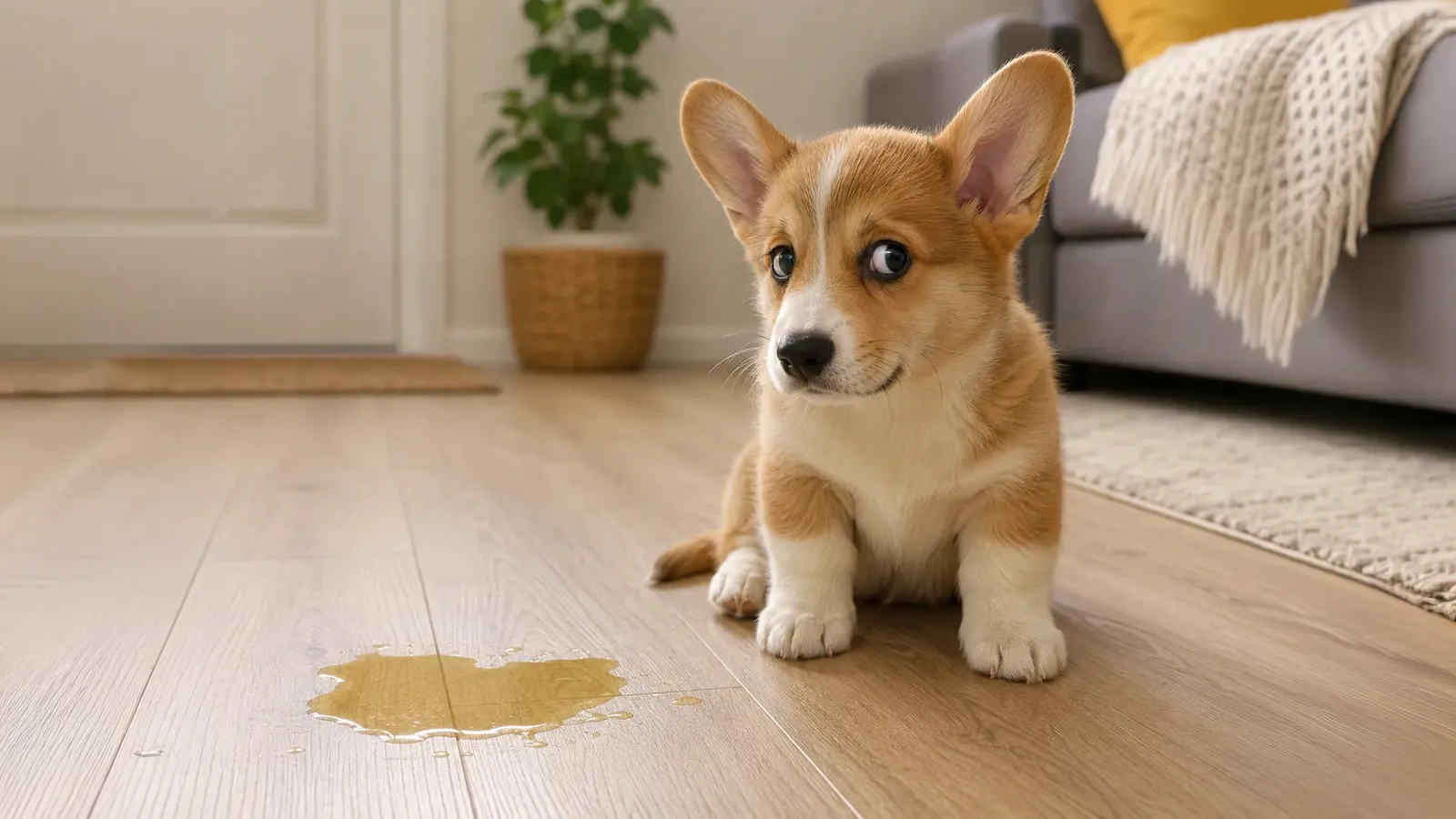
Many owners try to scold their puppy for puddles. Unfortunately, this is one of the least effective ways to teach house training.
A puppy cannot understand that you are angry about something that happened several minutes ago. From the puppy’s perspective, the punishment seems completely unpredictable.
Instead of learning “I must not pee indoors,” the puppy may learn something entirely different:
- my owner becomes scary when there is a puddle nearby;
- I should not pee when my owner is watching;
- it is safer to hide behind the sofa or go into another room.
Some puppies begin holding it outside and then relieve themselves at home when they are alone. Others try to hide the evidence and may even begin eating their own feces. Physical punishment, shouting, and especially “training methods” such as rubbing a puppy’s nose in a puddle are not only useless but can significantly slow down the learning process.
What If Your Puppy Has an Accident Indoors?
If you did not catch your puppy in the act, simply clean it up calmly.
If you catch your puppy while it is happening, do not shout or punish it.
Calmly interrupt the puppy, pick it up (or quickly take it outside if it is already going for walks), and give it a chance to finish there. Then be sure to praise it.
Successful repetitions, rather than punishment, are what build the right habit.
Puppy Pads: Helpful or a Hindrance?
There is no single answer.
If your puppy cannot yet go outside because it is still in the post-vaccination period, or if the owner is physically unable to take the puppy outside frequently, puppy pads can be a useful temporary solution.
However, it is important to remember that the puppy is still learning that it is acceptable to relieve itself indoors. Once outdoor walks begin, it is therefore a good idea to gradually move toileting outside and reduce the number of pads in the home. The sooner outdoors becomes the puppy’s main toilet area, the easier the transition usually is.
Our experience:
Before we moved to a house with a yard, where a puppy can go outside whenever necessary, we lived in a regular apartment and always used puppy pads. Once the puppy had learned to use the pad, we gradually moved it closer and closer to the front door. Eventually, the puppy’s toilet area was located as close to the way outside as possible.
A Crate Can Help Speed Up House Training
Many owners are surprised by how useful a crate can be when used correctly. Dogs instinctively try not to soil the place where they rest. If the crate is appropriately sized and the puppy gradually learns to regard it as its sleeping area, it will usually try to wait until it is taken outside.
Of course, this does not mean that a young puppy can be left in a crate for many hours. But a properly organized routine can genuinely help a puppy develop good toilet habits more quickly.
How Long Does House Training Take?
Every puppy develops at its own pace, but there are some general guidelines:
- At around two months of age, occasional puddles are completely normal.
- By three months, most puppies begin to show noticeably better control.
- By four to five months, many puppies can successfully hold it between walks.
Occasional accidents may still happen later, especially after a change in routine, a move to a new home, or during periods of intense excitement.
What matters most is the overall positive progress, rather than individual bad days.
When Should You See a Veterinarian?
Sometimes the problem has nothing to do with training.
Be sure to have your puppy examined by a veterinarian if it:
- urinates very frequently in small amounts;
- has blood in its urine;
- is constantly thirsty;
- cannot hold its urine even while asleep;
- suddenly begins regularly soiling the house after having been reliably house-trained for some time.
In these cases, it is important to rule out urinary tract problems and other medical causes first.
10 Most Common Mistakes Owners Make
Even the most caring owners can sometimes unintentionally make house training more difficult.
1. Expecting Too Much
A two-month-old puppy cannot hold it for as long as an adult dog. Expectations should always be appropriate for the puppy’s age.
2. Not Taking the Puppy Outside Often Enough
The fewer opportunities a puppy has to go outside, the fewer chances it has to succeed there. During the early stages of training, it is better to take the puppy out one extra time than to miss the right moment.
3. Scolding the Puppy for Accidents
Punishment does not explain what the puppy did wrong. It only creates fear and may lead to additional problems.
4. Failing to Praise Success
Many owners take good behavior for granted. But praise is what helps the puppy understand more quickly what is expected of it.
5. Making Potty Trips Too Long
If the purpose of going outside is toileting, it is better to wait calmly until the puppy goes, praise it, and only then move on to play and a longer walk. Otherwise, the puppy may learn that going to the toilet means the fun is over and begin holding it for as long as possible.
6. Distracting the Puppy With Play
Some owners immediately start running around, playing with a ball, or introducing the puppy to everything in its surroundings. As a result, the puppy may simply forget the main reason it was taken outside.
7. Using Ordinary Cleaning Products
The smell of urine may remain even when humans can no longer detect it. It is better to use a specialized enzymatic cleaner that breaks down organic residue and makes the puppy less likely to return to the same spot.
8. Having an Inconsistent Routine
If feeding and walking times constantly change, it is much harder for the puppy to develop a stable habit.
9. Keeping Puppy Pads for Too Long
If a puppy continues to have unrestricted access to pads indoors after regular outdoor walks have begun, the transition to toileting outside may take longer.
10. Losing Patience
House training is a process. A few unsuccessful days do not mean that something is going wrong. Consistency and patience are almost always more effective than strict training methods.
In Conclusion
House training is not an innate ability but a habit that develops gradually. An owner’s most important tools are patience, consistency, and a good routine.
Remember: one successful potty trip followed by sincere praise teaches a puppy far more than ten punishments for an accidental puddle.
Eventually, this stage will be behind you, and the little puppy who once left puddles on the floor will become an adult dog that calmly waits for its walk and keeps the home clean.