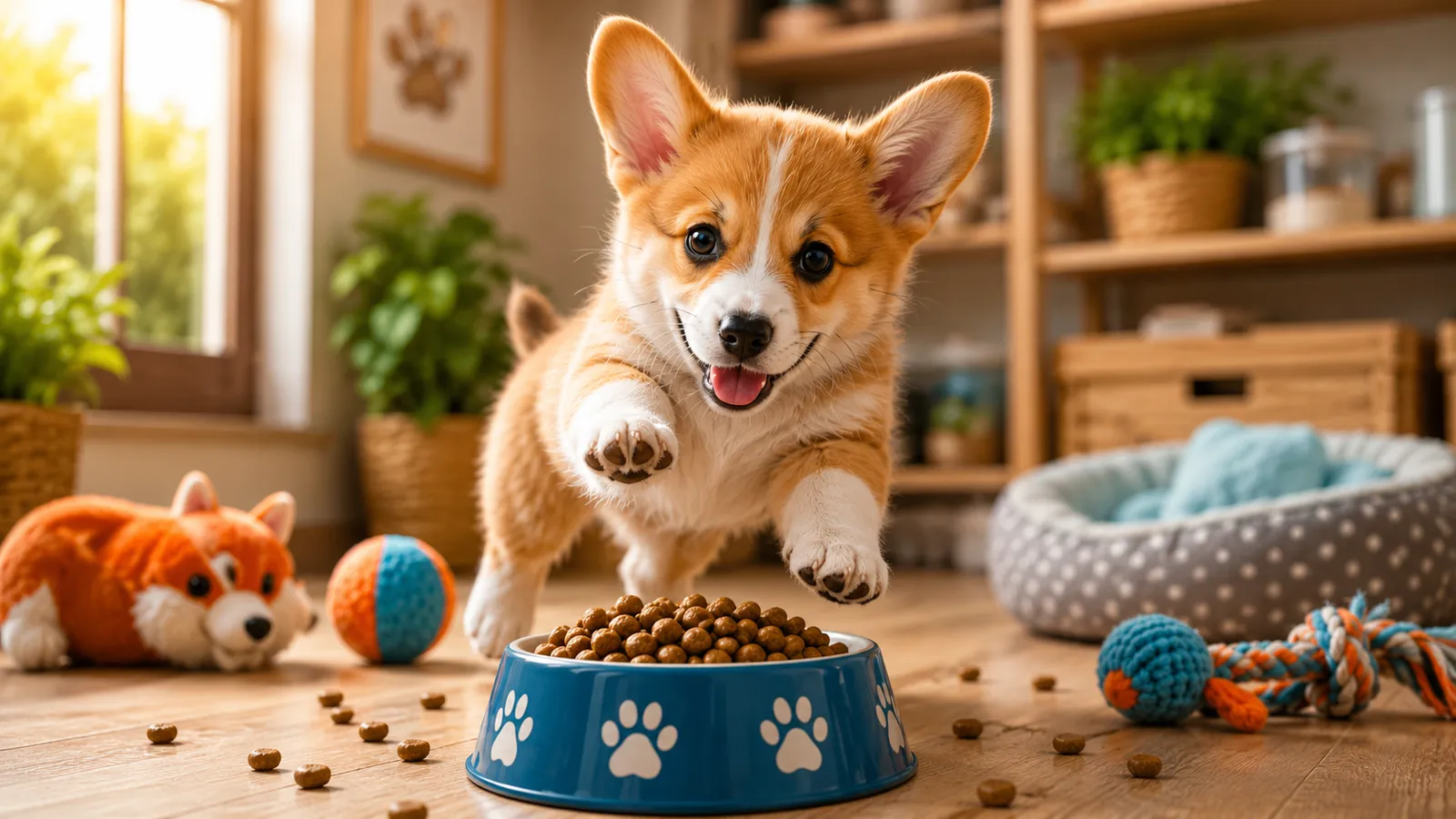
During the first year of life, a puppy grows and develops rapidly, and their nutritional needs change several times. At this stage it is especially important to choose a complete ration, calculate portions correctly, gradually reduce the number of daily meals, and avoid both nutrient deficiencies and excess weight gain.
Why Puppy Nutrition Requires Special Attention
The first year of life is a period of active growth and body formation for a dog.
In a puppy, the following are developing:
- bones and joints;
- muscles;
- internal organs;
- the immune system;
- the nervous system;
- skin and coat.
All these processes require energy, proteins and fats, vitamins and minerals. But it is not enough just to provide the puppy with everything they need. It is just as important to maintain the right balance.
More food does not mean more benefit.
An excessive number of calories will not make a puppy bigger, stronger or healthier than their genetics allow. But it can lead to overly rapid weight gain and create unnecessary stress on the developing musculoskeletal system.
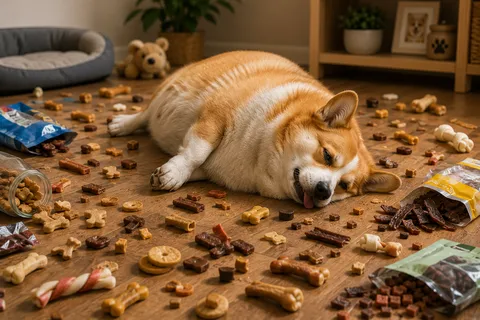
Owners of corgis need to monitor weight especially carefully. Short legs, a long body and an excellent appetite make maintaining a healthy body condition important from the very first months of life.
The First Days in a New Home
Moving to a new home is a major change in a puppy’s life.
They suddenly find themselves without their mother, littermates and familiar smells, and have to get used to new people, a new routine and a new environment. Even a completely healthy puppy can temporarily have changes in appetite and stool due to stress.
That’s why in the first days you shouldn’t change everything at once.
It’s better to keep:
- the usual food;
- the previous number of daily meals;
- approximately the same feeding times;
- the familiar way of serving the food.
The breeder usually gives the owner a supply of food and explains what the puppy has been eating, how many times a day and in what portion size.
Even if you have already chosen another ration in advance, you shouldn’t offer it to the puppy immediately after arrival.
First let the puppy settle in a little. If a change of food is really necessary, switch gradually. A sudden change of ration can cause diarrhea, vomiting, flatulence or refusal to eat.
What Puppy Food Should Be Like
A puppy needs not just a good-quality food, but a complete food formulated for growth.
The label should state that the ration:
- is complete;
- is intended for puppies or for growth;
- is suitable for a dog of the corresponding size;
- meets the needs of a growing body.
Adult-dog food does not always contain enough energy and nutrients for a puppy. The correct balance of calcium, phosphorus and other minerals involved in skeletal development is especially important.
At the same time, you should not independently add calcium, vitamin supplements, bone meal or other “for strong bones” products to a complete food.
An excess of some substances can be just as dangerous as a deficiency.
If a puppy is eating a complete commercial ration and the veterinarian has not made any special recommendations, additional vitamins are usually unnecessary.
How Many Times a Day to Feed a Puppy
A small puppy cannot easily eat their entire daily allowance in one or two sittings. That’s why the daily portion is divided into several meals.
An approximate schedule looks like this:
- at 2–3 months — 4 meals a day;
- at 3–6 months — 3 meals a day;
- after 6 months — 2 meals a day.
This is not a rigid calendar.
Some puppies are more comfortable staying on four meals a day a bit longer, while others easily switch to three meals earlier. The schedule depends on age, the dog’s size, appetite, the family’s routine and individual digestive characteristics.
It’s best to reduce the number of meals gradually. For example, instead of simply removing the midday meal, redistribute it over the remaining feedings over several days.
Adult corgis are usually kept on two meals a day. This makes it easier to control appetite and portions and avoids giving the entire daily allowance at once.
Do You Need Strict Feeding Times
A clear and reasonably stable routine is useful for a puppy.
You don’t have to put the bowl down every morning at exactly 7:03, but feeding times shouldn’t change chaotically from day to day.
A predictable schedule helps:
- regulate digestion;
- organize house training;
- plan walks;
- monitor appetite;
- notice changes in the puppy’s behavior in time.
The bowl is usually left down for a limited time, then removed until the next meal. Gradually the puppy learns that food appears according to a schedule.
However, you shouldn’t turn this principle into an endurance contest or deliberately let the puppy go hungry. If the puppy regularly refuses food, you need to look for the cause, not just keep removing the bowl.
How to Determine Portion Size
The feeding chart on the package is a convenient starting point, but not an exact instruction for every dog.
Manufacturers usually indicate daily allowances based on:
- the puppy’s age;
- current weight;
- expected adult weight.
Different foods have different calorie densities, so the same number of grams of two rations may contain very different amounts of energy.
You need to divide the daily allowance by the number of meals. For example, if a puppy should receive 240 grams of food per day and eats four times, one portion will be about 60 grams.
It’s best to measure food with kitchen scales, not a mug, cup or handful. Even a small daily error can add up over time and lead to noticeable overfeeding.
But the final portion size is determined not only by the number on the package. You also need to consider:
- the puppy’s body condition;
- rate of growth;
- activity level;
- number of treats;
- health status;
- your veterinarian’s recommendations.
Why the Portion May Differ from the Package Recommendation
Two puppies of the same age and breed can need different amounts of food. One moves a lot, plays actively and uses up energy quickly, while the other is calmer and spends much of the day resting. Their metabolism, build and growth rate may differ.
In addition, the guidelines on the package are calculated for an average dog.
If a puppy is steadily gaining excess weight, you cannot keep giving the same portion just because it’s printed on the bag. If the puppy is too thin, you may also need to adjust the allowance.
You need to assess not just the number on the scale, but also the body condition.
What a Puppy in Normal Condition Should Look Like
Owners often think that a healthy puppy should be round, chubby and “with a reserve.” In reality, excess fat does not protect the puppy and does not help proper growth.
A puppy in normal condition:
- has ribs that are easy to feel under a thin layer of fat;
- has a visible waist when viewed from above;
- has a moderately tucked-up abdomen when viewed from the side;
- does not look either bony or shapelessly round.
In a young puppy, proportions can change literally from week to week. They may suddenly shoot up in height, then look rounder again; legs, body and head may grow at different rates, so you should assess not a single photo, but the overall trend.
It’s useful to regularly:
- weigh the puppy;
- record the results;
- photograph them from above and from the side;
- check how easily the ribs can be felt.
Weight alone doesn’t show whether a dog is fat or thin. Two adult corgis of the same weight can have completely different builds and body conditions.
Why Excess Weight Is Especially Dangerous for Corgis
Corgis usually know very well how to convince their owners that they have never been fed in their entire life.
They closely watch food preparation, check other dogs’ bowls, beg for tidbits and quickly figure out which look will get them a refill.

But a good appetite does not mean the dog is underfed.
Excess weight creates additional strain on:
- the spine;
- joints;
- ligaments;
- muscles;
- the cardiovascular system.
For a dog with short legs and a long body, maintaining a normal body weight is especially important.
You shouldn’t wait until a young corgi develops clear obesity. It’s much easier to slightly adjust the ration at the first signs of losing a waist than to later achieve major weight loss.
We discuss the causes of weight gain, how to assess body condition and how to lose weight safely in a separate article: “Why Do Corgis Gain Weight So Easily?”
Treats Are Also Food
During training, a puppy may receive many small pieces of food throughout the day.
Individually they seem insignificant:
- a piece of cheese;
- dried meat;
- a biscuit;
- a treat after a walk;
- a reward for a command;
- a scrap from the table;
- a treat from each family member.
But by the end of the day, all these “little pieces” can add up to a whole extra meal.
You must include treats in the total daily calorie intake. For regular training, it’s convenient to use part of the puppy’s normal daily portion of food.
If you need a more attractive reward, choose very small pieces. For the dog, the fact of getting a reward is more important than the size of each piece.
Treats must not replace a complete ration or disrupt its balance.
Is It Okay to Give a Puppy Food from the Table
The habit of sharing your food with a dog often starts with a single “harmless” tidbit.
But human food may be:
- too fatty;
- salty;
- spicy;
- high in calories;
- unsuitable in composition;
- dangerous or toxic for dogs.
In addition, a puppy quickly learns to beg at the table and monitor every family mealtime.
If you want to give the dog an allowed food item, it’s better to do it separately and count it into the daily ration, rather than feeding the puppy directly from your plate.
What to Do If Your Puppy Eats Poorly
Skipping one meal doesn’t always mean the puppy is ill.
Appetite can be affected by:
- moving house;
- hot weather;
- fatigue;
- overexcitement;
- teething;
- a large number of treats;
- an unfamiliar routine;
- a sudden change of food.
First, assess the puppy’s general condition: are they active? Drinking water? Playing? Is there any vomiting, diarrhea, pain, abdominal bloating or marked weakness?
You shouldn’t immediately offer ten different foods, add cheese, pâté and meat to the bowl or constantly switch foods. That’s an easy way to teach a dog to refuse normal food while waiting for something tastier.
But young puppies are more sensitive than adult dogs to prolonged fasting and dehydration, so refusal of several meals in a row, especially combined with lethargy, vomiting, diarrhea or other symptoms, requires a vet visit.
What to Do If Your Puppy Is Always Asking for Food
Some dogs are always ready to eat. This is especially familiar to corgi owners.
Constant interest in food does not in itself prove that the portion is too small. You need to evaluate the ration based on the puppy’s condition, weight trends and body condition, not on how convincingly they stare at the fridge.
Sometimes the feeling of constant hunger is worsened by:
- very long intervals between meals;
- the habit of getting food on demand;
- boredom;
- lack of physical and mental stimulation;
- very fast eating.
You can give part of the food in puzzle toys, snuffle mats or use it during training. This doesn’t increase the daily portion, but makes feeding longer and more engaging.
A sudden increase in appetite combined with weight loss, diarrhea, vomiting, increased thirst or other changes is a reason to consult a veterinarian.
Can You Rotate Flavors Within the Same Food Line
A healthy dog doesn’t need constant flavor changes just for the sake of “variety.” If the ration is complete, suits the puppy and is well tolerated, they can stay on the same food for a long time.
Constantly rotating products can sometimes make it harder to assess the dog’s response and may encourage pickiness.
Switching between different formulas, even within one brand, is best done gradually, especially if they differ in protein sources, fat content or calorie density.
Do Puppies Need Their Dry Food Soaked
Dry food can be given either dry or soaked — depending on the puppy’s age, habits and individual needs.
Soaking can be helpful:
- at the start of weaning onto solid food;
- for very young puppies;
- when gums are sore during teething;
- if the puppy struggles to crunch the kibble;
- on your veterinarian’s recommendation.
If the puppy eats dry kibble well and drinks enough water, there is usually no need to soak the food.
A soaked portion should not be left out at room temperature for long. Any leftovers should be removed after feeding, because warm, moist food spoils faster than dry kibble.
We’ll discuss this question in more detail in a separate article: “Do You Need to Soak Dry Food?”
Water Must Always Be Available
A puppy must have constant access to clean, fresh water.
You should not restrict water to make them ask to go out less often: this does not help proper house training and can be dangerous, especially in hot weather.
Water must be changed regularly, and the bowl washed. In hot weather, after games, walks and when eating dry food, water requirements may increase.
A sudden change in the amount of water drunk — either up or down — should be discussed with your veterinarian.
How to Use Food During Training
Food is one of the most convenient tools for raising a puppy.
You can use part of the daily allowance:
- to reward attention and contact with the owner;
- when teaching commands;
- during crate training;
- for calm behavior;
- on walks;
- in nosework and enrichment games.
It’s important to set aside the training portion in advance, rather than giving it in addition to a full bowl.
There is no need for every meal to look the same. One part of the food the puppy can eat from a bowl, another part can be used during a training session, and a third can be hidden in a snuffle mat. The main thing is that the total amount of food per day remains under control.
When to Switch a Puppy to Adult Food
The switch to an adult ration depends not only on the date of birth, but also on the dog’s size, breed and rate of maturity.
Small and medium-sized dogs usually reach skeletal maturity earlier than large and giant breeds. So the universal rule “everyone switches exactly at one year old” is not always appropriate.
Corgis are most often switched to an adult ration at about 10–12 months of age, but the exact timing depends on the individual dog, their development, body condition and the chosen food.
You shouldn’t move to adult food too early just because the puppy already looks almost adult. Visible growth may slow down before the body has fully finished developing.
On the other hand, there is no need to keep feeding a fully grown dog a high-calorie puppy ration if their growth period is over and they’ve started gaining excess weight.
If in doubt, it’s best to discuss timing with your vet or with the breeder, who knows how dogs in this line develop.
The transition itself should be gradual. A detailed scheme is described in the article “How to Safely Switch a Dog to a New Food”.
How Nutrition Changes After Spay or Neuter Surgery
After spaying or neutering, a dog’s energy needs may change, while appetite often stays the same or even increases.
This does not mean that a puppy must immediately be switched to a food for sterilized adult dogs.
If the surgery is done before growth is complete, the ration still needs to meet the requirements of a growing body. Sometimes it’s enough to adjust the portion of the usual puppy food, and sometimes your vet may recommend a different approach.
After surgery it’s especially important to monitor:
- weight;
- waistline;
- number of treats;
- activity level;
- growth dynamics.
The decision must take into account both the puppy’s age and the change in their energy needs.
How We Feed Puppies in Our Kennel
By the time they move to a new home, our puppies are already used to eating on their own and are getting a complete food appropriate for their age.
We give new owners information on:
- which exact food the puppy is eating;
- what their daily portion is;
- how many times a day they eat;
- whether the kibble needs to be soaked;
- which treats they already know;
- how to switch to a different ration if necessary.
We recommend keeping the usual diet at least for the first few days. Moving, a new family and a new routine are already a major stress, so there is no need to add a sudden food change on top unless it’s really necessary.
At the same time, our recommendations are not a lifelong instruction.
The puppy grows, and their weight, activity level, appetite and needs change. The owner’s task is to watch the dog and gradually adjust the amount of food, rather than automatically pouring out the same portion for months.
This is especially important for corgis: a puppy can very convincingly ask for seconds even when they are already getting more than enough food.
When You Need to See a Veterinarian
You need to consult a vet if your puppy has:
- repeated vomiting;
- frequent or prolonged diarrhea;
- blood in stool or vomit;
- marked lethargy;
- abdominal pain or bloating;
- refusal of food and water;
- poor weight gain;
- sudden weight loss;
- constant, unrelenting hunger;
- a sharp increase in thirst;
- difficulty chewing or swallowing food;
- itching, skin inflammation or recurring ear problems;
- any other noticeable changes after introducing a new ration.
Not every digestive upset is related to food. The cause may be parasites, infections, swallowed objects, poisoning or other diseases. So you shouldn’t endlessly change foods without finding out what’s actually causing the symptoms.
Key Points About Feeding a Puppy
- Choose a complete food formulated for growth.
- Keep the puppy’s usual ration for the first days at home.
- Divide the daily allowance into several meals according to age.
- Weigh the food with kitchen scales.
- Count all treats and tidbits given during the day.
- Monitor not just weight, but body condition.
- Don’t add vitamins and calcium without a medical reason.
- Don’t overfeed a puppy in pursuit of rapid growth.
- Ensure constant access to fresh water.
- Switch to adult food after the main growth phase is over, not just by the calendar.
- For ongoing problems with appetite, weight or digestion, see your veterinarian.
Feeding a puppy requires attention throughout the entire growth period. As the puppy matures, their energy and nutrient needs change, and with them the ration and portion size. Watch their condition, regularly assess weight and body condition, take their lifestyle into account — and don’t let a corgi’s pleading eyes make feeding decisions for you.