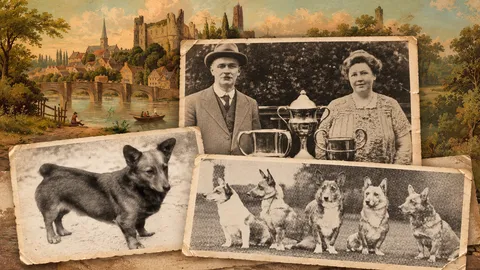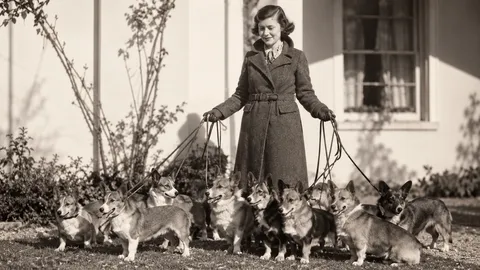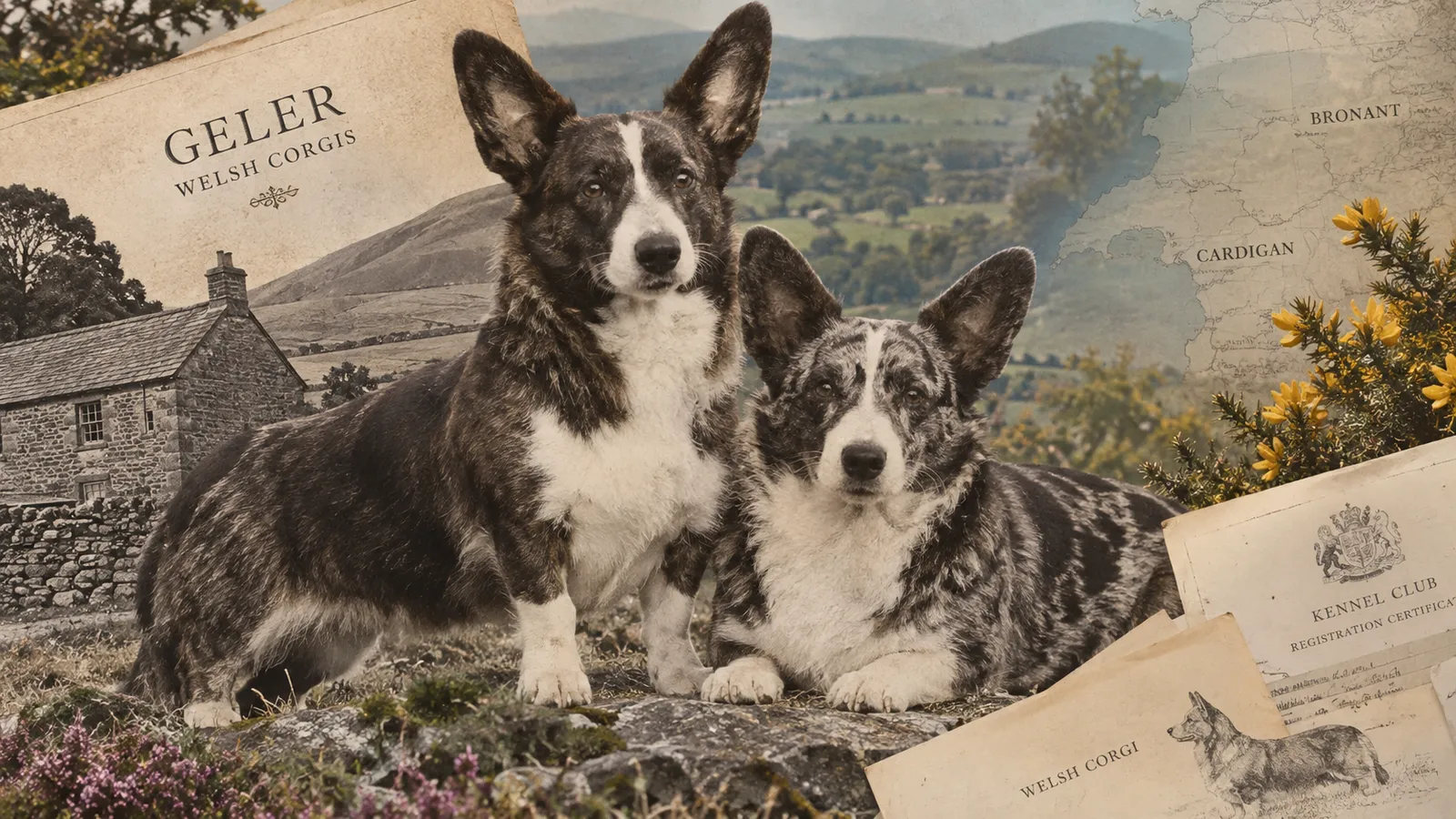
Конечно. Сохраняю структуру, Markdown, подписи к фото и внутренние ссылки.
# Geler: From the Corgis of Bronant to the Modern Cardigan
In 1935, a dog that was difficult to overlook entered the Cardigan Welsh Corgi ring at Crufts.
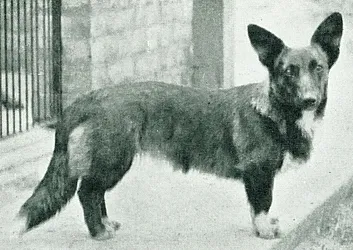
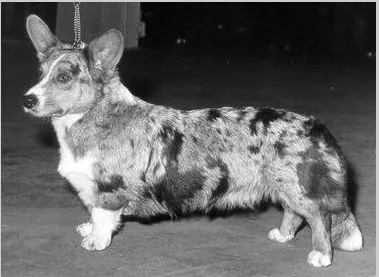
Low-set and long-bodied, with large erect ears and an unusual blue merle coat — Ch. Geler Caressa. She was one of the early Cardigans bred by Geler, the kennel founded by Daisy Wylie (D. F. Wylie), and behind her pedigree lay a story far older than the show breed itself.
But to understand where Caressa came from and why the dogs of Geler came to occupy such a special place in Cardigan history, we need to leave the show rings of the 1930s behind and travel to the Welsh hills — to a place where small working corgis existed long before breed standards, championship titles, or even the separation of the corgi into two breeds.
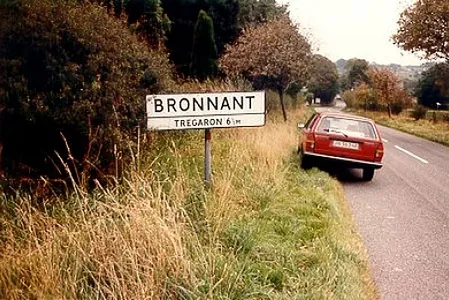
Welcome to Bronant.
Before the Cardigan Became a Breed
Bronant — a small village in the heart of the hills of historic Cardiganshire, now Ceredigion — appears to have been the only place in Wales where, until around 1870, no breed of dog other than the corgi was found. Old canine literature tells us that it was around Bronant that the old local type of corgi survived for the longest time.
This story has come down to us primarily through the research of W. Lloyd-Thomas and canine writer Clifford L. B. Hubbard, so some of its details should be regarded as a historical reconstruction of its time rather than a modern, genetically proven account of the breed's origins.
According to their descriptions, until roughly the 1870s Bronant remained a fairly isolated place where corgis were rarely crossed with other types of dog. These dogs were sometimes referred to simply as Bronant Corgis.
But they were valued, of course, neither for their ancient origins nor for a particular appearance. They were working dogs first and foremost, and their characteristics had developed around a very specific job.
To understand where the old Cardigan type — which breeders would later try so hard to preserve — came from, we need to imagine how life on Welsh farms was organised at the time. Until about 1875, the hills around Bronant consisted largely of common land, scattered with small holdings comprising only a few acres of enclosed ground. The owners of these holdings had equal rights to graze their livestock on the surrounding commons. Formally, the grazing land belonged to everyone, but over time individual families naturally came to regard certain areas as "theirs" — and livestock from neighbouring farms that wandered onto them as intruders.
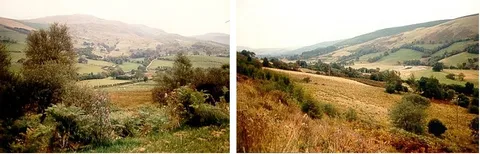
If someone else's cattle strayed where they were not supposed to be, a dog was needed that could quickly drive them back.
The small, low-set corgi was exceptionally well suited to this work. He could get close to the legs of a large animal, nip at its heels and, thanks to his short stature, evade a kick. The method by which these dogs were sent after trespassing herds was both simple and remarkably effective. At the first sign that a neighbour's cattle were about to invade his territory, the farmer would call his dog and take up a position, usually somewhere near his gate. There was no need to go any closer: the corgi could be relied upon to work effectively at a distance of a mile or more from his owner.
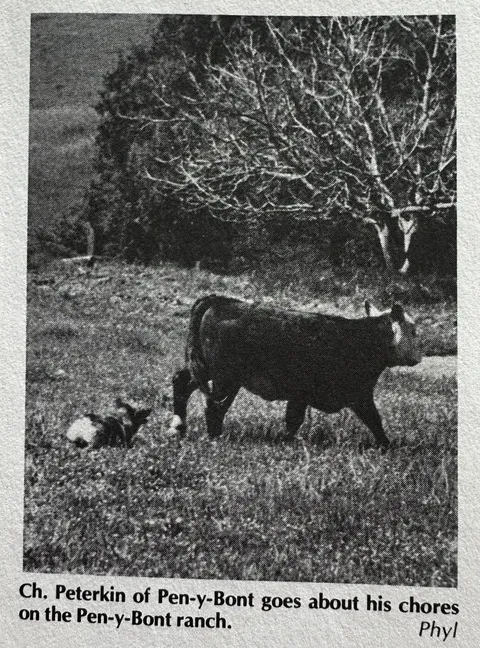
From where he stood, the farmer could already see the stray cattle, while the low-set corgi, because of the gently rolling terrain, often could not. The farmer would then direct the dog by whistle, quietly repeating two alternating notes — one high and one low. At the signal, the corgi would race off at a gallop in the indicated direction.
Lloyd-Thomas and Hubbard describe the corgi at work in wonderfully vivid terms. Picking up his owner's whistle with his extraordinarily sensitive ears, the dog would continue straight along the indicated course until the trespassing animals came into view. For a second he would stop and crouch, as though gathering himself for the attack, and then, with a grim ferocity almost unbelievable in a "creature otherwise so gentle and good-natured," he would go for the cattle's heels. Despite flying hooves and threatening lowered horns, the corgi attacked again and again, springing aside for only an instant to avoid a kick or a horn before immediately returning to the cattle's heels.
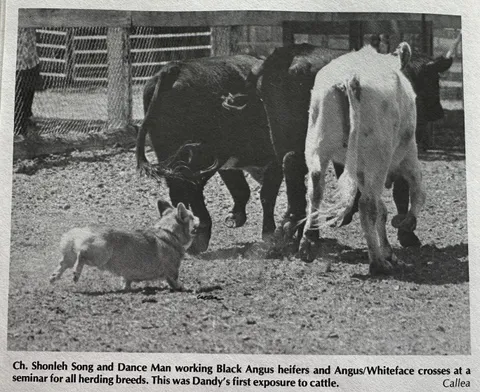
The nimble footwork, supple body and perfect timing reminded the writers of a highly trained lightweight boxer. "One holds one's breath watching a Corgi at work," Lloyd-Thomas and Hubbard wrote. "It seems that the dog must long since have been trampled and killed, but no — and the strange cattle are already stampeding from the pasture, frantic, bucking and kicking, while behind them, despite his short legs, keeping pace with ease, races a tiny golden speck, still dodging, still nipping at the cattle's heels.
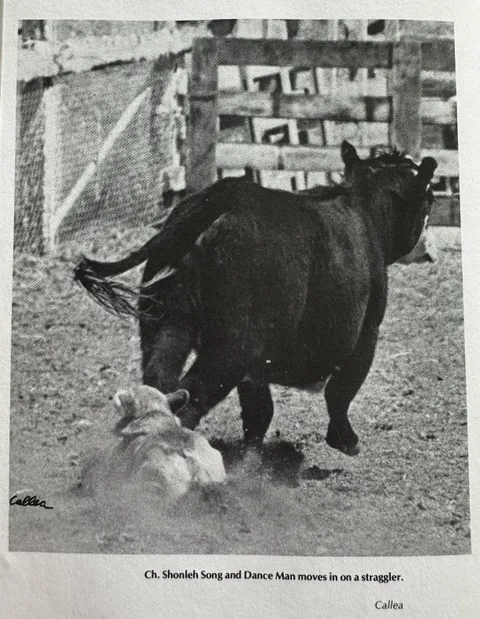
"At this moment the watching farmer slowly raises his fingers to his lips. A piercing, prolonged whistle cuts through the air. The speeding golden speck slows, hesitates, stops, turns, and a moment later races back like a speedboat through the tall, coarse upland grass."
In other words, the corgi was part of everyday farm life and a thoroughly practical working tool. His value was determined not by his appearance but by how well he handled livestock — work that directly affected the livelihood of the family.
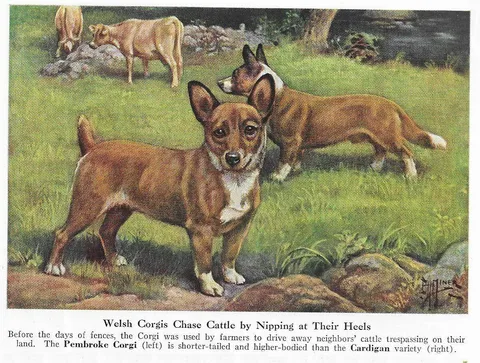
But rural life was changing. From around 1870–1875, common land was increasingly divided and enclosed, and with it the work of the herding dog changed as well. Previously, the corgi's main task had been to drive other people's cattle off the land and make them go as far away as possible. With clearly defined boundaries and fences, it became far more important to gather one's own animals into a herd and move them from one pasture to another.
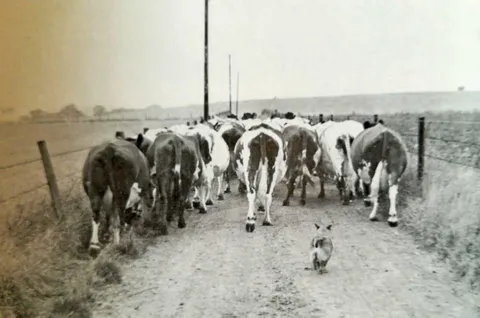
Other types of herding dog, better able to gather and direct livestock, were more suitable for this work. The old specialisation of the Bronant Corgi became less and less useful — and the type of dog shaped by that work gradually began to disappear with it. The remaining Bronant Corgis were crossed, among others, with the so-called Brindle Herder — a taller, lighter dog with erect ears. According to Lloyd-Thomas, the resulting dogs retained the long, low body and character of the old corgi, but became lighter and more elegant, with erect ears and a more refined head.
And here we begin to recognise the Cardigan...
At the same time, old Cardigans from different parts of Wales apparently did not all look alike. A historical overview published by the CWCCA quotes Thelma Gray's recollections: according to her, dogs around Bronant were predominantly brindle, while the Carmarthen area was particularly associated with blue merles.
The origin of blue merle was already a subject of debate. In the 1930s, there was a theory that the colour might have entered the Cardigan through crosses with the Welsh Sheepdog. Gray disagreed, pointing out that references to blue merle Cardigans in Wales existed long before these supposed crosses.
For the story of Geler, this detail is particularly interesting. The kennel, closely associated with the preservation of the old Bronant dogs, would later become famous for its own blue merles — Caressa, Coynant and Cledwyn. But before they appear, there is one more dog we need to meet: Mon.
The Last Corgi of Bronant
By the beginning of the twentieth century, the old Bronant Corgi was on the verge of disappearing. Lloyd-Thomas and Hubbard described a male named Mon, owned by David Jones, as the last representative of the "pure" type.
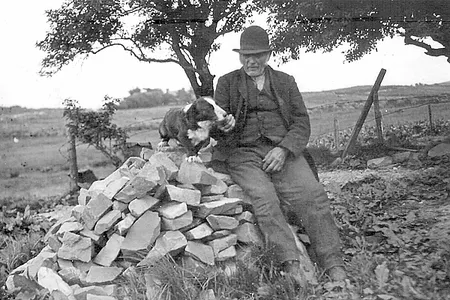
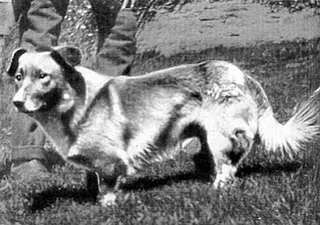
Mon died in early 1929 — according to historical accounts, after being struck by a vehicle — but not before leaving descendants.
He was bred to a bitch descended from a cross between a corgi and a Brindle Herder. One of his daughters was Fancy, owned by Daisy Wylie — a woman who would soon play a significant role in Cardigan history.
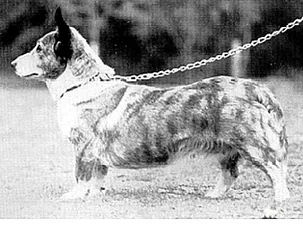
In the late 1920s, Wylie began breeding these dogs under the Geler prefix, and her kennel soon became one of the most prominent among the early breeders of Cardigan Welsh Corgis.
At first glance, a beautifully simple pedigree suggests itself: Mon → Fancy → the Geler dogs. Yet we have been unable to find evidence that Fancy was actually used by Wylie for breeding or became one of the foundation animals of her kennel.
The connection between the Geler dogs and Mon, however, can be traced through other documented pedigrees, to which we will return — and there Mon appears not once or twice, but repeatedly.
Daisy Wylie: Much More Than a Dog Breeder
Surprisingly little biographical information about Daisy Wylie has survived. The Geler kennel and its famous dogs are well known in Cardigan history, but we know far less about Daisy Wylie's own life.
Yet even the few scattered sources that remain gradually reveal a remarkably vivid portrait.
Local Welsh recollections preserve the story of her marriage to William Lewes of Llysnewydd. The groom's father was reportedly looking for a suitable — and, importantly, wealthy — bride for his son, and Daisy Wylie was a rich heiress. The marriage of William and Daisy, however, proved unhappy and ended in divorce several years later, something far less commonplace in the early decades of the twentieth century than it is today.
The same source describes her as generous and kind to her friends and deeply interested in horses. She rode extensively, competed in show jumping and followed horse racing. After separating from her husband, Wylie left Llysnewydd, spent some time at an estate called Werville Brook, and later moved to Shropshire. Her main home there became Reabrook, near Minsterley, where she farmed. At the same time, Wylie retained her Welsh home, Blas Geler, and continued to visit it.
The name of Wylie's Welsh home — Blas Geler — immediately attracts attention: she used the same word as her kennel prefix. It seems quite possible that the name Geler came from the house, although we have found no direct statement from Wylie herself explaining the origin of the kennel name.
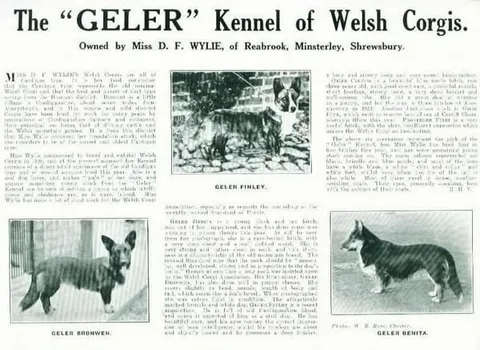
Reabrook was more than Wylie's country residence: surviving records show that she was actively engaged in farming. Material on the history of British women farmers includes an entry dated 8 June 1936:
Miss Wylie — Reabrook, Minsterley, Shropshire — Dairy and Sheep.
Her farm, then, was involved in dairy cattle and sheep. This adds an important detail to her portrait: she was not simply a wealthy horsewoman and exhibitor of pedigree dogs, but a woman directly involved with agricultural livestock.
Against this background, her interest in the old working Cardigan seems far from accidental: Wylie knew the farming world for which dogs like these had originally been shaped.
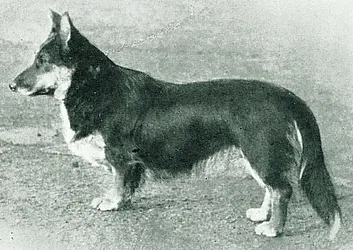
Geler and the Attempt to Preserve the Old Bronant Type
In the late 1920s, Wylie began breeding and showing Cardigans. By 1933, her kennel was already a significant presence in the breed, and Wylie herself was involved in the development of the Cardigan and its standard.
But she was not the only person trying to preserve dogs of old Welsh origin.
Historical accounts name a whole group of owners and breeders involved in preserving the old Bronant type: Morgan Morgan, R. W. Jones, G. E. Owens, Thomas Griffiths, Dr. J. T. Lloyd of Tregaron, David Jones, the owner of Mon, and others. Daisy Wylie continued this work, bringing together some of the remaining stock and breeding these dogs under the Geler prefix.
Geler became one of the most prominent kennels working with this old Welsh type.
Hubbard later wrote that the Geler dogs came extraordinarily close to the rare old Cardiganshire Corgi type that he had attempted to reconstruct from historical evidence.
The pedigrees of the early Cardigans clearly show just how small the breed's original breeding population was. The same dogs appear again and again in different branches: Bob Llwyd, Cassie, Mon, Bellorophon, Fronfelen Tiny, Tanffynon Tango and others.
But these pedigrees contain another detail that may seem surprising today: among the ancestors of early Cardigans are dogs identified as... Pembrokes.
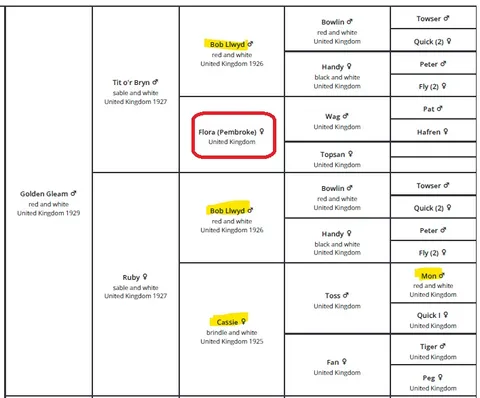
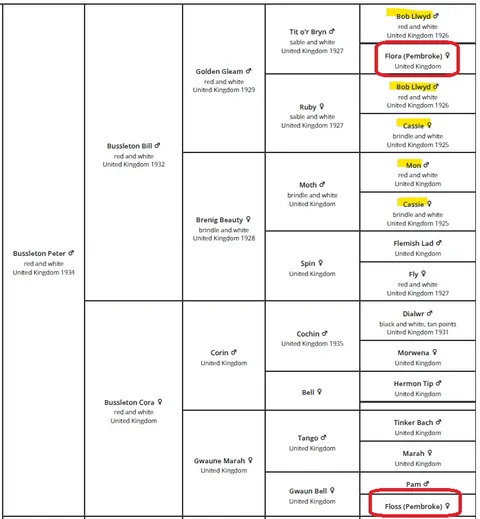
This is not a mistake.
Until the breeds were finally separated in 1934, the Cardigan and Pembroke officially existed as varieties of the Welsh Corgi, and crosses between them did occur. After the separation, owners had to decide to which of the two breeds their dogs would be assigned, which is why historical Cardigan pedigrees sometimes contain ancestors explicitly identified as Pembrokes.
The story of Geler unfolded during this very period of transition.
The Blue Merle Stars of Geler
On 30 August 1930, two puppies were born at Geler who would become some of the best-known early blue merle Cardigans:
Geler Caressa and her brother Geler Coynant.
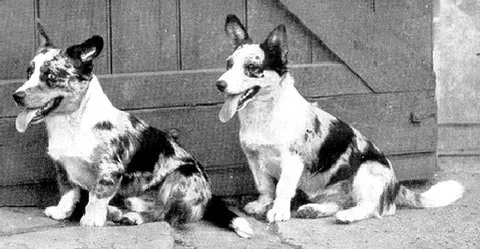
Their sire was Y Brython, and their dam Geler Nell.
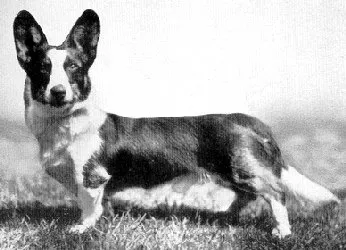
Historical accounts describe Caressa and Coynant as two outstanding blue merle Cardigans of their time. Caressa in particular became a notable show dog. In 1935, at the first Crufts following the official separation of Cardigans and Pembrokes into two distinct breeds, she was named Best of Breed. Her fame later extended far beyond Britain: a photograph of Caressa was used in the American Complete Dog Book of 1943 as an image representing the Cardigan Welsh Corgi.
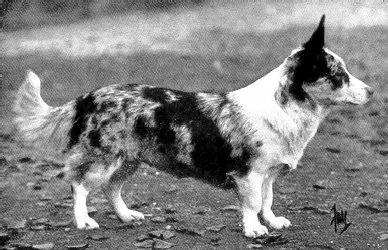
Coynant left a different mark on the history of Geler. Bred to a bitch named Bit, he sired the blue merle Geler Cledwyn, who continued the line's success in the show ring. In the 1936 Crufts catalogue, he was described as the winner of many first prizes and four Reserve Challenge Certificates; at Crufts itself that year, he once again won the Reserve CC.
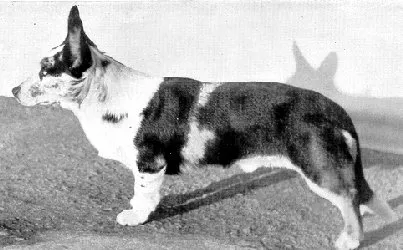
By the mid-1930s, then, several blue merle Geler dogs were well known in British show rings. Looking back on the history of the colour, Thelma Gray later named Ch. Geler Caressa and Ch. Geler Cledwyn as the last notable blue merles seen in British show rings before such dogs virtually disappeared after the war.
And the pedigree of Caressa and Coynant takes us back to the very beginning of this story — to Mon. Through their paternal line, their ancestry can be traced as follows: Mon → Toss → Cassie → Y Brython → Geler Caressa and Geler Coynant.
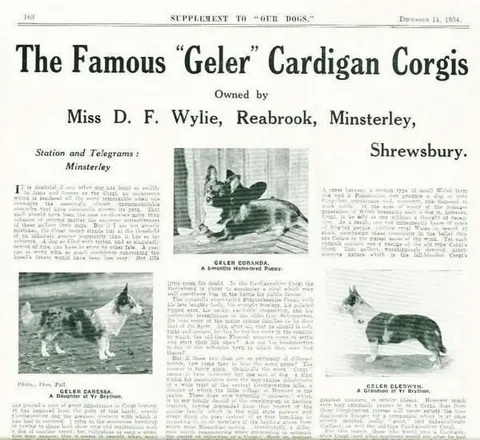
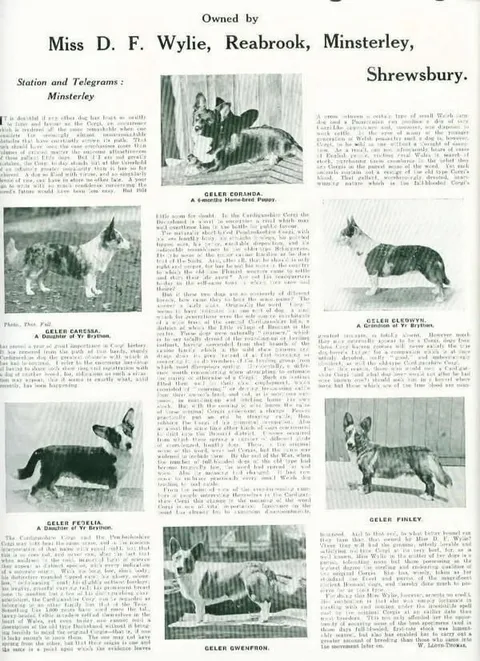
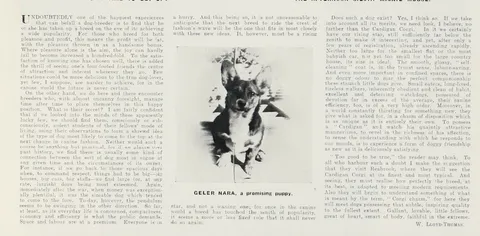
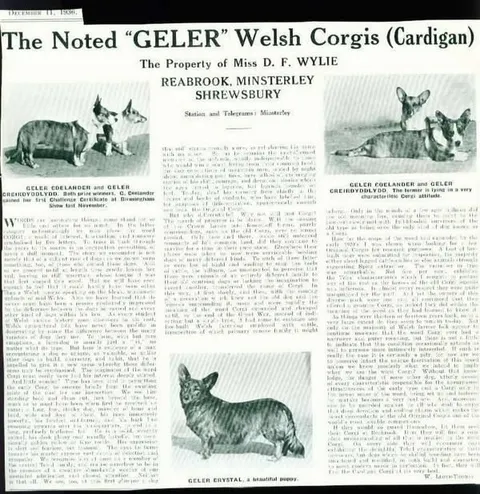
In December 1937, Our Dogs devoted a large illustrated feature to the Geler kennel. In his article, W. Lloyd-Thomas focused less on the Cardigan's past than on its future. Under the heading “The Dog That Fits the Times,” he explained why the compact, undemanding and devoted Cardigan was ideally suited to modern life. Alongside the show dogs, the photographs featured Corgis making themselves comfortable in bed, a sleeping Mickey Mouse and a whole group of puppies. The old herding Corgi of Bronant was gradually becoming a household companion — and the Geler kennel was at the very heart of this transformation.
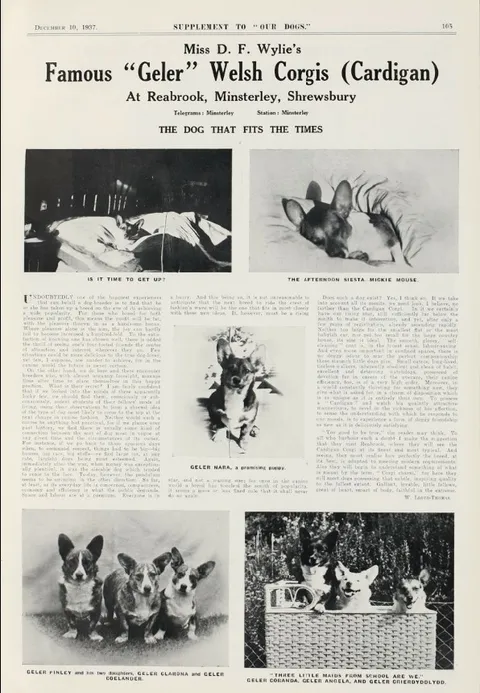
Only a few generations separated the old corgi of Bronant from the famous show dogs of Geler.
How Blue Merle Returned to British Show Rings
After the war, blue merle Cardigans became so rare in Britain that the colour itself was in danger of disappearing. British breeder Sandra Tonkyn Applegate of Beckrow later wrote that merle had virtually vanished.
The pre-war Geler line that had produced dogs such as Caressa and Cledwyn had already been lost by this point, making it impossible to continue it.
The breeder who set out to bring blue merle back was Thelma Gray of the Rozavel kennel, whom we have already met in the history of the Pembroke. But she could not begin with descendants of the famous Geler merles; instead, she effectively had to find another route.
That route appeared in the form of a red Cardigan named Minor from the Taxicar kennel. He had a blue eye — a feature that led Thelma Gray to suspect that behind this apparently non-merle dog there might be a merle factor. Minor was bred to a tricolour bitch, and among the puppies was a blue merle male named Samswn Bach.
He was not an ideal representative of the breed. Gray later described him as somewhat high on leg, with small pointed ears, although she also noted his good head and excellent coat. More importantly, Samswn Bach provided an opportunity to work once again with a colour that had by then virtually disappeared from British breeding. He became the first blue merle to appear in British show rings after Ch. Geler Caressa and Ch. Geler Cledwyn.
The work that followed took more than one generation. After several attempts, one of Gray's bitches, Rozavel Brithwyn, finally produced two well-marked blue merle puppies, a dog and a bitch. The bitch died soon afterwards, while the male received the wonderfully expressive name Rozavel Blue At Last. The name did not mean, of course, that he was the first blue merle Gray had encountered — his own sire, Samswn Bach, was already one. For Gray, Blue At Last was the first successful result of her own programme to restore blue merle Cardigans.
A new British line of blue merle Cardigans developed from this work. Sandra Tonkyn Applegate later wrote that virtually all English blue merles of her time had Rozavel dogs in their pedigrees.
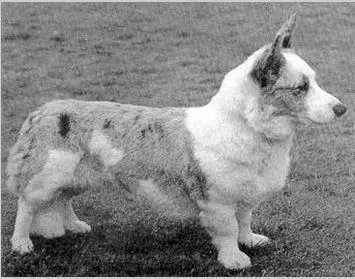
As far as the surviving pedigrees allow us to determine, the blue merle Geler line that produced Caressa, Coynant and Cledwyn eventually died out. Gray effectively revived the blue merle colour in the British population and established it through a different branch of the breed.
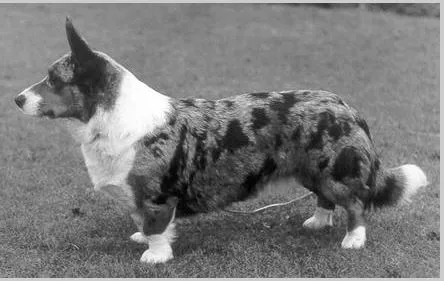
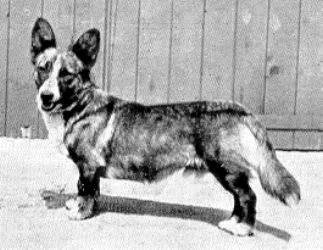
And then the story comes full circle in an intriguing way. While the blue merle line of Geler was disappearing, another branch of the kennel survived through Geler Finley → Geler Garrath → Nic → Moira → Shemin. Several generations later, descendants of this branch once again appeared in the same pedigrees as the new Rozavel blue merle line.
So the Geler blue merle line did not survive, but Geler itself did — through other dogs, without the famous colour with which the kennel's name had become so closely associated.
Why Were the Geler Lines So Difficult to Preserve?
Despite Geler's success in the show ring, there was one aspect of the kennel's history that later puzzled breeders considerably: Wylie's dogs were famous and highly regarded, yet according to the recollections of later breeders, gaining access to them for breeding was far from easy.
Sandra Tonkyn Applegate of Beckrow, writing about the history of blue merle Cardigans, stated that Wylie did not sell her dogs and did not allow her males to be used for breeding. Applegate believed that this was why the old Geler blue merle line disappeared after the war.
Yet when the surviving pedigrees are examined more closely, the picture becomes less straightforward.
Geler Finley was used for breeding outside Wylie's kennel: his mating with Groten Ddu produced Geler Garrath, and Thomas Griffiths was listed as the breeder of the litter, while Garrath later became Wylie's own dog. Garrath, in turn, also produced offspring, and through Nic, Moira and Shemin, this branch spread into other British lines. One of Shemin's descendants would later reach the United States.
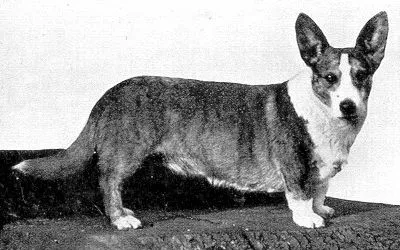
It would therefore not be quite accurate to say that Geler simply disappeared. The kennel itself ceased to exist, and its name stopped appearing in new generations of dogs, but descendants of Geler continued to enter other breeding lines — until the kennel's trail gradually became harder to see within the history of the breed.
The Legacy of Geler
Dogs carrying the Geler prefix continued to be registered until the war; some were registered during the war years themselves, and breeding resumed after it ended. The final registrations of puppies from the Geler kennel date to around the end of the 1950s, after which the kennel name gradually disappears from the stud books.
But by then it was much more difficult for the Geler dogs themselves to disappear from the breed.
Over the course of a few decades, the Cardigan had undergone an enormous transformation. From a local Welsh working dog, it had become an officially recognised breed with its own standard, show champions and kennels not only in Britain but across the Atlantic. And pedigrees travelled with the breed: descendants of the old Welsh dogs entered new kennels, were used again and again for breeding, while the names of their original ancestors receded ever deeper into the generations.
The same happened with Geler. The famous blue merle line that produced Caressa, Coynant and Cledwyn came to an end, but other branches continued. We were able to trace one of them from Geler Finley through Geler Garrath, Nic, Moira and Shemin to Pantyblaidd Liew-Or-Bryn, who crossed the Atlantic in 1956 and arrived in the United States. Other descendants of the same branch spread through British kennels, and the Geler prefix quite quickly ceased to reveal their ancestry.
Perhaps this is why the influence of old kennels can be so easy to underestimate. After a few generations their names disappear from registered names; after a few more, familiar dogs lie far back in the pedigree. But that does not mean that the line itself has disappeared.
The story of Geler began at a time when dogs descended directly from the old corgis of Bronant could still be found. Only a few generations separated Mon, described as the last representative of the old type, from the famous Geler Caressa; another quarter of a century later, a descendant of another Geler branch was already entering the show ring in America.
Daisy Wylie was only one of several people whose work allowed the old Welsh lines to become part of the developing breed. Not everything created at her kennel survived: the story of the blue merle Geler dogs came to an end, and some details of her breeding work remain unclear nearly a century later. But other lines outlived both the kennel itself and its famous prefix.
The Geler kennel disappeared, but its legacy remained in Cardigan pedigrees.
================================================