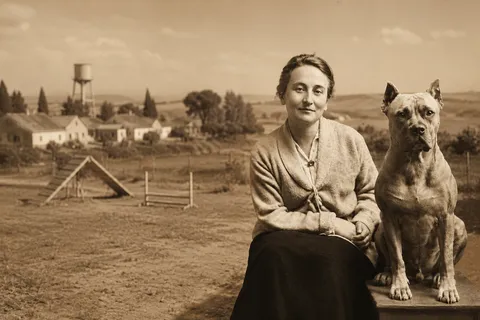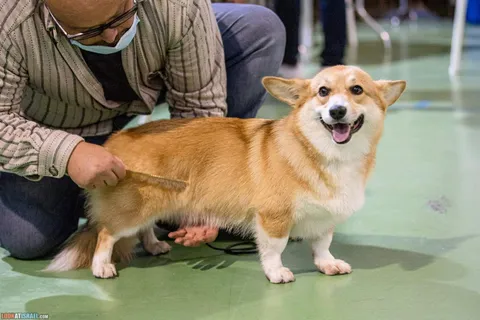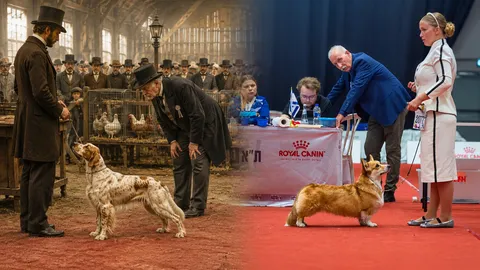
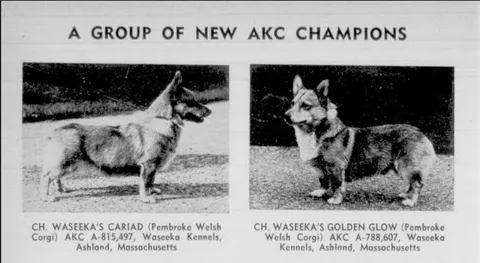
Today, anyone familiar with both breeds would find it fairly difficult to confuse the Pembroke Welsh Corgi with the Cardigan Welsh Corgi. The Cardigan is larger and heavier, with a long tail, large rounded ears, a somewhat different body shape, and a characteristic front assembly. The Pembroke looks more compact and lighter, and for decades its image was so closely associated with a short tail that, for many people, the absence of a tail still remains the defining feature of a “real corgi.”
Which makes it all the more surprising to learn that just a hundred years ago these dogs entered the same show ring, competed for the same titles, and were officially regarded as a single breed — the Welsh Corgi.
What is more, they were sometimes bred to each other.
And when the British Kennel Club finally decided that it was time to put things in order and separate the Welsh Corgi into Pembrokes and Cardigans, it turned out that drawing the line between them was considerably more difficult than it might seem today.
Were they one breed — or not quite?
The popular version of corgi history is often told very simply: once there was a single Welsh Corgi, and in 1934 it was divided into two breeds — the Pembroke and the Cardigan.
Historically, however, what happened was almost the reverse.
Different parts of Wales had long been home to somewhat different types of small, short-legged herding dogs. In Cardiganshire, the dogs tended to be longer and heavier, with long tails; in Pembrokeshire there was a somewhat different type, among which naturally short-tailed dogs occurred.
How ancient this division was, and exactly what dogs each type descended from, is much harder to establish. Breed histories are fond of stories about Celtic dogs, Dachshund ancestors, Flemish weavers, and spitz-type dogs brought by Vikings. Some of these theories have been repeated for decades, but reliable medieval stud books do not, of course, exist, so beautiful legends are best left as legends.
By the beginning of the twentieth century, however, the existence of different regional corgi types can already be traced through dog shows, breeders’ recollections, photographs, and the earliest breeding records.
And when the British Kennel Club officially recognized the Welsh Corgi in 1925, it did not create two breeds. Quite the opposite: it brought the existing types together under a single name.
It soon became clear that this had not been the best idea.
1925: Welcome to one breed
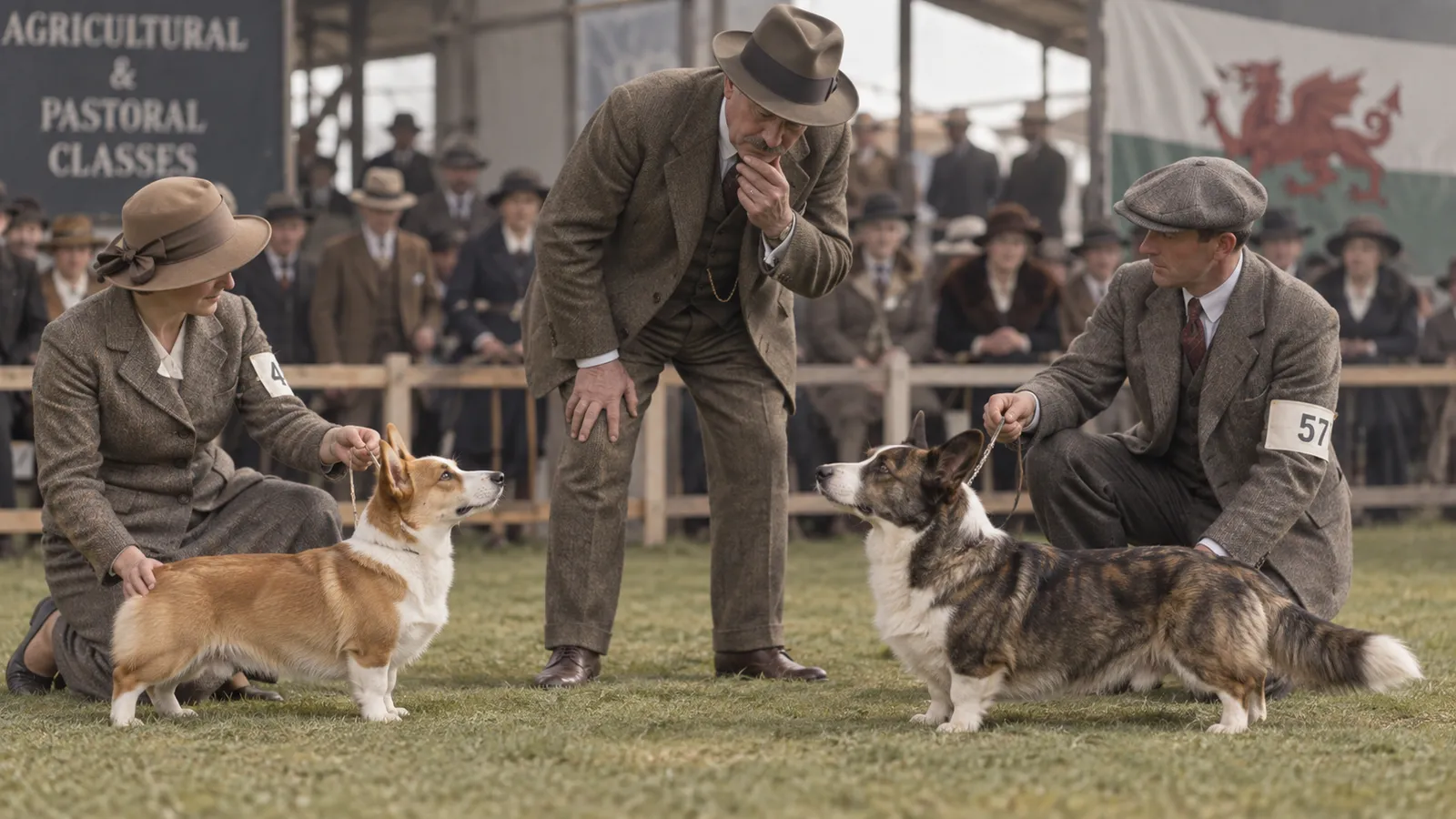
One of the important shows that year was the Royal Welsh Agricultural Show in Carmarthen on 5 August 1925. There was not yet a fully established Welsh Corgi breed category in the show classification, so the dogs were exhibited under Any Other Variety not classified.
And representatives of both future breed types were already among the winners: Buller and Ted, both of Pembroke type, placed first and second in the dog class, while Bellorophon, a Cardigan, won the bitch class.
At smaller rural shows, the terminology was even more flexible. Some organizers used Corgwn, the correct Welsh plural of corgi; others continued to use the old term Cur, while at the Lampeter agricultural society show in 1926 the classes were called Sodlwr, a Welsh word for a dog that worked at the heels of livestock. In other words, even agreeing on what to call these dogs took the canine world a little time.
Another problem was that most early corgis did not come with neat pedigrees extending back several generations. Many belonged to Welsh farmers who bred working dogs rather than future show champions.
Breed historians describe a rather charming picture of early dog breeding: instead of a tidy centralized database, there were notebooks, albums, and loose sheets of paper with dogs’ names written on them. Filling in official English pedigree forms did not always inspire much enthusiasm among farmers whose native language was Welsh, either.
The first corgi registered with the Kennel Club was the Pembroke bitch Rose.
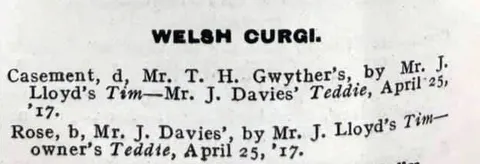
Rose was not a show dog in the modern sense, but a genuine working farm corgi. According to the recollections of Captain Jack Howell, his bailiff brought her down from the hills and claimed that she could handle a savage bull that other dogs had been unable to control. Rose did, in fact, manage to put the bull in its place.
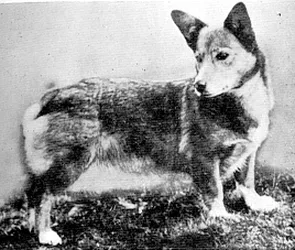
The modern history of the breed was beginning.
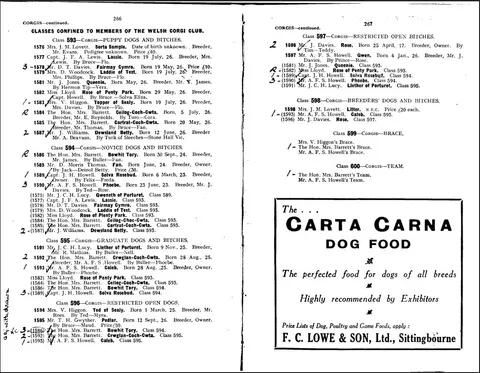
At Crufts in 1927, there was an amusing family episode: three generations of one of the oldest Pembroke lines met in the same bitch class. Solva Rosebud took first place, her grandmother Rose came second, and Rose’s daughter Phoebe was third. Meanwhile, the best representative of the Pembroke group was Caleb — Phoebe’s son and Rose’s grandson.
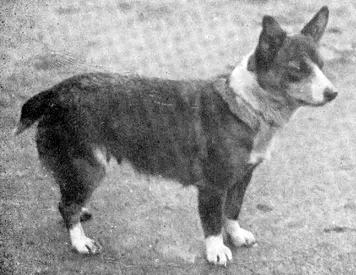
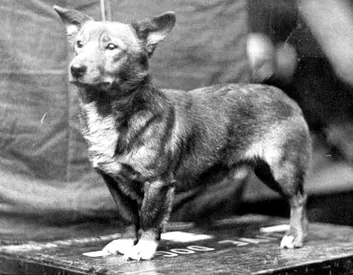
So one of the first Crufts appearances for corgis turned into something close to a family competition: grandmother, daughter, and two grandchildren were all at the same show — and all were among the winners.
“We’re actually not the same”
Interestingly, corgi enthusiasts themselves quickly ran into the problem created by placing the two types within a single breed. Cardigans and Pembrokes differed noticeably in appearance, and their breeders’ ideas of what a correct Welsh Corgi should look like did not always agree either.
By the end of 1925, interest in corgis had grown enough for the time to come to establish a breed club. An announcement appeared in a Pembrokeshire newspaper inviting everyone interested to meet on 15 December at the Castle Hotel in Haverfordwest. The meeting began at 4:30 p.m. and attracted an unexpectedly large attendance: J. H. “Captain Jack” Howell, who became chairman of the new club, recorded in his diary that 40–50 people were present and summed up the meeting succinctly as “very good.”
The organization was originally called The Corgi Club. Its first rules set out its principal aim: to establish a single description of breed type and encourage breeders, judges, and show organizers to use it as a common standard.
But there was already no single view of what a Welsh Corgi ought to be. Most members of the new club were associated with Pembrokeshire and favored the local type of dog: by the end of the year the club had almost 80 members, more than 60 of whom lived in Pembrokeshire.
The following year, in 1926, Cardigan supporters formed their own Cardigan Corgi Club to preserve and develop the old Cardiganshire type.
Attempts were made to unite the two clubs, but agreement proved difficult. A surviving letter written in May 1928 by Captain Jack Howell, chairman of the Welsh Corgi Club, shows that the dispute was no longer merely about what a correct corgi should look like. His club had only recently secured the right from the Kennel Club to compete for Challenge Certificates, and Howell feared that amalgamation with the Cardigan Club might put that achievement at risk. A combined club would also have had to negotiate the breed standard with the Kennel Club all over again.
By the end of the 1920s, therefore, the division existed not only in the appearance of the dogs. The two types had their own supporters, their own clubs, their own ideas about the standard — and their own very practical interests.
One of the stumbling blocks was the tail. The Pembroke club insisted on its own standard, which called for docking. Cardigan owners, for whom a long tail was a normal breed characteristic, understandably had little enthusiasm for the idea.
No compromise was reached.
Crufts 1927 provided an especially striking demonstration of how artificial the official union of the two types had already become. The Kennel Club still regarded all corgis as one breed, but Charles Cruft agreed to arrange two separate sets of classes: one supported by the Cardigan Welsh Corgi Club and the other by the Welsh Corgi Club, whose membership consisted predominantly of Pembroke supporters. Each even had its own judge — a specialist in the respective type.
The result was rather telling: officially, one breed called the Welsh Corgi had arrived at Crufts; in practice, almost two breeds were being shown. The entry lists barely overlapped, and each group had its own Best of Breed. Among the Cardigans, the famous Bob Llwyd took BOB, while the Pembrokes had their own set of classes and their own winner.
In April 1928, the Cardigan Corgi Club began discussing its own standard, and on 19 July the committee formally adopted it. The model used in describing the Cardigan type was a very real dog.
Bob Llwyd — the corgi they used to write the standard
The red-and-white Bob Llwyd was born in 1917. His parents, Bowlin and Handy, were not registered with the Kennel Club, and Bob himself appeared on the major show scene when he was already a mature dog.
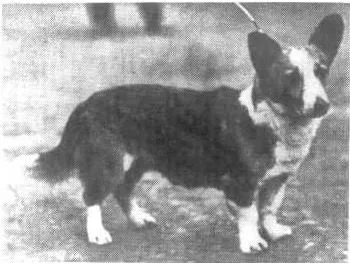
In September 1926, he won the Open Dog class at the Lampeter show.
Bob Llwyd was considered such a successful example of the desired Cardigan type that, according to historical accounts, the first breed standard was drawn up largely with him in mind.
For a modern breeder, this is almost unimaginable. Picture the situation: the standard does not yet properly exist, an actual dog is standing before the committee, and the people around him decide — yes, more or less, this is what he should look like.
Bob Llwyd lived for around 18 years and left an enormous breeding legacy. The Cardigan Welsh Corgi Association notes that his name appears in almost every pedigree of Cardigan champions from the period 1928–1939.
His son Golden Arrow, born in 1928, became the first male Cardigan to gain a championship title in 1931.
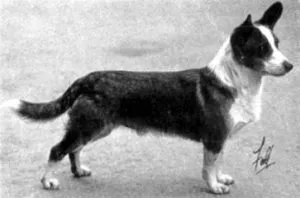
Only minutes later, Nell of Twyn became a champion as well — the first Cardigan bitch to gain the title.
In just a few years, the Cardigan had begun its transformation from a local Welsh type into a breed with its own standard and recognizable appearance.
But in the show ring, there was still simply the Welsh Corgi
In 1928, the Kennel Club removed the Welsh Corgi from the unclassified varieties, placed the breed in the Non-Sporting group, and granted Challenge Certificates — the certificates required to obtain a British championship title.
And this is where things became particularly interesting. Imagine a judge faced with a small, short-tailed Pembroke and a longer, heavier Cardigan with a large tail. Officially, they were one breed, so they had to be judged together.
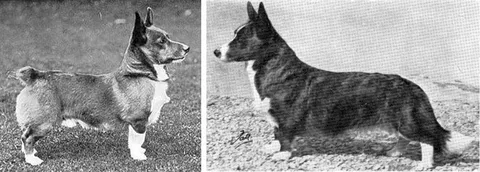
But what was the ideal Welsh Corgi supposed to look like?
A judge who knew Pembrokes well might look for their straighter front and penalize a Cardigan for slightly bowed forelegs — even though that anatomy was perfectly correct for a Cardigan.
If the judge was a Cardigan specialist, Pembroke owners might suspect that the judge would favor “their own.”
Show organizers tried appointing all-round judges who were associated with neither camp. That did not always help either: a judge might sincerely try to choose the best Welsh Corgi without realizing that the dogs before them effectively represented two different sets of breed characteristics.
It reached the point where owners simply did not enter their dogs if they believed the appointed judge favored the opposite type, while spectators looked at the ring and became even more confused...
Historical descriptions of early shows list an almost comic range of variation: corgis were long and short, tall and low, heavy and light, long-coated and smooth. Small, short-tailed Pembrokes stood beside larger Cardigans with “fox-like” tails.
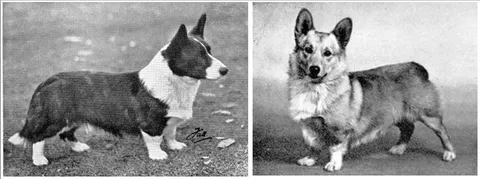
And this is not merely a modern impression formed from looking at old photographs. In December 1934, only a few months after the breeds had officially been separated, R. H. Voss wrote in the British canine newspaper Our Dogs that despite the rapidly growing popularity of the Welsh Corgi, enthusiasts of other breeds still complained of its “crossbred and mongrelly appearance.” Voss himself acknowledged that there was still some truth behind the criticism and urged breeders to use more careful breeding and selection to improve both existing types.
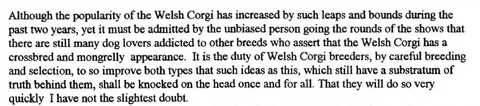
It paints a revealing picture of the breed in the year of its separation: corgis were already becoming fashionable at remarkable speed, yet even within each type breeders still had work to do before achieving the uniform appearance that seems so self-evident to us today.
And then the breeders decided to make things a little more complicated
As long as the Kennel Club regarded them as a single breed, there was no formal barrier to breeding the two types together — and such matings did occur.
One of the most remarkable examples is the champion My Rockin' Mawr, who was regarded as a Cardigan.
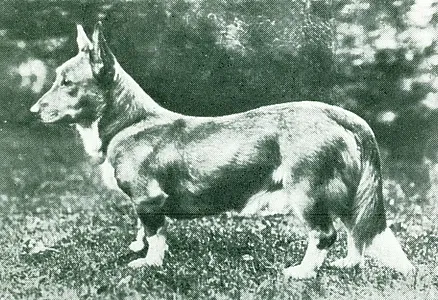
His sire was the Pembroke Ch. Bowhit Pepper.
His dam, Fancy, also had Pembrokes in her pedigree: her dam was Nellie, while her sire was the Pembroke champion Ch. Bonnie Gyp. Yet Fancy herself looked entirely convincing as a blue merle Cardigan bitch and was successfully shown.
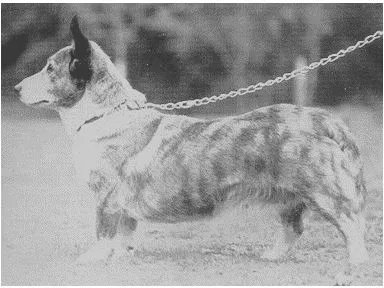
My Rockin' Mawr ultimately entered Cardigan history despite half of his immediate parentage being Pembroke.
So when someone today says, “But they are completely different breeds!”, historical pedigrees can rather mischievously remind us that breed boundaries were once far less tidy.
The great tail confusion
And now we finally reach the question that inevitably arises when looking at old photographs. If Pembrokes and Cardigans were regarded as one breed, were Cardigans docked too?
No.
A full, long tail was a characteristic feature of the Cardigan type. The modern Royal Kennel Club still emphasizes that the Cardigan has traditionally remained undocked. There was even an old name, Yard Dog — Ci Llatharid: according to one interpretation, the dog from the tip of its nose to the tip of its tail was supposed to measure approximately one Welsh yard.
With the Pembroke, things were more entertaining. According to the recollections of prominent early breeders Thelma Gray and John Holmes, around 50–60 percent of Pembrokes were born with naturally short tails. Puppies born with long or intermediate tails were generally docked. In the show ring, therefore, things looked relatively straightforward: Cardigan — long tail; Pembroke — short tail.
The natural bobtail of early Pembrokes is supported by more than later breeders’ recollections. On 6 January 1926, Captain Jack Howell recorded the birth of three puppies to his Rosebud in his diary and specifically noted that two of them — a dog and one of the bitches — were born bobtailed. Such records are particularly interesting in light of the later disputes over docking: natural bobtails existed within the Pembroke type independently of the practice of docking.
Then, in July 1931, the Kennel Club decided to prohibit the docking of Pembrokes.
Breed historians have never conclusively established why this decision was made. One theory suggested that Cardigan supporters had backed the move in the hope of demonstrating that the differences between the two types were not so great after all, but there is insufficient evidence for this appealing little theory.
The result, however, is perfectly clear: long-tailed Pembrokes began appearing in the ring, and the familiar shortcut of distinguishing the two types by their tails stopped working.
Pembrokes with natural bobtails continued to be born as before, but there were plenty of long-tailed dogs as well. And since the two Welsh Corgi types had also become somewhat genetically mixed during the preceding years, the tail could no longer provide a reliable clue as to exactly what was standing in front of you in the ring.
A wonderful photograph survives of Penelope of Sundance, an undocked Pembroke from around 1932. Show it to someone accustomed to identifying corgis primarily by their tails and you can give them a small breed-identification exam.
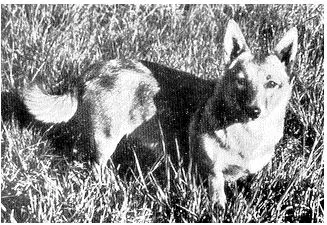
The ban remained in force until September 1934.
By then, the Kennel Club had apparently become thoroughly convinced that keeping two kinds of corgi under one roof required a rather more radical solution.
Meanwhile, one Pembroke made it into the palace
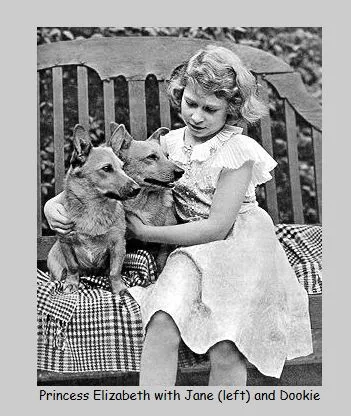
In 1933, something happened that had nothing to do with breed standards but would have a major influence on the future of one of the two breeds: seven-year-old Princess Elizabeth and her younger sister Margaret met a Pembroke belonging to family friends and decided that they wanted one too.
The well-known breeder Thelma Gray brought three puppies from her Rozavel kennel to the family of the Duke of York. The girls chose Rozavel Golden Eagle, who went down in history under his pet name, Dookie.
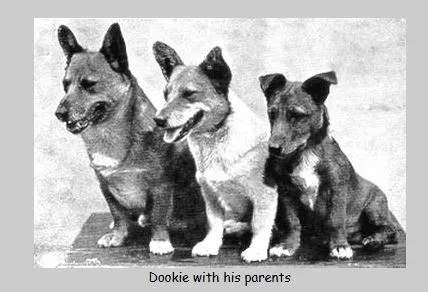
And once again, a tail found its way into corgi history. According to the familiar story, the family chose this puppy partly because he still had enough of a tail to be visible: the Duchess of York wanted to be able to see when the dog was happy and wagging it.
Dookie himself was by no means a perfectly behaved little court gentleman. Contemporaries recalled that he was quite capable of biting visitors and members of the household, while the Duke of York called him the “black sheep of the family” — and at the same time admitted that this was probably why everyone loved him so much.
Photographs of the young Princess Elizabeth with her corgi spread through the press, giving the Pembroke publicity that no breed association could possibly have arranged.
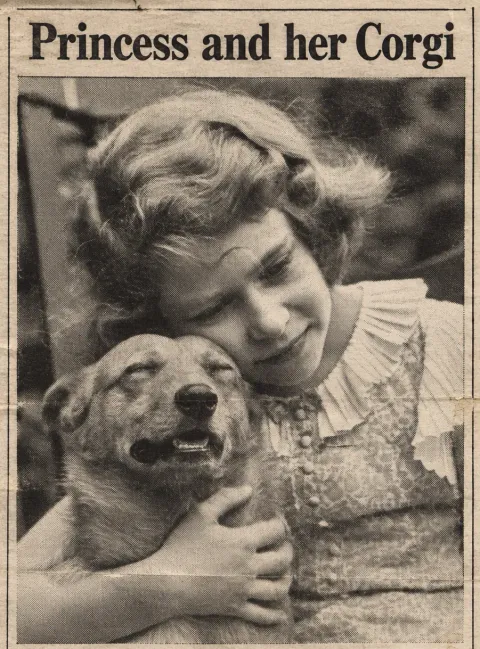
Its popularity began to soar.
1934: Enough — now there are two of you
By 1934, the absurdity of the situation had become too obvious to ignore: there were two breed clubs with different ideas about the standard. The dogs differed noticeably in appearance. Judging them together repeatedly caused disputes, and owners had been asking for years for the two types to be recognized as separate breeds.
On 4 September 1934, the Kennel Club Committee made the decision breeders had been seeking for several years: from then on, Welsh Corgis were to be registered as two separate breeds — Welsh Corgi (Cardigan) and Welsh Corgi (Pembroke).
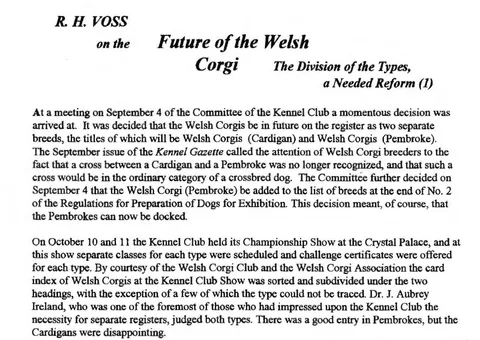
In the September Kennel Gazette, breeders were informed of another fundamental change: a mating between a Cardigan and a Pembroke would no longer be recognized as purebred, and the offspring of such a mating would henceforth be regarded as crossbred.
On the same day, the Kennel Club returned the Pembroke to the list of breeds for which docking was permitted.
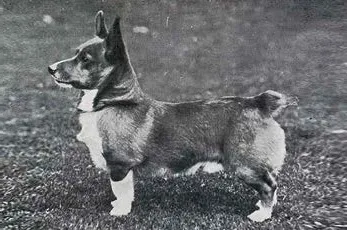
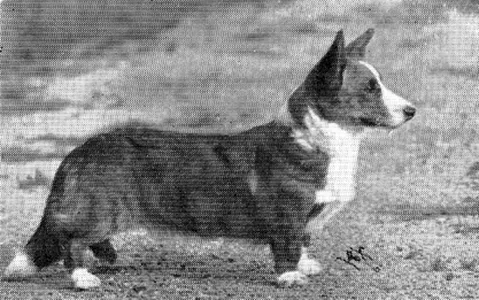
For puppies born on or after 16 October 1934, the rules became simple: a dog could be registered as a purebred Pembroke only if both parents were Pembrokes, and as a Cardigan only if both parents were Cardigans. From that point onward, the breeds’ official paths diverged.
In February 1935, the Western Mail even played with Shakespeare: “A tail or not a tail — that is the question,” while explaining to readers the recently introduced division of the Welsh Corgi into Pembroke and Cardigan.
There remained one small problem: what was to be done with all the corgis that had already been registered?
“What do you consider your dog to be?”
With the assistance of the Welsh Corgi Club and the Welsh Corgi Association, the Kennel Club’s card index began to be divided into two sections — Pembroke and Cardigan. Most dogs could be assigned successfully, but the ancestry and type of some remained unclear.
The Kennel Club’s initial decision had been fairly strict: after the separation, a Cardigan–Pembroke cross was no longer regarded as a purebred dog. It quickly became apparent, however, that such a sharp dividing line created problems for existing dogs of mixed ancestry.
The rules therefore had to be relaxed. Dogs born before 16 October 1934 could be registered under either of the two new breed names even if both types appeared in their ancestry. For dogs born on or after that date, the rule was unequivocal: a Pembroke could be registered as purebred only if both parents were Pembrokes, and a Cardigan only if both parents were Cardigans.
The transitional rule produced an unexpected side effect. Voss pointed out that, formally, it even allowed a purebred Pembroke born before the cutoff date to be registered as a Cardigan — and vice versa; moreover, he stated that this had actually happened. In his estimate, as many as 10% of the dogs in the new registers might have been crossbred, up to another 5% might have been purebred dogs registered under the wrong heading, while about 85% were purebred dogs registered correctly. Voss expected that once crossbreeding ceased, the proportion of crossbred blood within each breed would gradually diminish.
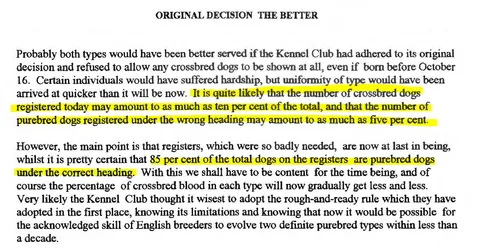
Experts worked through pedigrees and the dogs’ type until they reached cases in which no confident decision could be made.
And then the Kennel Club found a surprisingly human solution: it wrote to the owners and asked them which variety they themselves thought their dog should belong to.
From a modern perspective, the situation is delightful. Today we discuss DNA testing, genomic COI, and pedigree databases extending back dozens of generations; a hundred years ago, the breed identity of some corgis could apparently be settled along the lines of: “Dear Sir, we have looked at your dog and, frankly, we are not entirely sure. What do you think?”
After the sorting was completed, there were 240 Pembrokes and 59 Cardigans.
As early as 10–11 October 1934, at the Kennel Club Championship Show at Crystal Palace, the two breeds had separate classes and separate Challenge Certificates. Both were judged by Dr. J. Aubrey Ireland, one of the people who had actively campaigned for separate registers.
A few weeks later, the same happened in Birmingham.
The nine-year experiment was over.
From then on, the two breeds grew further and further apart
The separation did not mean that on the morning of 16 October 1934 every Pembroke suddenly looked like a modern Pembroke and every Cardigan like a modern Cardigan.
Quite the opposite. Breeders of each breed could now consistently establish their own type, and numerically the two breeds very quickly began following different paths.
In 1934, 240 Pembrokes and 59 Cardigans were registered. In 1935, the figures were already 360 versus 110. By 1937, Pembroke registrations had reached 919, while Cardigans numbered 96. In 1938, the figures were 975 versus 78.
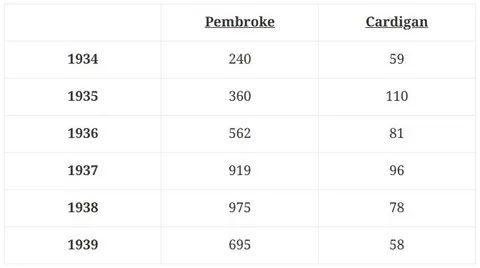
The Pembroke had a spectacularly unfair marketing advantage: the young future Queen of Great Britain was constantly being photographed with her dogs.
The Cardigan remained a considerably rarer breed — and remains so to this day.
At the same time, changes within the breeds themselves happened very quickly. By December 1936, the Canadian magazine Kennel and Bench was already expressing surprise at how rapidly the Pembroke type had become more uniform, considering that separate registration for Pembrokes and Cardigans had existed at the Kennel Club for only two years. The author was already describing them as two clearly distinguishable breed types.
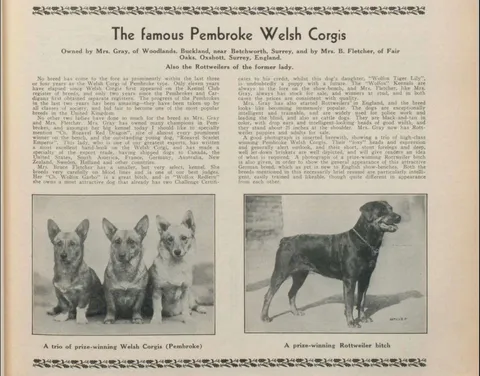
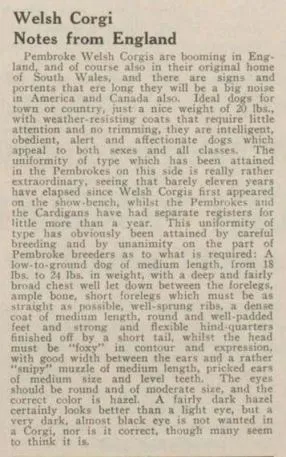
Officially separating the breeds, however, proved easier than persuading everyone else to get used to the idea. In April 1947, thirteen years after the Kennel Club’s decision, the first column of the American Cardigan Welsh Corgi Club appeared in the AKC Gazette. Its author rather pointedly explained that one purpose of the column was to “edify the judges.”
The club had good reason. One well-known judge still believed that there was a single breed, the Welsh Corgi, with two varieties — Pembroke and Cardigan. Another all-round judge thought that Pembrokes were the Welsh Corgis, while Cardigan Welsh Corgis were some separate breed called “Cardigan.”
The author remarked on the disappointment of having the “doubtful privilege” of showing a dog under a judge who did not even know what was on the other end of the lead.
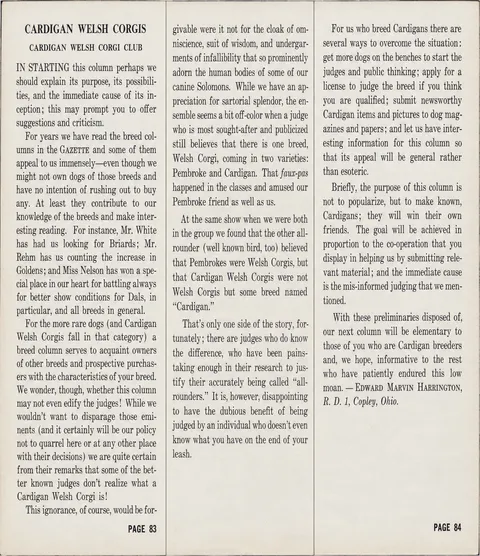
So by this point, Pembrokes and Cardigans had had separate registrations, standards, and their own breed clubs for more than a decade — yet the canine world still needed to be reminded that these really were two different breeds.
So were the Pembroke and Cardigan once one breed?
If we are talking about Kennel Club registration between 1925 and 1934 — yes.
If we are talking about their actual history, the answer is much more interesting.
Different regional types already existed before official breed recognition. Their supporters recognized the differences, formed separate clubs, and argued about what a Welsh Corgi ought to be in the first place. The canine establishment then grouped them together as one breed for nine years, allowed them to compete together and to be bred to one another, and was eventually forced to draw a boundary between them again.
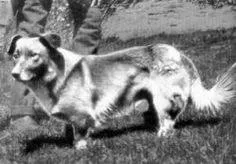
For that reason, 1934 is better understood not as the moment when one breed became two, but as the moment when the British canine establishment officially acknowledged that two different breeds had been hiding under the name Welsh Corgi all along.
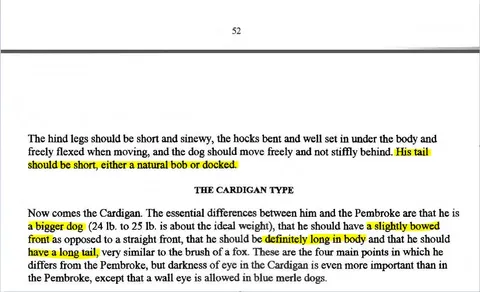
Contemporaries, in fact, spoke quite openly about these differences. In a 1934 letter, breed authority Edith Morgan described the Cardigan as a longer, heavier dog with bowed forelegs and a long, bushy tail, while the Pembroke was a lighter type with a straight front and a short tail or none at all. She welcomed separate show classes for the two types for a simple reason: “they are so different from each other.”
In December of the same year, while explaining the distinction between the newly separated breeds to readers of Our Dogs, R. H. Voss identified four principal features of the Cardigan: it was larger than the Pembroke, had a slightly bowed front, a longer body, and a long, fox-brush-like tail.
Perhaps the funniest part of the whole story is that today the tail seems like the simplest way to explain the difference between the two corgis to a newcomer: “this one has a tail, and that one usually doesn’t.”
Yet in the early 1930s, the Kennel Club prohibited docking for several years, long-tailed Pembrokes entered the show ring, the two breeds had already been bred to each other to some extent — and the tail helped turn an already complicated story into a full-blown canine detective story.
Fortunately, in 1934, the mystery was finally resolved.
The Cardigan was allowed to be a Cardigan — with its large tail, large ears, and distinctive construction.
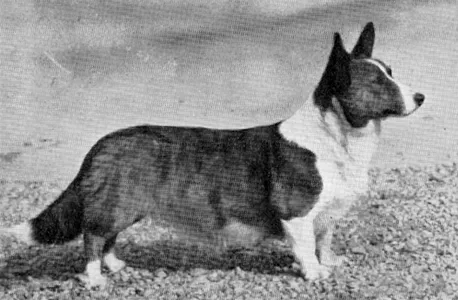
The Pembroke was allowed to be a Pembroke.
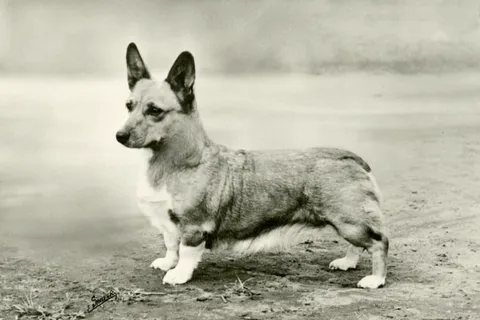
And what we inherited are two wonderful breeds and a collection of old pedigrees that occasionally remind us that the boundary between Pembroke and Cardigan was once considerably less clear than it seems today.
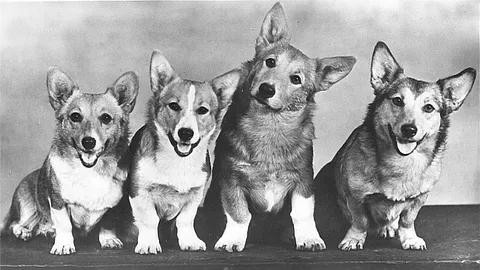
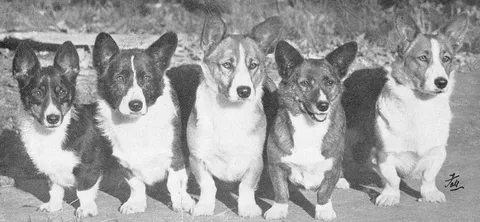
=================================
Sources:
- History of the Cardigan Welsh Corgi
- Corgis first time to be classiefied at Cruft's Show
- Looking Backward - and Forward
- The Kentwood Cardigans - 1948-1996
- Cardigans in Pembroke Pedigrees and vice versa
- 100 Years of Corgi History
- History
- Breed History
- The Separation of the Breeds
- Kennel and Bench
- AKC Gazette, 04/1947
- Voss, R. H. “The Future of the Welsh Corgi: The Division of the Types, a Needed Reform.” Our Dogs, December 1934. Reprinted in Cardigan Welsh Corgi Club of America 1992 Handbook, pp. 50–54. Courtesy of the Cardigan Welsh Corgi Club of America (CWCCA).
Special thanks to the Cardigan Welsh Corgi Club of America (CWCCA) for providing pages from the 1992 CWCCA Handbook containing the reprint of R. H. Voss’s 1934 article.