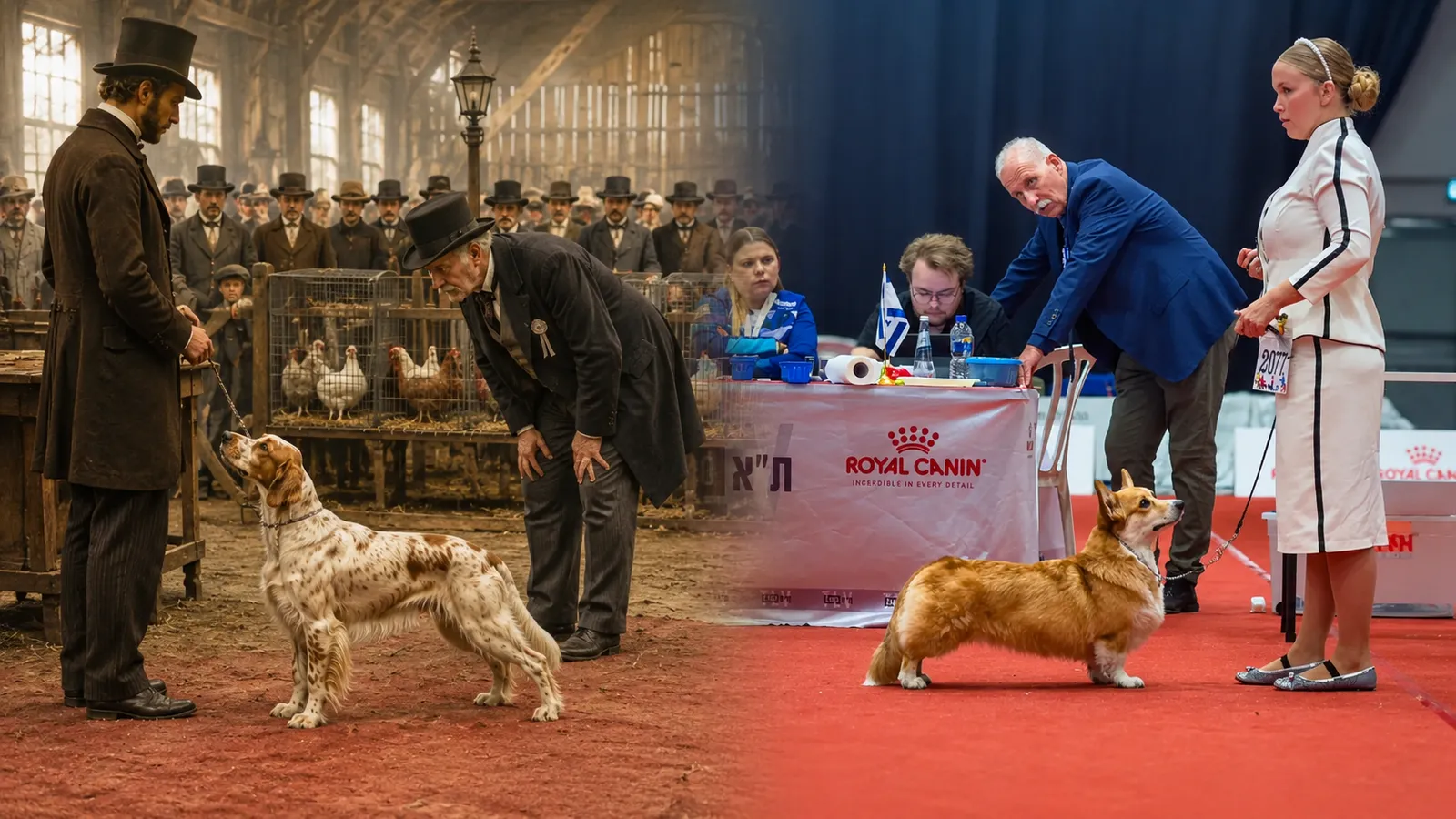
Britain, sometime in the eighteen-hundreds.
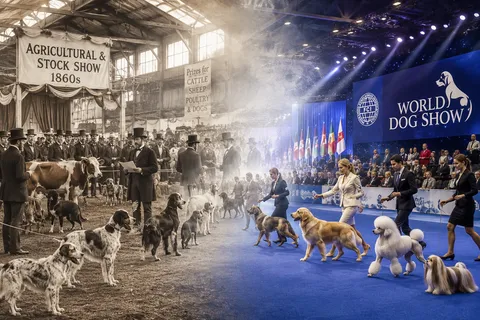
Early morning. The mist has not yet completely lifted from the damp grass, trampled by hundreds of feet. The cool air carries a mixture of smoke, hot sausages, strong tea and fresh manure.
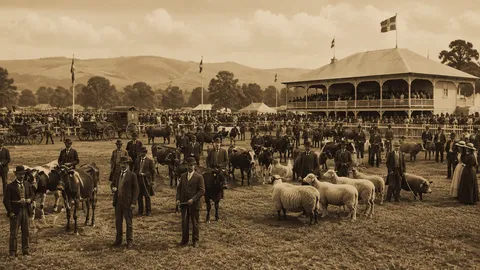
Above it all rises a cacophony of sound: bulls low, sheep and goats bleat, horses neigh, poultry cluck and honk. People call to one another, animal owners discuss the merits of their stock, and visitors move between rows of pens...
This is an agricultural show — one of those places people come to not only for entertainment, but also to exhibit the finest animals that owners and breeders take pride in. They are examined, compared, judged and awarded prizes.
But listen closely... There is a new voice in the chorus.
A dog barking.
Dogs had been bred and selected long before dog shows existed, because people needed good hunters, herders, guards and ratters. For centuries, recognisable types of dogs had existed, each suited to a particular kind of work.
But the 19th century brought something new: people increasingly began gathering dogs in one place not to hunt, herd or perform some other task, but to show them and compare them with one another.
And that became the beginning of enormous change.
From agricultural shows to dog shows
By the first half of the 19th century, exhibition culture was already familiar to the British public. Agricultural shows featured breeding cattle, horses, sheep and other livestock, while poultry and pigeon shows were also enormously popular.
Behind the entertainment for spectators lay a very serious idea: the results of breeding could now be compared.
Which bull was better built? Which sheep represented the most desirable type? Which traits should be preserved in future generations?
A show allowed a breeder to see not only their own animals and the offspring of a neighbour’s sire, but also the results of other people’s breeding programmes.
Gradually, a similar interest developed around dogs.
Several changes of the 19th century helped dog shows to develop: rising prosperity, the already established culture of agricultural shows, and the expansion of the railways.
That last factor is easy to underestimate, yet the railway dramatically shortened distances. An owner could now bring a dog from another town relatively quickly, while spectators could travel to see the event. A show no longer had to be an exclusively local affair.
Only one more step remained.
Newcastle, 1859
On 29 and 30 June 1859, the annual poultry show was held in Newcastle upon Tyne.
This time, the organisers decided to add a new section — Sporting Dogs.
There were no hundreds of breeds yet, so only Pointers and Setters were shown — hunting dogs well known to the wealthier British public.
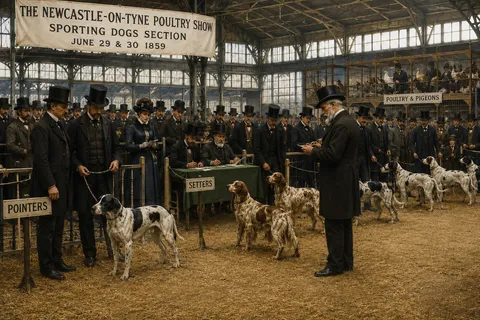
Around sixty dogs were gathered there.
Today, that might look like a fairly modest breed-club show, but at the time, the opportunity to see so many dogs belonging to different owners gathered in one place was unusual.
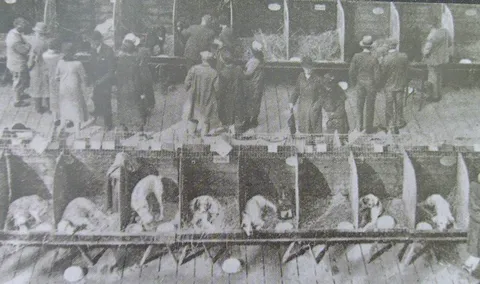
A newspaper report of the show has survived. On 1 July 1859, the Newcastle Courant reported that the new sporting-dog section had become one of the main attractions for visitors. Separate spaces with bedding and partitions were arranged for the dogs along three sides of the spacious building. The dogs were kept on chains, with barriers separating them from the public. A total of 23 Pointers and 37 Setters were entered, some of them having travelled considerable distances. The newspaper noted that the city had never before seen an exhibition quite like it, and that it was of particular interest to sportsmen.
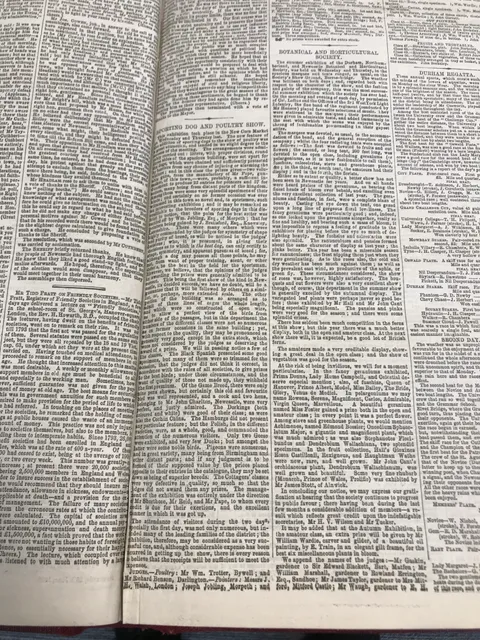
The prizes awarded to the winning dogs, incidentally, looked very different from today’s trophies and rosettes.
One of the organisers was gunsmith William Rochester Pape. He provided two double-barrelled guns of his own manufacture as prizes — one for the winning Pointer and one for the winning Setter.
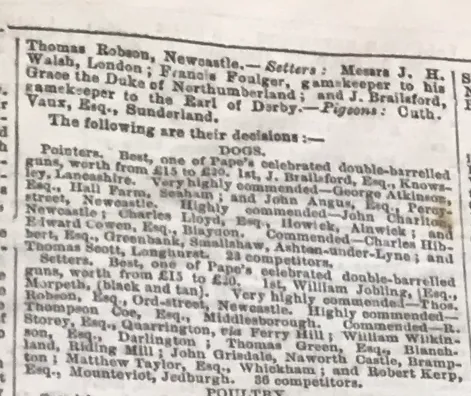
Judging was also very different from what we know today: each of the two groups was assessed by three judges. Both judging panels included John Henry Walsh, known by his pen name Stonehenge. Walsh was the author of The Dog in Health and Disease (1859), one of the notable canine books of the 19th century, in which he systematised information about breeds, their purposes, breeding and care. He was also editor of the popular sporting magazine The Field and one of the prominent dog authorities of his time: he wrote about breeds, conformation, breeding and working ability, and later played a role in the development of the first field trials.
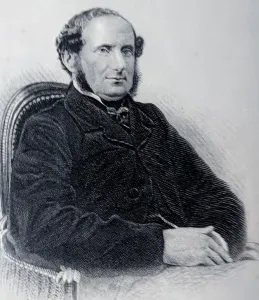
His presence among the judges gives us a good idea of the kind of people who were being asked to answer a completely new question for the time: how do you compare several dogs of the same breed and decide which one is better?
At the same time, another problem emerged — one that has accompanied the show world ever since. Judges could assess a dog’s construction, proportions and breed type, but how could they tell how well that dog would actually work in the field?
Contemporaries understood perfectly well that appearance alone could not answer that question. In other words, one of the central debates in modern cynology — the relationship between conformation and working ability — arose almost at the same time as dog shows themselves.
The idea caught on
Later that same year, in 1859, another dog show was held in Birmingham.
From there, events began moving quickly: shows became increasingly popular, new organisers appeared, and the range of dogs represented expanded. What had begun as a small addition to other events was becoming an attraction in its own right.
And as dog shows grew, a very practical problem emerged.
Suppose several Pointers are standing before a judge. How do you decide which one is better?
You can compare movement, proportions, head, coat and overall type — but first you have to agree on something else: what should a good Pointer actually be like?
And what if two people have different ideas of the correct Pointer? Which traits should be considered characteristic of the breed, and by what criteria should the dogs be compared?
Shows required criteria, and those criteria gradually required breed standards.
When a breed became something that could be described on paper
Different types of dogs had existed for thousands of years before the first Newcastle show. People had long bred sighthounds, scent hounds, herding dogs, guard dogs and companion dogs, but the modern concept of a breed developed much later.
During the second half of the 19th century, dogs were increasingly classified not only by their work and general type, but also by sets of characteristics expected to be consistently passed on to their offspring.
Written descriptions of the desired type began to appear.
One of the best-known early examples was the Philo-Kuon Standard for the English Bulldog, published in London in 1865 and often described as the first formal written breed standard.
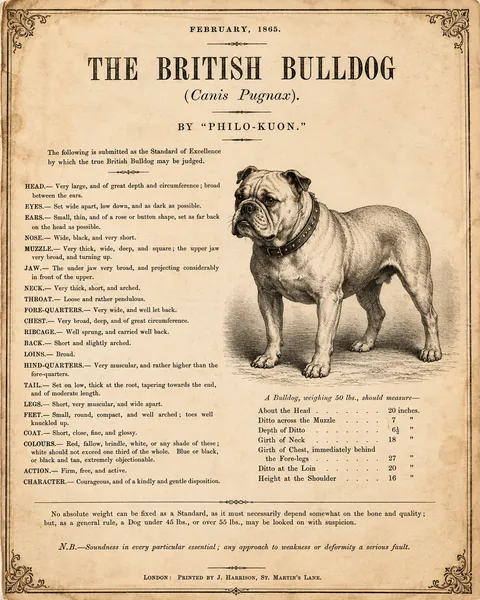
The breed standard gradually became a kind of verbal portrait of the breed: what the head, body, limbs, coat and movement should be like, and what proportions should characterise the dog.
During the final quarter of the 19th century, the process of defining and standardising breeds accelerated considerably, both in Britain and continental Europe. Many dogs of that period, however, looked noticeably different from their modern descendants.
But a standard alone was not enough, because a second question arose: if two dogs look like members of the same breed, does that mean they actually belong to the same breeding population?
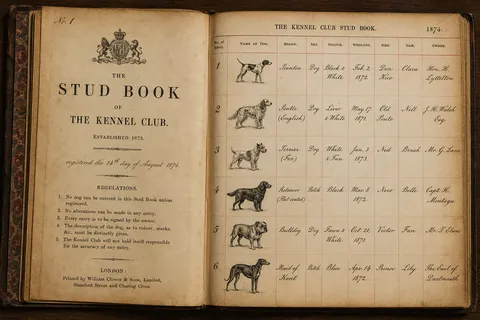
To answer that, their ancestry had to be known. And so another foundation of modern cynology appeared alongside the standard — the stud book.
Why the Kennel Club became necessary
While dog shows were few in number, individual organisers could establish their own rules. But as the new pastime became more popular, the need for a common system became increasingly obvious.
How should dogs be registered?
Which shows should be recognised?
Who could judge?
Which results should count?
How should ancestry be recorded?
On 4 April 1873, Sewallis Evelyn Shirley and twelve other enthusiasts founded The Kennel Club in Britain — the first national organisation of its kind. Its purpose was to bring order to the rapidly expanding world of dog shows and field trials.
The first Kennel Club Stud Book appeared in 1874, but its history did not begin with 1874. Results were retrospectively included from dog shows going back to Newcastle in 1859 and from field trials beginning in 1865, together with information about the dogs and their ancestry.
This marked a fundamental shift: there was now an organisation capable of establishing rules, keeping records and preserving information about dogs’ origins.
Gradually, a system took shape that, in various forms, still exists today:
Breed → standard → pedigree → registration → show → judging under common rules.
Dog shows changed the breeds themselves
This system had another important consequence: once dogs began to be regularly compared against a standard, breeders had an incentive to produce animals that conformed to that standard.
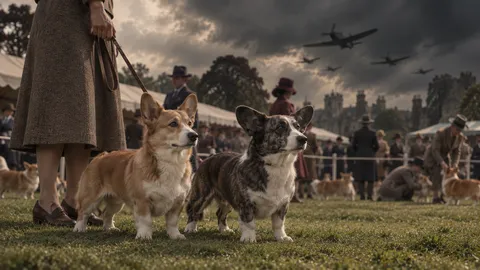
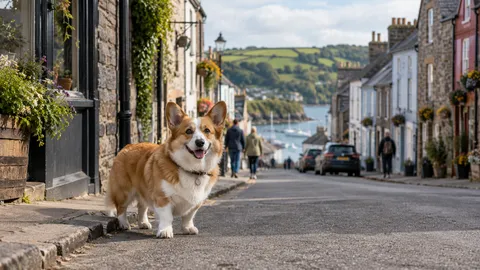
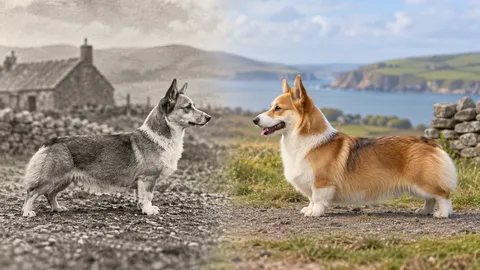
Differences between breeds became more clearly defined. Some older types were separated into distinct breeds. For example, Pembrokes and Cardigans were long regarded as varieties of the Welsh Corgi, but in 1934 the British Kennel Club recognised them as two separate breeds — the Pembroke Welsh Corgi and the Cardigan Welsh Corgi. Breed clubs were established to refine the desired type and help preserve it.
During the second half of the 19th and early 20th centuries, this process of standardisation accelerated dramatically.
That is why modern breeds should not be viewed simply as unchanging types of dogs handed down to us from the distant past. Many do indeed have very old ancestors and working types behind them, but the breed boundaries, standards and closed stud books familiar to us today are, to a considerable extent, the result of organised dog breeding over the past century and a half.
The new system crosses the Atlantic
Very soon, similar developments began in the United States.
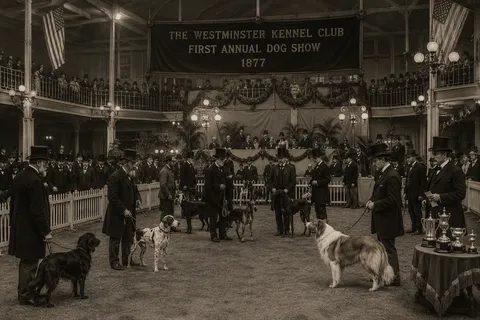
In 1877, the first Westminster Kennel Club dog show was held.
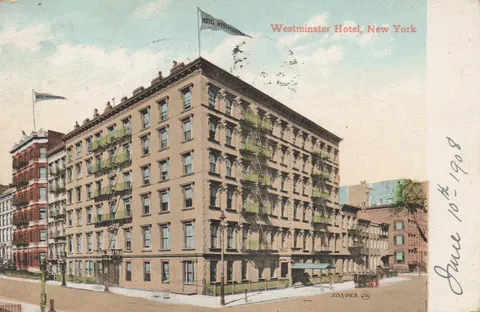
The story of the club itself sounds almost like the plot of a film. In the 1870s, a group of wealthy sporting enthusiasts regularly met at New York’s Westminster Hotel. They owned Pointers of their own and were involved in hunting and field trials.
A Pointer named Sensation was imported from England, and his image later became the emblem of the Westminster Kennel Club.

The club’s first show was enormous by the standards of the time, with more than a thousand dogs. Public interest was so great that the event had to be extended by an additional day. The catalogue even indicated whether some of the dogs were for sale.
But American clubs soon encountered the same problem Britain had faced a little earlier: the number of shows was increasing, but there was no unified system.
In 1884, representatives of twelve clubs met in Philadelphia and founded the American Kennel Club — AKC.

The British idea of a national organisation for pedigree dogs had acquired an American counterpart.
From sixty dogs to Crufts
Meanwhile, dog shows continued to grow.
One of the people who recognised the potential of this new enthusiasm was Charles Cruft.
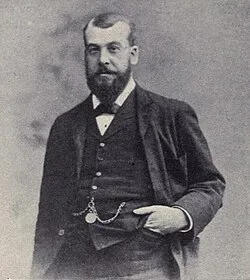
His career did not begin in dog breeding at all. Charles Cruft was born in 1852 into a jeweller’s family, but he had no desire to continue the family business. As a young man, he went to work for James Spratt, a manufacturer of dog cakes, one of the earliest commercial dog foods.
Starting in a relatively modest position, Cruft soon became a travelling salesman. His work took him to large estates and sporting kennels, introduced him to breeders and dog owners, and brought him into contact with dog shows. In effect, his job at Spratt’s placed him right at the centre of Britain’s rapidly developing canine world.
Cruft’s greatest talent, however, seems to have been not so much dogs themselves as organisation and the ability to turn an event into a spectacle. He worked on Spratt’s exhibition activities not only in Britain but also in continental Europe, and in 1878, while in France, he was invited to organise the canine section of the Paris Exposition. In 1886, he was entrusted with organising the Allied Terrier Club show at London’s Royal Aquarium. By then, Cruft clearly understood how to attract exhibitors and spectators, manage large numbers of dogs and turn a dog show into a notable public event.
Contemporaries remarked on his extraordinary energy and organisational ability, and he was later even compared with the American showman P. T. Barnum for his talent for turning exhibitions into large-scale spectacles. Cruft did not invent dog shows — they had existed long before him. His achievement was something else: he took them to an entirely new level.
On 11 February 1891, the doors of the Royal Agricultural Hall in Islington, London, opened to visitors for another dog show. But its scale was already very different from the early dog shows of the mid-century.
Under the enormous roof of the Victorian exhibition hall were dogs of many different breeds. Alongside Collies and Setters, visitors could see Terriers, Toy dogs and representatives of other breeds that, not so long before, would hardly have appeared together at a single show. The organisers received 2,437 entries representing 36 breeds — compared with around sixty dogs at Newcastle three decades earlier.
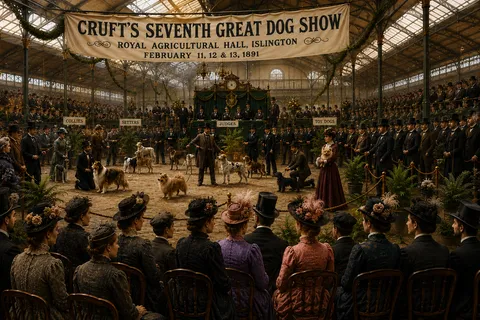
Today, that exhibition is regarded as the first Crufts, although contemporary posters called it “Cruft’s Seventh Great Dog Show.” There is no contradiction: Cruft had been organising dog shows since 1886, but his earlier events had been devoted to particular groups and breeds. The 1891 show was the first to bring together dogs of all breeds, and it is from this event that the history of the modern Crufts is traced.
Accounts of that historic show describe dogs housed in their allotted places, visitors walking along the rows to look at the exhibits, and judging proceeding class by class. There was no Best in Show final of the kind familiar to us today — that would not appear at Crufts until 1928. For the time being, the show consisted of numerous separate breed competitions and prizes.
Among the entrants were dogs belonging to Queen Victoria. Her Collie Darnley II and two Pomeranians won prizes, immediately lending the young show a particular prestige. The contrast is easy to imagine: only thirty years earlier, a few dozen Pointers and Setters had been shown as a small addition to a poultry exhibition in Newcastle; now thousands of entries were gathering beneath the roof of one of London’s largest exhibition halls.
And yet this was still very different from the Crufts we know today. There was no enormous final ring, no television cameras and no Best in Show. What visitors saw was more like a gigantic Victorian dog exhibition — noisy, crowded and spread over three days. Some dogs remained in the building overnight; exhibitors who wanted to take their dogs home had to pay an additional fee.
And so, in February 1891, began the history of a show whose name, more than a century later, would be known to dog lovers around the world.
Cruft’s show outlived its creator. After his death, his widow managed the event for a time, and the rights to run Crufts were eventually transferred to the Kennel Club.
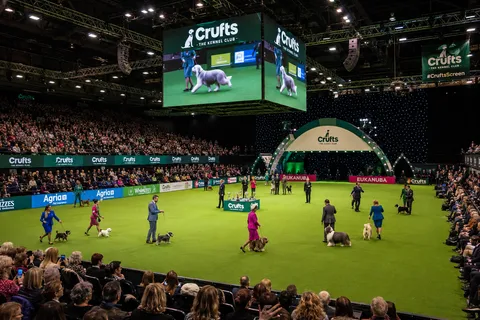
Crufts has long since become much more than a conformation show. Alongside breed rings, it hosts competitions in various dog sports, breed presentations and an enormous trade area. Breed winners can continue into the main ring, where group winners are selected, and on the final day those group winners meet in the Best in Show final.
In 2026, almost 19,000 dogs representing more than 200 breeds were entered at Crufts.
And so, from two shotguns in Newcastle, we arrive at an event followed by dog lovers around the world.
Crufts is not the World Dog Show
Crufts is sometimes called the “world championship of dogs”, but in terms of the modern canine system, that is not correct.
Britain has its own system under The Royal Kennel Club and is not a member of the FCI. Crufts is therefore a famous international British show, but it is neither an FCI show nor the World Dog Show.
Nor can you enter Crufts simply by submitting an entry form. Most dogs must first earn the right to compete — they must qualify. Qualification rules differ for British and overseas exhibitors and can change from year to year.
For the owner of a show dog, therefore, the journey to Crufts begins long before stepping into its famous green rings.
Why the FCI was created
By the beginning of the 20th century, national canine organisations already existed in many countries, but a new problem had emerged.
What happens when a French dog travels to a show in Belgium? Will its pedigree be recognised there? Can titles earned in another country be recognised? Who decides which breed standard should be used?
International cynology required more than national kennel clubs — it required cooperation between them.
In 1911, organisations from five countries — Germany, Austria, Belgium, France and the Netherlands — established the Fédération Cynologique Internationale — FCI.

The First World War brought the new federation’s activities almost to a halt, but it was re-established after the war.
Today, the FCI brings together national canine organisations from many countries around the world. Israel is represented within this system by the Israel Kennel Club — IKC.

We have devoted a separate article to the history of the development of organised cynology in Israel. Here, the important point is different: by the 20th century, dog shows had grown from a local British enthusiasm into an international system.
And that system developed major events of its own.
World Dog Show
One of the most important is the World Dog Show, the FCI’s global dog show.
Unlike Crufts, it has no permanent home. The right to host the show is awarded to one of the FCI’s national canine organisations, so the World Dog Show moves from country to country.

It is a huge international show where, in addition to the usual show certificates, special world titles are awarded, including FCI World Winner, FCI World Junior Winner and FCI World Veteran Winner.
The title World Winner, however, can sometimes confuse newcomers: it does not mean that one single dog has “won the world championship”.
World titles are awarded within breeds and the relevant categories. The competition then continues: the Best of Breed dogs are selected, followed by group winners and, finally, Best in Show.
That is why a single World Dog Show produces many dogs carrying a World Winner title — but only one ultimately becomes Best in Show.
European Dog Show
The European Dog Show works in a similar way, with European titles awarded there.
It, too, is held in a different country each year and attracts thousands of dogs.
For a breeder, the World Dog Show or European Dog Show is not a compulsory next step after an ordinary show. A dog does not have to progress through a sequence of “local → international → European → World”. These are separate major events with their own entry requirements and titles.
So how do modern dog shows work?
Over a century and a half, the system has, of course, become considerably more complex. Today, dogs are entered in different classes, receive ratings and certificates, compete first within their breed, and breed winners may then continue into group and final competitions.
This is where the familiar abbreviations CAC, CACIB, BOB, BOS, BIG and BIS come from, along with national and international championship titles.
We explain in detail why dog shows are held, how judging works, which classes dogs compete in, and what all these titles and certificates mean in a separate article: Dog Shows: Why Do We Need Them?.
But isn’t a dog show just a beauty contest?
From the outside, it can certainly look that way. Dogs are bathed, groomed and prepared for the ring, while handlers try to present them at their best — standing and moving in a way that allows the judge to assess their conformation and breed type. Music plays in the halls, cameras are everywhere, and spectators crowd around the rings.
Historically, however, dog shows had a different purpose: they arose as a way to compare the results of breeding.
A breeder could see not only their own dogs, but also animals from other lines and kennels. A judge assessed how well a dog represented the desired breed type. Wins influenced the reputation of breeding dogs and the selection of future breeding pairs.
At the same time, the limitations of this approach were already understood by participants in the earliest 19th-century shows.
Conformation cannot tell us everything. A beautifully built Pointer will not necessarily be an outstanding working dog. A show winner does not automatically become a genetically healthy breeding animal. The result of a single judging cannot tell us everything about a dog’s temperament, health or heredity, which is why modern cynology extends far beyond the show ring.
Alongside conformation shows, there are field trials, herding tests, working trials, obedience, agility, tracking and many other disciplines. For some breeds, a show result alone is not enough: to obtain certain championship titles, a dog must also demonstrate its working ability in specialised trials — for example, by showing that it can work in the field, follow a track or perform another task for which the breed was originally developed. A German Shepherd Dog, for example, cannot obtain the international C.I.B. title on show results alone; it must also meet the relevant working requirement. Hunting breeds have their own working trials, assessing qualities connected with their original hunting purpose.
So the question that arose at the very first dog shows of the 19th century — “Is looking at a dog enough to understand how good it really is?” — has never disappeared. Today, we simply have many more ways of assessing the different qualities of a dog.
What dog shows really gave us
Let us return for a moment to that misty British morning.
Cattle are still lowing, sheep are bleating and poultry are honking. Somewhere, an owner proudly displays a particularly fine bull while visitors argue over the merits of the animals.
Among all that noise, a dog barks.
No one has yet invented the terms CACIB or Best in Show. There is no FCI. There is no World Dog Show. Most modern breed standards have yet to be written, and many of the breeds familiar to us today have yet to be defined and separated from one another.
But the idea is already there: dogs can be brought together, shown, and the results of breeding compared.
From that simple idea grew something much larger than a spectacular competition.
To compare dogs, breeds had to be defined. To define breeds, their standards had to be written. To control ancestry, stud books had to be maintained. And for all of this to be trusted, clubs and common rules had to be created.
Then, as dogs and their owners began crossing national borders, international agreements and organisations became necessary.
And so, between a noisy 19th-century agricultural show and the enormous modern final of the World Dog Show stretches a history more than a century and a half long.
And somewhere near its beginning, among the lowing, bleating and honking, another voice suddenly rang out more clearly than before.
A dog barking.