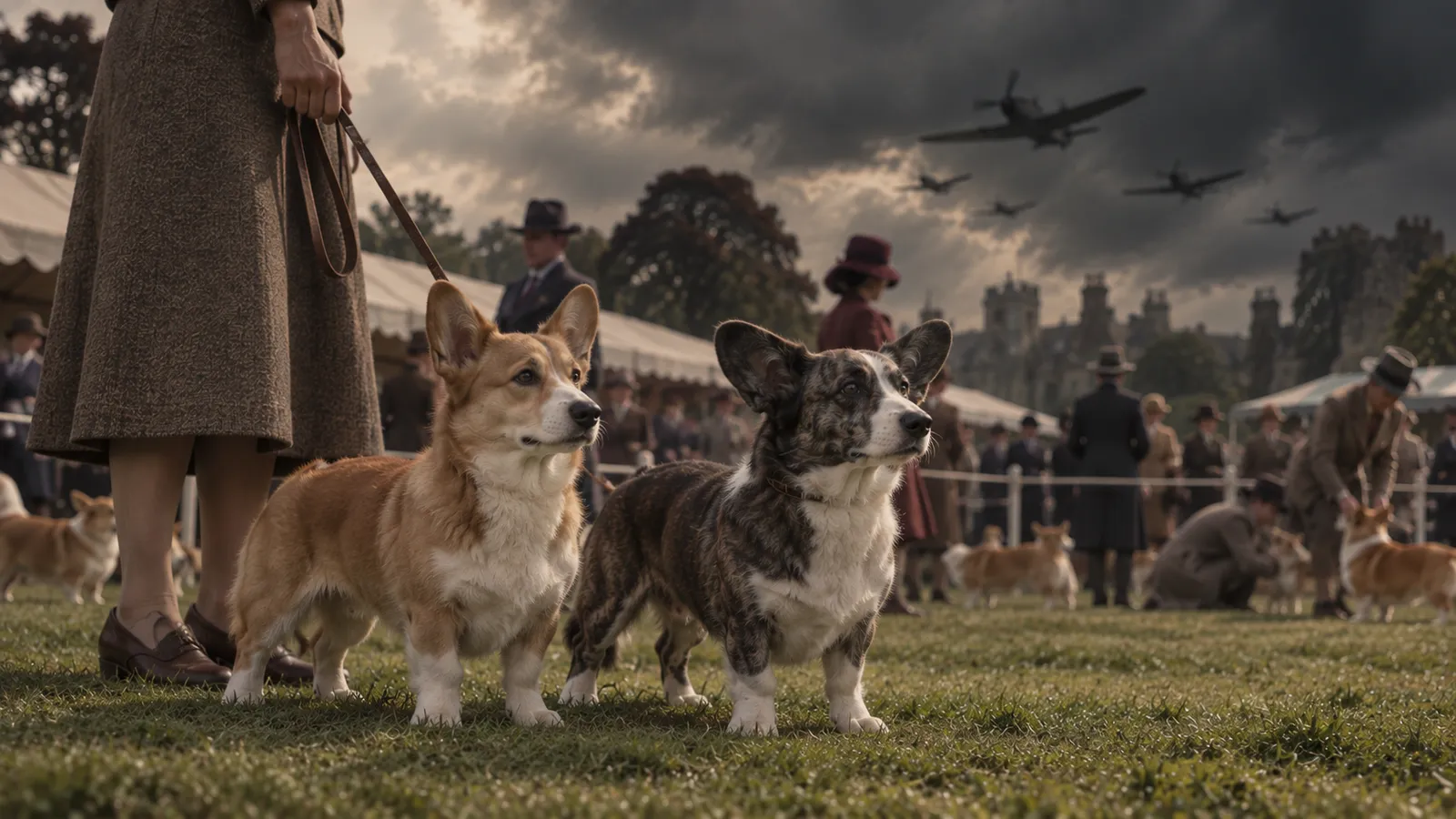
When we talk about dogs during the world wars, we usually think of those who found themselves alongside people at the front. Dogs searched for the wounded, carried messages, guarded military facilities, served as messengers and became unit mascots. Their photographs survive in military archives, and some of their stories have become almost legendary.
But war also changed the canine world far from the front lines.
Dog shows stopped. Breeders left for military service or were forced to leave their homes. Travelling to a chosen stud dog could become impossible. Transport between cities and countries was disrupted or restricted, and amid food shortages, keeping a large number of dogs became a challenge in itself. Planned matings did not take place, kennels reduced their numbers, and individual breeding dogs — sometimes entire bloodlines — disappeared from breeding.
After the war, dog populations could grow again. Restoring a lost bloodline was much harder — and sometimes impossible.
The history of the two corgi breeds provides a particularly striking example of what can happen when the development of a breed is suddenly interrupted by a major historical catastrophe. The Pembroke and the Cardigan became separate breeds only five years before the outbreak of World War II, yet they entered the war in very different circumstances.
And the consequences of those few years can still be seen in their pedigrees today.
World War I: when the two corgi breeds did not yet exist
World War I had already shown European breeders just how fragile the world of organised dog breeding could be.
The war disrupted international connections, halted numerous dog shows and breeding programmes, and transformed the lives of kennels. For some small European breeds, the loss of even a few breeding animals could mean losing a significant part of the available gene pool.
But it is impossible to tell separate stories about the Pembroke and Cardigan during World War I for one simple reason: in the modern cynological sense, the two breeds did not yet exist.
Welsh farm dogs of different types, from which the Pembroke and Cardigan would later develop, were of course already living in Wales. However, official recognition of the Welsh Corgi by the British Kennel Club came only in the 1920s, and for some time the two different corgi types continued to be registered and shown together — and were occasionally even crossed with one another.
The war that would leave the deepest mark on the history of the modern corgi therefore began twenty years later, almost immediately after the two breeds had finally gone their separate ways.
1934: one corgi becomes two
We have told the story of the separation of the Pembroke and Cardigan in detail in a separate article. Here, one point is especially important: the independent history of the two breeds began only shortly before World War II.
In 1934, the British Kennel Club recognised the Pembroke and Cardigan as separate breeds, and the registered Welsh Corgis that already existed had to be divided between two new stud books.
A total of 240 dogs were classified as Pembrokes, while only 59 were classified as Cardigans.
Over the next few years, the difference became even more pronounced.
| Year | Pembroke | Cardigan |
|---|---|---|
| 1934 | 240 | 59 |
| 1935 | 360 | 110 |
| 1936 | 562 | 81 |
| 1937 | 919 | 96 |
| 1938 | 975 | 78 |
| 1939 | 695 | 58 |
The Pembroke was rapidly gaining popularity, and by 1938 the number of registrations had approached one thousand.
The Cardigan, by contrast, remained a small breed. In 1939, only 58 dogs were registered — almost exactly the same number as had been assigned to the breed when the two corgis were separated five years earlier.
But even these figures give an overly optimistic impression of the Cardigan's genetic diversity: fifty-nine dogs do not mean fifty-nine unrelated breed founders.
The Cardigan Welsh Corgi Association names the male Bob Llwyd as one of the major founders of the early population. His name appears in all but two pedigrees of Association champions from 1928 to 1939. In one of those two cases, the dog's parents were unregistered; the other dog was Ch. My Rockin Mawer, who was half Pembroke.
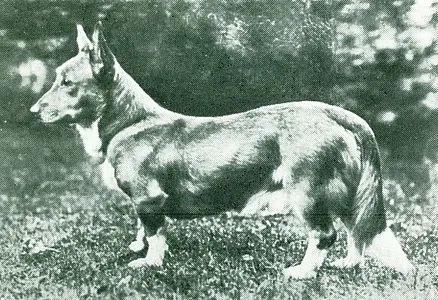
Thus, even before the war, the Cardigan was a small population with heavily overlapping pedigrees. In September 1939, this tiny breed entered a new era alongside the far more numerous Pembroke.
The last show before a long interruption
The Welsh Corgi League had been founded only shortly before the war, in the summer of 1938. One of its founders was Thelma Gray, owner of the famous Rozavel kennel.
The League's first specialist show was held in London in the spring of 1939. The Pembroke was becoming increasingly numerous and popular, new owners and kennels were appearing, and a recognisable breed type was gradually taking shape.
A few months later, the war began.
Nevertheless, on 22 May 1940, the Welsh Corgi League managed to hold one more show.
Best in Show went to the already eight-year-old Ch. Rozavel Red Dragon.
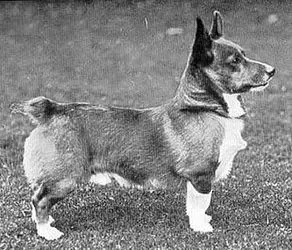
Today, this name is best known to those who begin seriously exploring old Pembroke pedigrees. Red Dragon was one of the most influential sires of the breed's early period. The Welsh Corgi League describes him as a highly prepotent male who had a considerable influence on establishing Pembroke type.
On that May day, he entered the ring once more and won the show.
...The next show would have to wait until the war was over.
In her own recollections, Thelma Gray wrote that after the May show, the war descended upon the League in full force. Normal club activities ceased for several years, and the history of the breed continued outside the show ring.
Rozavel on opposite sides of the war
By then, the name Rozavel was known far beyond British breeding circles.
In 1933, the Duke of York, the future King George VI, acquired a puppy from Thelma Gray for his daughters, Princess Elizabeth and Princess Margaret. The puppy was Rozavel Golden Eagle, known to the family as Dookie.
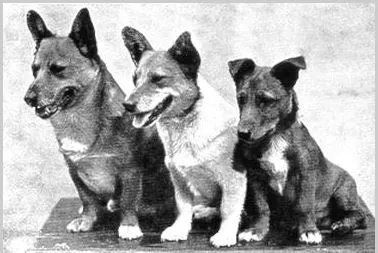
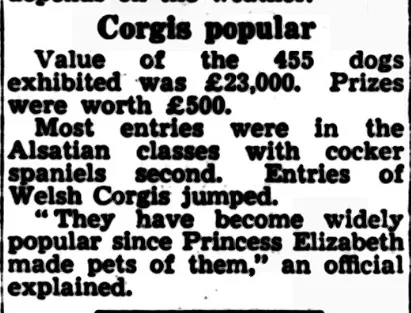
The arrival of a corgi in the Royal Family greatly increased the breed's popularity. Photographs of the young princesses with their unusual short-legged dogs appeared in the press, and the Pembroke gradually began its transformation from a little-known Welsh farm dog into a fashionable breed.
But Rozavel dogs did not go only to British homes. Before the war, Thelma Gray's dogs were also exported abroad, including to Germany.
In June 1940, Gray wrote in the British magazine Dog World about dogs she had previously sold to German owners and whose fate she could now only wonder about. Among them, she mentioned two corgis supplied to Joachim von Ribbentrop — formerly the German ambassador to Britain and by then the foreign minister of Nazi Germany.
When those dogs had been sent to their new owners, it had been an ordinary international transaction between breeder and buyer. A few years later, the two countries were on opposite sides of the war.
The fate of those two corgis is unknown.
The corgi from a German submarine
There is another strange chapter to this story.
In a post-war edition of her book The Welsh Corgi: Pembrokeshire and Cardiganshire Types, Thelma Gray recalled a photograph of the crew of a British warship with a dog that the sailors had taken from a German submarine. According to Gray, the dog had been the German crew's mascot and looked like a corgi.
Corgis were extremely rare in pre-war Germany. Knowing that she herself had sold dogs to Ribbentrop, Gray wondered whether this unusual shipboard mascot might have descended from those very Rozavel dogs.
We do not have an answer. So far, it has not been possible to establish with certainty the dog's name, the submarine on which it had served, or its pedigree. Any connection with Ribbentrop's corgis therefore remains only Thelma Gray's speculation.
But the story itself illustrates just how far representatives of this young breed had already travelled: a dog whose ancestors may once have herded livestock in Wales could have ended up as the mascot of a German submarine — and then in the hands of British sailors.
Whether that mysterious dog really was a descendant of Rozavel, we will probably never know.
Corgis at war
Nor was this the only such story.
In 1944, an American naval officer stationed in Africa sent home a four-month-old Welsh Corgi puppy that had previously served as the mascot of a U.S. Navy unit.
The puppy received an unusual gift for the journey: a local “medicine man” made him a red collar with a small pouch of lizard skin. Inside was juju — a charm intended to protect the dog from snakes and evil spirits. For that corgi, the war was effectively over: he travelled across the ocean to an American home.
Episodes like these remind us that dogs really did accompany people throughout the war — aboard ships, on military bases and within military units.
But for the future of the Pembroke and Cardigan, a different question mattered far more: not how many corgis were serving alongside military personnel, but how many corgis continued to be born at home.
Five years that changed two breeds
The war did not stop breeding completely. Puppies continued to be born, some kennels remained active, and owners kept their dogs and tried to preserve the lines developed over the preceding years. Nevertheless, the normal breeding system was severely disrupted.
The Welsh Corgi League explicitly notes that the war brought Pembroke shows and breeding programmes to a halt. At the same time, the club points to an important factor: because small dogs were comparatively easy to keep, breeders' efforts allowed several important Welsh Corgi lines to survive.
The Pembroke benefited from the size of its pre-war population. By the beginning of the war, it was already a fairly numerous breed, with several active kennels and breeding animals. Red Dragon had an enormous influence on the breed, but the future of the Pembroke did not depend upon a single surviving line.
The Cardigan entered the war in a very different position. The Cardigan Welsh Corgi Association describes the wartime period very simply: very few puppies were born, and after the war the breed was far from being in good condition.
And during this very period, a male was born whose influence on the modern Cardigan would be difficult to overstate.
Withybrook Brock: a puppy born in 1941
On 2 March 1941, Ch. Withybrook Brock was born at the Withybrook kennel.
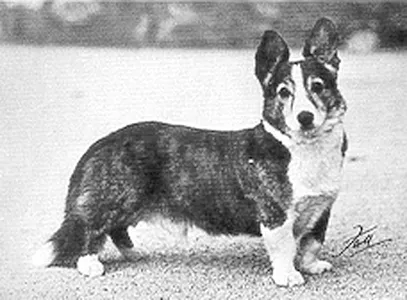
He came from established pre-war Cardigan lines. His sire was Bussleton Chips, one of four Bussleton brothers who played a significant role in Cardigan breeding during the 1930s. Through this branch, Brock's pedigree was connected to the breed's early breeding nucleus, in which Bob Llwyd had an enormous influence.
Brock was not the only Cardigan whose line survived the war. Other important branches survived as well, including those associated with Drudwyn and Dialwr, and after the war several females played an important role in bringing these lines together in new kennels.
This distinction matters: the Cardigan was not rebuilt from a single dog, but the contributions of individual surviving animals were highly unequal.
And Brock became the most striking example.
The Cardigan Welsh Corgi Association calls him the breed's first great sire: between 1947 and 1950, six of his sons and daughters became champions, and between 1949 and 1957, seventeen of his grandchildren achieved championship titles.
His descendants became part of the foundation of Kentwood, which by the end of the 1950s had produced twelve British champions. Through other matings, Brock's blood spread into Greenfarm, Lisaye and numerous later lines.
The breed was recovering, while at the same time its pedigrees were becoming increasingly intertwined around a relatively small number of dogs.
1945: organised dog breeding returns
After the war ended, British breed clubs began returning to normal life surprisingly quickly. As early as November 1945, the Southern Section Welsh Corgi League held the first post-war show in London. Major specialist events resumed in 1946.
The first post-war shows clearly illustrate the very different condition in which the Pembroke and Cardigan emerged from the war: at the first post-war Cardigan Welsh Corgi Association championship show in 1946, only 18 Cardigans were shown, whereas 122 Pembrokes entered the ring at the first post-war Welsh Corgi League championship show.
Of course, these figures do not represent the total populations of the two breeds in Britain; they refer only to dogs shown at those particular events. But the contrast between 18 and 122 gives a vivid indication of just how different the situation of the two breeds was in the first post-war years.
Both breeds survived the same war, but one returned to the ring with more than a hundred dogs, while the other returned with just eighteen.
Saving a breed — and narrowing it at the same time
Rebuilding a breed's numbers after a war does not necessarily restore its former genetic diversity. If the breeding population has declined sharply, breeders have to work with the dogs and bloodlines that remain — and the contribution of those dogs to subsequent generations is almost never equal.
Successful sires can have an especially large influence. If a male fits the desired breed type and reliably passes his qualities to his offspring, he may be used by several kennels. His sons and daughters then enter breeding programmes, followed later by his grandchildren and great-grandchildren. Gradually, the descendants of a single dog spread through numerous kennels and come to be perceived as representatives of different lines. But when those lines meet again in later matings, their common ancestor begins appearing several times within a single pedigree.
This is exactly what happened with Withybrook Brock. His influence spread through the post-war Cardigan population so rapidly that he already appears several times, through different descendants, in the pedigrees of some dogs born in the early 1950s. With each successive generation, the number of these intersections increased.
The basic mathematics of a pedigree is simple: a dog has two parents, four ancestors in the second generation (two grandmothers and two grandfathers), eight in the third, sixteen in the fourth, and the theoretical number continues to double from there. But in a small closed population, all those positions cannot indefinitely be occupied by different dogs. Pedigrees intersect, and the same ancestors appear again and again — sometimes through dozens or hundreds of different paths, and at great depth even through thousands.
The scale of this phenomenon is well illustrated by Brock, whom geneticist Jerold Bell discusses in materials published by the AKC Canine Health Foundation. In a typical modern Cardigan pedigree, Brock lies far back — he first appears at around the fourteenth generation — and at first glance such a distant ancestor might seem too remote to matter very much.
But when all branches of the pedigree are traced rather than a single line of descent, the picture changes completely. According to Bell's estimate, Withybrook Brock occupies, on average, more than 500,000 positions in the pedigree of a modern Cardigan, with an estimated total genetic contribution of about 25%.
Those half a million appearances do not mean that Cardigans were repeatedly bred to close relatives generation after generation, or that breeders deliberately tried to concentrate the breed around one male. Brock's enormous contribution developed gradually: his descendants spread among different kennels, their own lines continued to develop, and generations later those lines repeatedly came together again.
This is how the effects of a small number of breeding animals surviving a period of severe population decline can persist far longer than the crisis itself. By the time a breed becomes numerous again, its pedigrees may already contain a disproportionately large contribution from the dogs that once played the central role in its recovery.
Why Brock's influence became so enormous
Looking at the figures today, it is easy to conclude that the reason for Withybrook Brock's enormous contribution is obvious: a successful sire was simply used too extensively. But that explanation leaves out the most important factor — the condition of the breed in which he was born and used.
The Cardigan had been a small breed long before Brock appeared. When the two corgi breeds were separated in 1934, only 59 registered dogs were classified as Cardigans, and their pedigrees were already closely intertwined. The enormous influence of Bob Llwyd and other early sires shows that the breed's breeding base was fairly narrow even before World War II. The war further reduced breeding opportunities: few puppies were born, normal connections between kennels were disrupted, and some breeding lines were not continued.
After the war, therefore, breeders were not rebuilding from a large and diverse population but from a limited pool of surviving dogs. Under such circumstances, a good sire became particularly valuable. Brock not only conformed to the desired breed type but also passed his qualities successfully to his offspring. His children won championship titles and were themselves widely used for breeding, followed by later generations of his descendants.
This was an understandable way to rebuild a small breed. Breeders faced a practical task: preserve the Cardigan, increase its numbers and establish the desired breed type. They did not have today's tools for assessing genetic diversity. They could not calculate genomic relatedness between a potential pair, examine the distribution of genetic variants across the entire population, or trace pedigrees through dozens of generations in seconds.
The enormous modern contribution of Brock therefore cannot be explained simply by saying that one male was once “used too much.” It resulted from several processes acting together: a small and already related pre-war population, further disruption of breeding during the war, a limited number of surviving breeding lines, and the subsequent success of Brock and his descendants. As the breed recovered, those descendants spread among different kennels, and several generations later their branches began to meet again.
As a result, a dog that helped the Cardigan emerge from a difficult post-war period also became one of the major common ancestors of later generations. This is not a contradiction but a characteristic feature of rebuilding a small closed population: the animals that allow a breed's numbers to recover inevitably make a disproportionately large genetic contribution to its future.
Why the Pembroke was different
The Pembroke also had outstanding ancestors whose influence spread through enormous numbers of later dogs.
One of them is already familiar from the last show of 1940: Ch. Rozavel Red Dragon. Born in 1932, he had already produced numerous descendants before the war. His children and more distant descendants appear in many famous British lines, and the Welsh Corgi League associates him with a significant part of the development of the recognisable Pembroke type.
But we do not have a direct equivalent of the Brock estimate — “half a million appearances and about a quarter of the gene pool” — for Red Dragon, and assigning him such a figure merely for the sake of neat symmetry would be misleading.
The main difference between the two breeds was not whether they had an exceptionally influential sire among their ancestors: such dogs existed in both Pembrokes and Cardigans. Far more important was the state of each population at the beginning of the war.
In 1938, 975 Pembrokes and only 78 Cardigans were registered in Britain. In the few years following the official separation of the breeds, the Pembroke had become far more numerous, while the number of kennels breeding Pembrokes had also expanded. Therefore, even during the war, when normal breeding activity was seriously disrupted, breeders still had more dogs and more lines capable of continuing into the next generation.
The Cardigan faced the same historical crisis with a much smaller and already substantially related population. For such a breed, the loss or discontinuation of even a few breeding lines carried far greater weight, while the contribution of the dogs whose descendants continued to be bred after the war inevitably became more pronounced.
Thus, two breeds that had only recently shared the common name Welsh Corgi lived through the same war with very different reserves of resilience. The war disrupted the development of both, but its long-term imprint on their pedigrees was different.
Susan: another line that began during the war
While the Cardigan was going through one of the most difficult periods in its history, Pembrokes continued to be born during the war — including dogs that would leave a significant mark on the breed. The most famous of these was Susan, given to Princess Elizabeth for her eighteenth birthday in 1944.
By then, corgis had already been part of Royal Family life for years. In the 1930s, Elizabeth's father, the future King George VI, had acquired the Pembroke Dookie for his daughters, and Jane later joined the family. But Susan occupied a special place in this story: she was Elizabeth's own dog, and from her began the line of Pembrokes that the future Queen would maintain for decades.
Susan was born in the middle of the war, when British dog shows had largely ceased, travel and breeding arrangements were difficult, and keeping dogs required additional effort. Yet her story illustrates another aspect of the Pembroke's wartime experience. The breed did not escape the consequences of war, but its larger pre-war population allowed many more breeding lines to survive and continue after 1945.
Later, Susan's descendants became perhaps the most famous Pembroke family in the world because of their association with Queen Elizabeth II. But for our story, another point matters more: Susan was not a single “rescue ancestor” around whom the breed had to be rebuilt. Hers was one of many lines that continued after the war.
And here the difference between the two corgis becomes especially clear. Brock and Susan were born only a few years apart — in 1941 and 1944 — but they entered the post-war histories of their breeds in very different ways. Brock became one of the key ancestors of a small Cardigan population, whereas Susan's line existed within a much larger Pembroke population. The war affected both breeds, but the room they had for subsequent recovery was very different.
War changes more than numbers
Imagine a hypothetical breed that, before the war, contains six relatively independent lines: A — B — C — D — E — F.
After the war, breeding representatives remain in only three of the six — A, B and C — and even their contributions are unequal:
- A - produces fifty breeding dogs in subsequent generations.
- B - produces ten.
- C - produces two.
Twenty years after the crisis, the breed may once again number thousands of dogs. Show rings are full, hundreds of litters are born every year, new kennels appear, and the breed spreads to different countries. In terms of population size, nothing seems to remain of the time when its existence depended on just a handful of surviving breeding animals.
But restoring population size does not restore the former genetic diversity. If some lines disappeared during the crisis — D, E and F in our example — while others continued through only a small number of dogs, as with B and C, all subsequent generations will descend from that limited set of ancestors. The number of dogs grows, but the lost pedigree branches do not return with that growth.
This is the essence of a genetic bottleneck: a population first declines sharply and later expands again, but only part of its former genetic diversity passes through that narrow period. Decades later, the breed may appear numerous and thriving while remaining genetically much more homogeneous than it was before the crisis.
Thousands of modern representatives of a breed therefore do not necessarily mean an equally rich gene pool. What matters is not only how many dogs are alive today, but also how many ancestors and how many surviving lines were responsible for rebuilding that population.
All of this sounds rather abstract until you open the pedigree of a modern dog and try following it backwards. We decided to do exactly that with our Eevee — Sababa Shire Elizabeth Eevee, born in 2021 — to see whether we could reach one of the dogs discussed in this article. The famous Ch. Rozavel Red Dragon turned out to appear more than once: he can be traced through both her maternal and paternal sides. Along one maternal branch, he appears in the 23rd generation; along one paternal branch, in the 24th. Even by manually exploring the pedigree, we found at least four different paths leading from Eevee to Red Dragon, some passing through entirely different kennels before converging again many generations later.
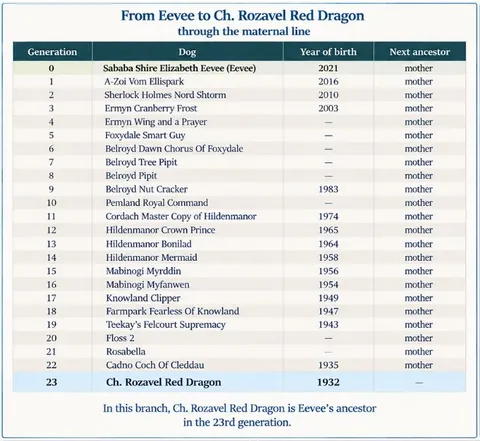
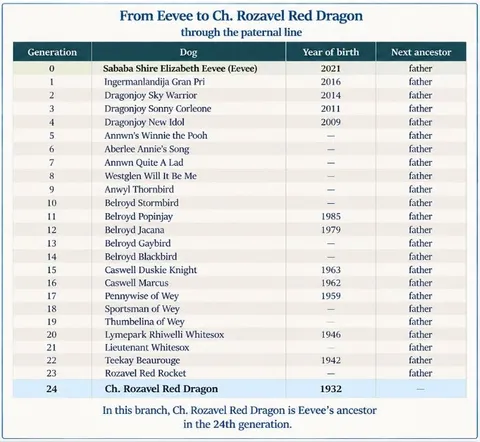
This gives a tangible example of what the repetition of a distant ancestor means in a closed breed population. Nearly ninety years separate Eevee and Red Dragon, yet his name still appears in different parts of her pedigree — not as a single historical entry, but as a common ancestor shared by several lines.
We repeated the same experiment with our Tory — Sababa Shire Karma Vic Tory, born in 2024 — and tried to reach Withybrook Brock. We did not have to search for long: even a manual examination of the pedigree revealed at least six different paths leading from Tory to Brock, with him appearing on both sides of her pedigree. Two of the paths we traced run through her sire's side and four through her dam's side. Depending on the branch, Brock appears approximately 14–17 generations behind Tory. And if we continue still further back, the pedigree begins converging on the breed's earlier breeding nucleus: Bob Llwyd appears again and again, not only through Brock but through other branches as well.
This is Tory's paternal line. We did not even attempt to fit her maternal line into anything resembling a comprehensible diagram :)
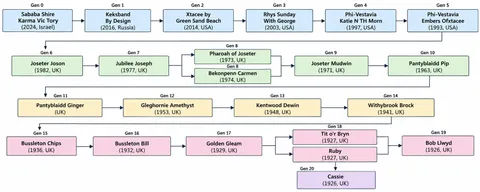
Thus, the story of the Cardigan's small pre-war population, the wartime genetic bottleneck that followed, and the enormous influence of individual breeding dogs becomes visible in the pedigree of a dog born more than eighty years later.
Why this history still matters today
Modern breeders have far more tools available to them than the people who rebuilt breeds after World War II. Today, we can trace a pedigree through dozens of generations, calculate an inbreeding coefficient, assess the relatedness of a potential pair, use genetic tests, and travel between kennels in different countries is no longer the obstacle it was eighty years ago.
All these tools help us manage the genetic diversity that remains in a breed more thoughtfully — but they cannot recreate diversity that has already been lost. If a breeding line ended and particular genetic variants disappeared from the population with its last representatives, simply increasing the breed's population cannot bring them back.
Old pedigrees, therefore, are far more than lists of dogs that died long ago. The names that recur within them allow us to see how the modern population was formed: which breeding animals gained exceptional influence, which lines continued and which disappeared, how freely dogs moved between different kennels, and what periods of severe population decline the breed passed through. Sometimes the causes of these changes arose within dog breeding itself; at other times, they were determined by events entirely beyond it.
The history of the Pembroke and Cardigan during World War II illustrates this particularly well. Two related breeds lived through the same wartime years, but entered them with very different population sizes and different reserves of genetic diversity. After the war, both returned to the show ring, began growing again and eventually spread around the world. But recovering their numbers did not erase what had happened to their breeding populations during the 1940s.
For people, World War II ended in 1945. In the history of dog breeds, its consequences proved far more enduring: they remained in the lines that survived, in those that disappeared forever, and in the pedigrees of modern dogs, where eight decades later we still encounter the names of the few ancestors through whom a breed once continued its story.