In 1968, Pembroke breeder B. M. Morgan decided to look back and remember what corgis had been like before the Second World War. By then, she had known the breed for more than thirty years and had seen several generations of dogs.
Among her recollections is a wonderful observation: “When I came into the breed in 1936, the Corgi was a convenient sized dog, but latterly the emphasis has been on length and bone.”
Morgan went on to explain how, after the war, breeders tried to move away from the overly light type that had appeared during the war years. Good bone became one of the most highly valued qualities — and at times the pendulum swung too far: along with heavier bone came heavy heads and poor feet.
It is a fascinating first-hand account. We are used to looking at old photographs of dogs as if they were a series of frozen moments: this is what the corgi looked like then, and this is what it looks like today. But breeders who spent decades with the breed watched these changes almost in real time. They noticed dogs becoming longer, heavier and more substantial; they debated size and proportions, welcomed some changes and worried about others.
And yet only about a century has passed since corgis first appeared in stud books and show rings. That is roughly twenty to thirty canine generations — enough time for the breed to remain completely recognisable while changing considerably at the same time.
Let us trace those changes through old photographs, breeders’ recollections and the dogs that, in different decades, were considered outstanding representatives of the breed.
When There Was No Single, Uniform Type
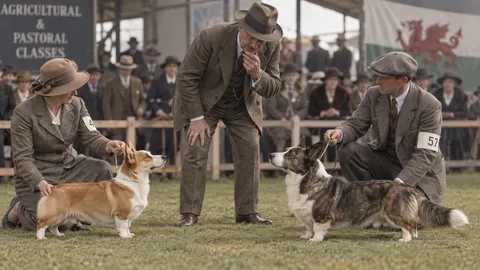
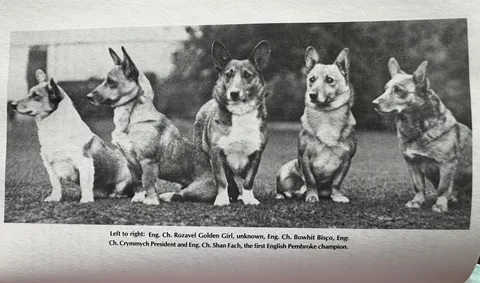
At the earliest Welsh Corgi shows, the variety among the dogs was enormous. It was not only the future Pembrokes and Cardigans that differed from one another — even within each type, there was nothing like the degree of uniformity we expect from a modern breed.
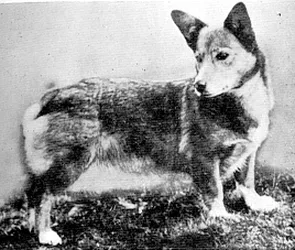
In the ring one could see taller and lower dogs, long-bodied and relatively short-bodied ones, lightly built and substantial ones. Heads, ears, fronts, coats and overall balance varied considerably.
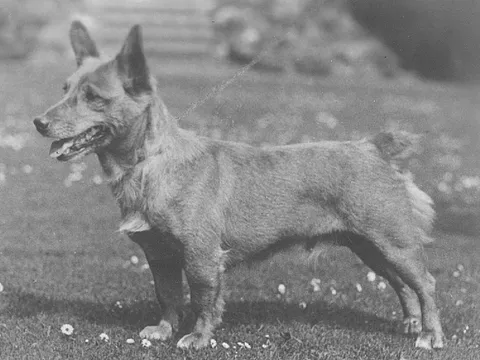
This is easy to see in photographs from the 1920s and early 1930s. Some dogs look surprisingly similar to modern corgis; others would make anyone familiar with the breed take a second look at the caption.
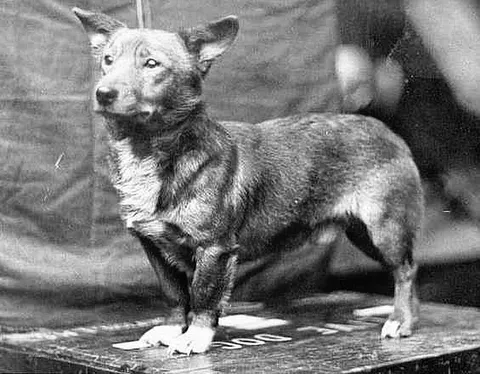
Contemporary observers were well aware of this lack of uniformity.
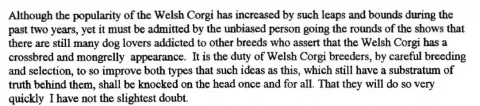
In December 1934, R. H. Voss wrote in Our Dogs that some enthusiasts of other breeds regarded the Welsh Corgi as having a “crossbred and mongrelly appearance.” Voss himself admitted that there was some justification for the criticism and believed that breeders should improve both types through careful breeding and selection.
This is an important starting point for our story. The first breeders were working with practical farm corgis that differed considerably from one another. The familiar, instantly recognisable breed type we know today did not yet exist — it still had to be shaped by selecting dogs with desirable traits and gradually establishing those traits over subsequent generations.
First the Dogs Create the Standard. Then the Standard Changes the Dogs
The first standards were based on corgis that already existed. Breeders looked at the best representatives of their type and gradually decided which characteristics should be preserved and established in future generations.
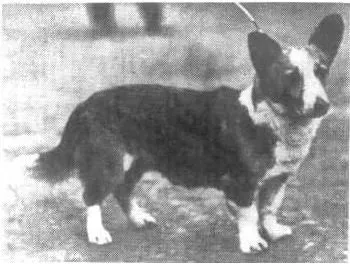
The early Cardigan provides a particularly good example. One of these reference dogs was Bob Llwyd, a red-and-white working corgi born in 1917. He appeared at a major show in Lampeter, Wales, in 1926 and became such an important representative of his type that he is associated with the development of the first Welsh Corgi Cardigan standard.
Once a standard existed, the approach to breeding began to change as well. Breeders could compare their dogs with the ideal described in the standard and plan matings so that desirable characteristics became more pronounced and more consistent. Dog shows influenced this process too: successful dogs attracted attention, were used more often for breeding and produced more descendants.
But this mechanism also has a downside. A winning dog can popularise not only a desirable characteristic but also an exaggeration of it. If similar dogs become increasingly common, within a few generations a new feature may begin to seem perfectly normal for the breed — even if the original standard called for something different.
The history of breed type, therefore, is not a simple progression towards a predetermined ideal. At different times breeders and judges favoured different characteristics, tried to correct the shortcomings of previous generations, sometimes went too far and then changed direction again.
How the Pembroke Changed
By the early 1930s, the Pembroke was already a recognisable dog, but it was still quite far from the modern type familiar to us today. At the same time, the breeding base of the young breed was very small.
In the third edition of The Welsh Corgi (1947), Thelma Gray wrote that, as far as she had been able to trace the pedigrees, all Pembrokes of her time descended from just six bitches and three dogs. In the next generation of these early breeding lines we find Ch. Crymmych President, born in 1929, followed by his son Ch. Rozavel Red Dragon, born in 1932.
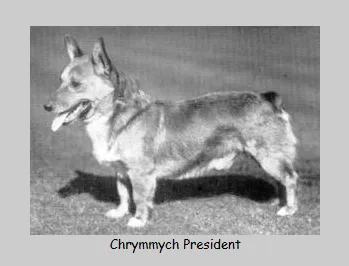
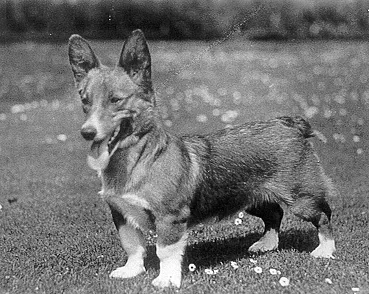
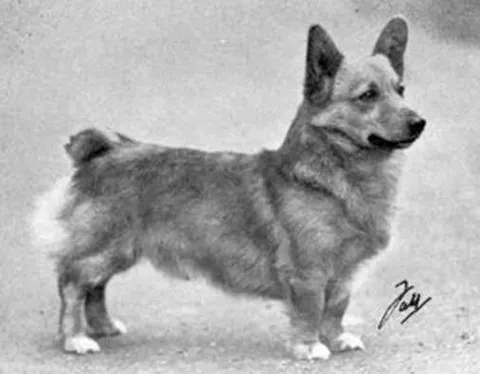
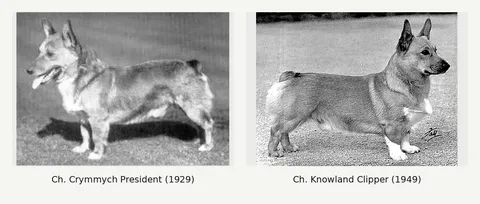
Today, the photograph of Crymmych President is particularly interesting. He is unmistakably a Pembroke, yet his outline differs noticeably from that of a modern dog: he appears lighter, taller, less deep in body and more modest in bone.
Just three years later, his son was born — a dog destined to become one of the most influential Pembrokes in the history of the breed.
Red Dragon and the Power of One Stud Dog
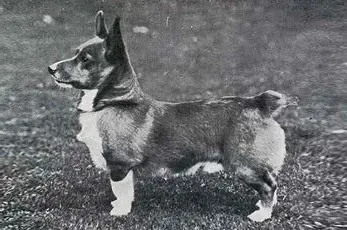
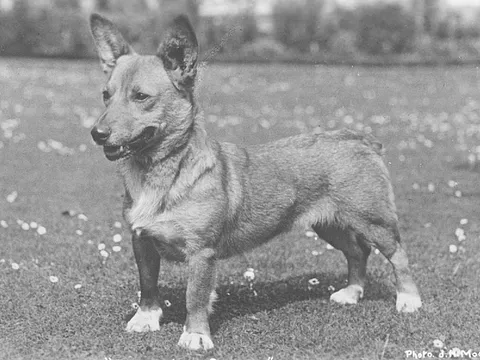
B. M. Morgan believed that Rozavel Red Dragon marked an important stage in the development of modern Pembroke type. He was used extremely widely at stud: he was mated to around one hundred bitches, and thirteen of his offspring later became British champions.
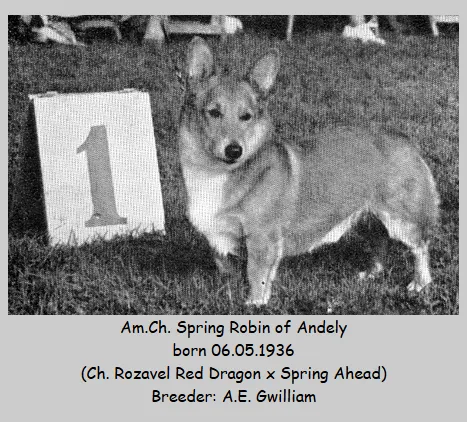
But it was not simply the number of his offspring that mattered; it was their quality. According to Morgan, Red Dragon transmitted the characteristic features of his conformation very strongly to his offspring. Decades later, she still thought highly of the dog himself. In 1968, when the Pembroke had already changed considerably, Morgan wrote that a photograph of Red Dragon could still compare well with the leading winners of her own time. She particularly admired the absence of exaggeration in his conformation.
With such a small original breeding base, the influence of a widely used stud dog could spread through the breed very quickly. Red Dragon remains an ancestor of an enormous number of Pembrokes today, although more than ninety years and many canine generations have passed since his birth.
How far the lines of a single influential sire can spread is easy to see even in the pedigrees of our own dogs. We traced several branches of the pedigrees of Eevee and Kaya back to Rozavel Red Dragon — and found him in both dogs, on both sides of their pedigrees. In Kaya’s pedigree, the lines we traced lead back to him in the 21st and 22nd generations; in Eevee’s, in the 23rd and 24th generations.
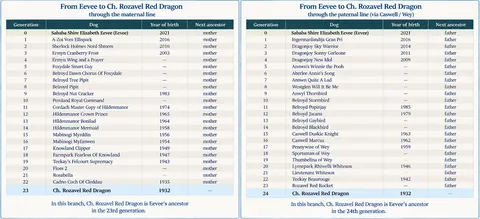
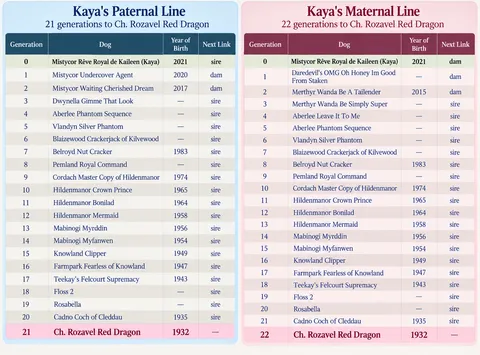
This also revealed another interesting detail: Eevee and Kaya, whose pedigrees look completely different in the first few generations, turned out to be distant relatives themselves. Some of the branches we traced converge as early as Belroyd Nut Cracker, born in 1983: he appears in the 7th and 8th generations of the two lines we found in Kaya’s pedigree, and in the 9th generation of one of Eevee’s lines.
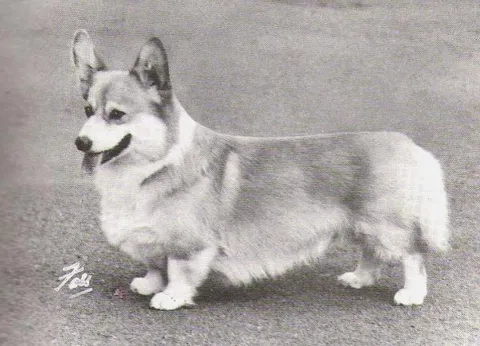
From there, they share the same chain of ancestors, which includes Knowland Clipper and Teekay’s Felcourt Supremacy, and, further back, Rozavel Red Dragon.
Of course, this does not mean that after more than twenty generations a modern dog necessarily retains a significant proportion of DNA specifically from Red Dragon. A pedigree tells us about ancestry, but it cannot tell us which segments of DNA from such a distant ancestor actually made their way to a particular dog. What it does illustrate beautifully is something else: how the lines of a widely used sire can spread through a closed breed, intertwine with one another, and still be found decades later in the pedigrees of dogs that may appear completely unrelated in their first few generations.
********************
Returning to our famous ancestor, there is a wonderful story about Red Dragon that has survived — and it is simply too good not to tell, even if it is not entirely relevant to the subject of this article.
In 1934, before he had become a champion, he was being taken to a dog show — and escaped at Ryde railway station on the Isle of Wight.
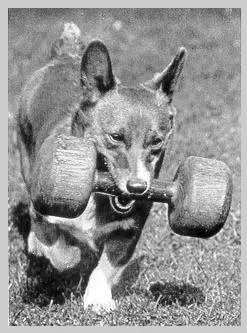
The police joined the search, posters were put up and an advertisement was placed in the newspaper. But simply writing “lost corgi” was not enough at the time: the breed was still little known. So Red Dragon had to be introduced to readers as a small reddish-brown dog with a fox-like head and no tail.
Fortunately, the escape did not last long. The following day, Red Dragon was discovered under a bench, from which he had to be retrieved rather decisively — with a rugby tackle. After all those adventures, he still made it to the show.
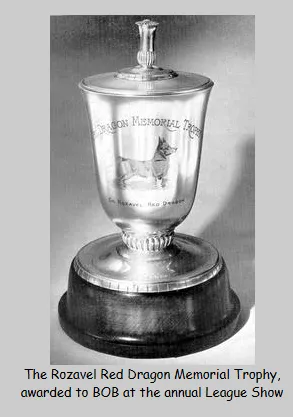
...Returning to the history of the breed, however, it would be wrong to imagine it as a simple chain in which Red Dragon and his descendants alone gradually “turned into” the modern corgi. Many dogs and several breeding lines contributed to the formation of the new type, and thanks to surviving photographs we can follow the process almost generation by generation.
From Red Dragon to the Modern Pembroke
Breed historian Simon Parsons believes that the most striking changes in Pembroke type took place between the 1930s and the 1960s. In his account, he traces these changes through individual dogs and shows how several lines gradually came together to produce the appearance we now regard as familiar.
One important dog of the next period was Ch. Teekay's Felcourt Supremacy, born in 1943.
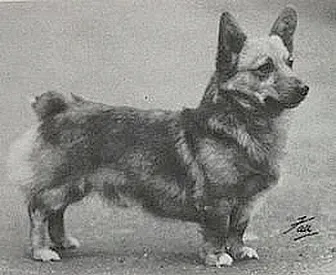
In Parsons’s view, Supremacy himself did not differ dramatically in type from dogs of the previous generation, but as a sire he proved much more significant: his offspring possessed qualities that breeders and judges were looking for.
At around the same time, other influential lines were emerging, including those associated with Ch. Broom of Ballybentra and Ch. Sonec of Rode. Modern type did not develop within a single family of dogs — breeders combined lines and selected descendants with the most successful combinations of traits.
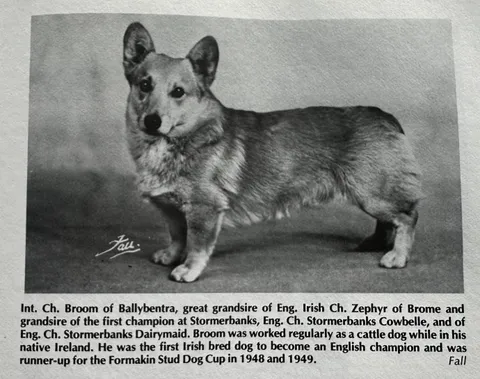
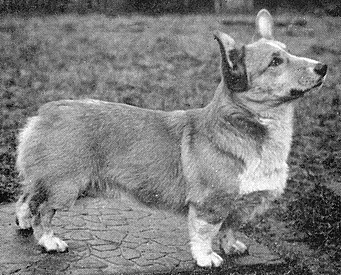
And within just a few years, dogs began to appear in which it is much easier to recognise the modern Pembroke.
The Pembroke Becomes More Familiar
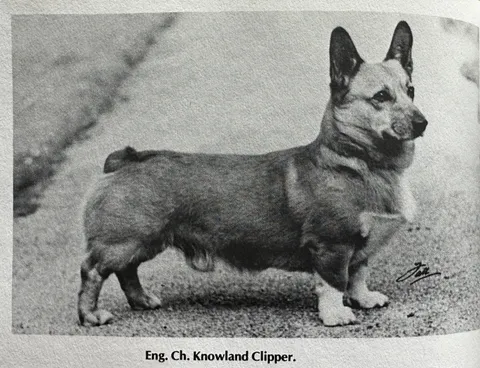
Simon Parsons describes Ch. Knowland Clipper, born in 1949, as perhaps the first dog to display the balance we are accustomed to seeing in modern Pembrokes.
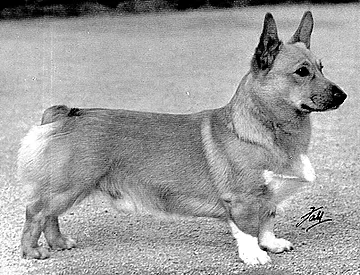
Place him beside Crymmych President from twenty years earlier, and the changes are difficult to miss.
In Ch. Lees Symphony, born in 1951, modern type becomes even more apparent.
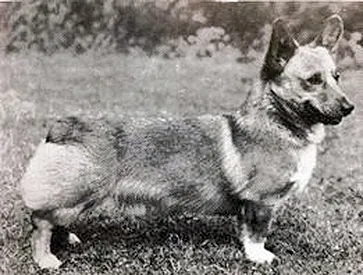
And that is particularly striking: only twenty-two years separate Crymmych President and Symphony — a very short period in terms of breed development.
But change did not occur evenly or in a single direction. Different lines carried different combinations of traits; breeders brought those lines together, selected the most successful dogs again and used the results in subsequent generations.
The new Pembroke gradually emerged from the accumulation of many small breeding decisions.
Why the Pembroke Became Heavier
Photographs show us how the Pembroke changed, while breeders’ recollections help us understand why. Size and bone did not move steadily in one direction: at different times breeders sought lighter, more compact dogs and then, conversely, tried to restore greater size and substance.
When B. M. Morgan entered the breed in 1936, the Pembroke was, in her words, a dog of fairly moderate, “convenient” size. By the late 1930s, however, another trend had appeared: dogs were becoming smaller and lighter.
In 1946, Thelma Gray recalled that early Pembrokes had varied greatly in size, but large and medium-sized dogs predominated, while small, fine-boned animals were relatively uncommon. A year or two before the beginning of the Second World War, this started to change: smaller, lighter dogs appeared more frequently, and Gray associated the trend in part with close linebreeding and inbreeding used to establish desirable traits.
The war severely disrupted normal breeding programmes, and the problem became even more apparent. Morgan recalled seeing many overly light, fine-boned dogs during the war years.
After the war, however, breeders began moving in the opposite direction: good bone once again became highly valued.
By 1954 the result was noticeable enough for breeder Anne Biddlecombe to devote an entire article to Pembroke size, under the telling title “The Vexed Question of Size”. She regarded the return to more substantial dogs as beneficial to the breed, while at the same time noting a new tendency: show Pembrokes were increasingly approaching the upper limits of desirable size and weight.
Biddlecombe compared what was happening to a pendulum. Only recently the breed had been in danger of becoming too small and fine-boned; now the pendulum had swung back, and it was important not to let it travel too far in the opposite direction.
Those concerns proved justified. By 1968 Morgan was writing that the desire for more bone sometimes resulted in excessively heavy heads and poor feet.
The more substantial Pembroke familiar to us today did not appear because breeders simply decided one day to make the corgi larger and heavier. They were reacting to what they saw in the breed at a particular moment: trying to correct excessive lightness, selecting for stronger bone, and then noticing when movement in that direction began to go too far.
It is a perfect example of how breed type changes. Selection can shift a breed in one direction surprisingly quickly — and the next generation of breeders may already be trying to find a balance between two extremes.
The Head: the Ideal Came Before Uniformity
The idea of what a desirable Pembroke head should look like developed quite early. As early as 1936, when Pembrokes and Cardigans had only recently been recognised as separate breeds, Kennel and Bench described the Pembroke head as fox-like in shape and expression, with good width between the ears, a muzzle of medium length and erect ears of medium size.
The familiar features are easy to recognise in the modern standard as well: a skull fairly broad and flat between the ears, a moderate stop, a muzzle tapering gradually and erect ears. One could say that the idea of what a Pembroke should look like has changed less over the decades than old photographs might suggest. The greater challenge was making sure that the desired characteristics appeared together consistently in most dogs.
In 1946, Thelma Gray compared the Pembrokes of her own time with those she remembered from the 1930s. Among the early corgis, she wrote, there had been many coarse heads, but also some beautifully proportioned ones with the characteristic fox-like expression.
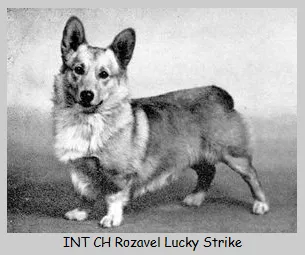
Ten years later, Gray did not consider the situation an unequivocal improvement. There were few heavy heads, but truly magnificent ones were also rare. Instead, she was concerned by the prevalence of small, narrow, pointed heads, often accompanied by a pronounced occiput and prominent eyes — a type she considered entirely uncharacteristic of the Pembroke.
This creates an interesting paradox: breeders developed a fairly clear idea of what a good Pembroke head should be quite early, but the path towards reproducing it consistently was anything but straightforward. Some faults became less common only for others to appear in their place, and heads could still vary considerably among dogs of the same generation.
Photographs from different decades show this variation gradually diminishing. Modern Pembrokes are not identical either, but the characteristic combination of skull shape, muzzle, ears and expression has become a much more consistent part of breed type.
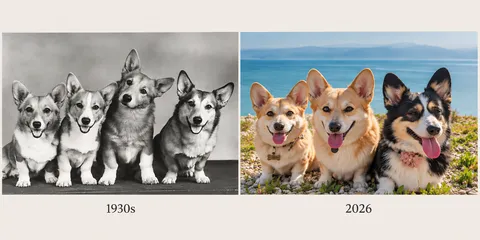
By the 1960s, Modern Type Is Already Visible
By the early 1960s, Pembrokes begin to appear in photographs that look much more familiar to anyone who knows the modern breed well.
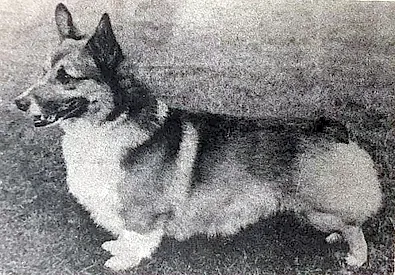
One of the most important dogs of this period was Ch. Caswell Duskie Knight, born in 1963.
Even more revealing is his daughter, Ch. Evancoyd Personality Girl, born in 1967.
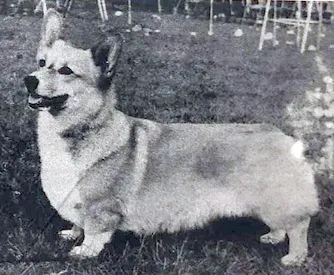
Parsons regards these dogs as representatives of the type and balance that would, to a considerable extent, guide the breed’s subsequent development. In the earliest photographs we sometimes have to look carefully for the familiar Pembroke; here, we recognise it almost immediately.
Within just a few decades, the outline had become much more consistent. But development certainly did not stop there.
Coat Changes the Outline Too
Comparing early and modern representatives of the breed, the Welsh Corgi League notes several other changes: over time, the Pembroke became larger, heavier in bone and acquired the more glamorous coat demanded in the show ring.
The last of these is particularly obvious in photographs.
Many early dogs have coats that look relatively modest and practical, while the coat of a modern show Pembroke can noticeably alter the entire outline: a rich ruff adds volume to the front, well-furnished thighs make the rear appear more powerful, and a dense body coat increases the impression of depth and substance.
So when comparing photographs from different decades, it is worth remembering that it was not only what lay beneath the coat that changed — the coat itself changed too.
Did the Legs Really Become Shorter?
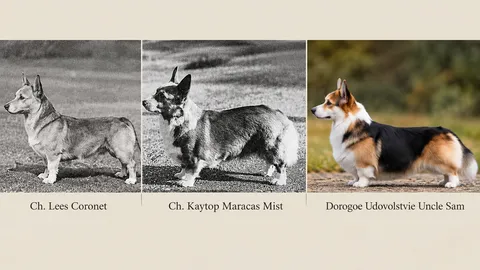
In old photographs, Pembrokes often appear noticeably taller than modern dogs; Crymmych President is an excellent example.
But it would be too bold to conclude from photographs alone that the Pembroke’s legs simply “became shorter” over the course of a century.
Several factors affect what we see. A deeper, fuller body brings the lower line of the chest closer to the ground. Heavier bone changes the visual impression of the limbs. A richer coat adds volume to the body. Even with relatively little change in the actual length of the legs, the whole dog can appear much lower.
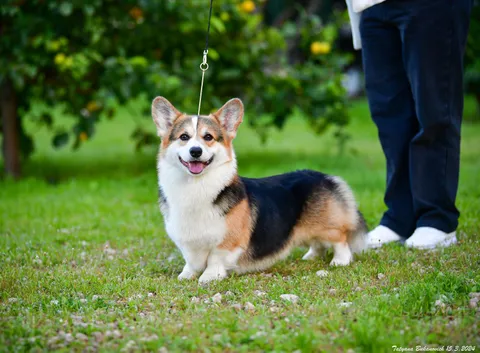
There is also a simpler problem: old photographs were taken from different angles, dogs were posed very differently, and sometimes only a single photograph of a particular champion survives. These images allow us to speak with reasonable confidence about changes in overall outline and proportions, but they should not be treated as measuring instruments.
If, instead of comparing only two photographs — “then and now” — we place an entire sequence before us, Crymmych President → Red Dragon → Felcourt Supremacy → Knowland Clipper → Lees Symphony → Duskie Knight → Personality Girl → modern Pembroke, the change becomes much easier to understand.
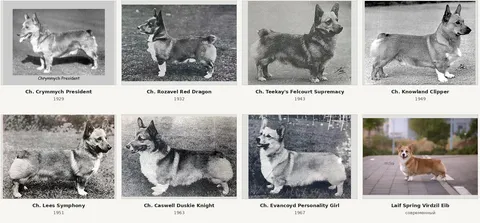
And perhaps the most interesting thing is not even that the Pembroke became heavier, deeper-bodied or more profusely coated.
In early photographs we see a fairly broad range of types. By the 1960s, the differences between individual dogs become noticeably smaller, while good modern Pembrokes, despite differences between lines and individual animals, are much more readily recognisable as representatives of the same breed.
Over several decades, breeders did more than change individual characteristics — they made breed type itself far more consistent.
The Cardigan Took a Different Path
After the official separation of the breeds in 1934, Pembrokes and Cardigans were able to develop independently.
We have already told the story of the separation itself in a separate article, so here it is enough to remember the central point: differences between the two types existed long before separate stud books were established.
Contemporary observers saw them clearly. In a 1934 letter, Edith Morgan described the Cardigan as a longer, heavier dog with curved forelegs and a long, bushy tail, and the Pembroke as a lighter type with a straight front and a short or absent tail.
In December of the same year, R. H. Voss identified four principal characteristics distinguishing the Cardigan from the Pembroke: larger size, a slightly bowed front, a decidedly long body and a long, fox-brush tail.
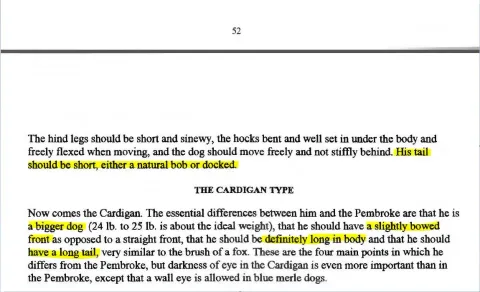
The modern Cardigan is still easily recognised by these characteristics, and this is one of the most interesting differences between its history and that of the Pembroke. The Cardigan also looks different in old photographs, but many features of modern breed type can already be seen in the earliest dogs.
The Dog That Helped Shape the Standard
One of the best examples is Bob Llwyd, mentioned earlier in this article, a red-and-white working corgi born in 1917 to unregistered parents.
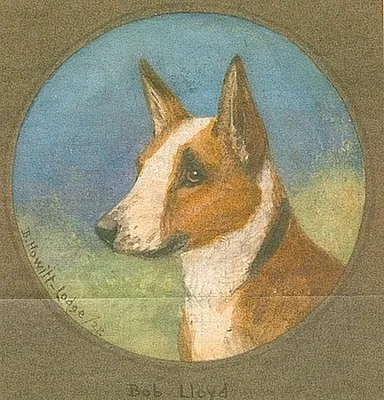
In 1926 he was shown at the agricultural show in Lampeter, where separate classes were held for local herding dogs. Bob Llwyd won the open dog class and soon became one of the most influential sires among early Cardigans.
But something else is even more relevant to our story: when the first standard for the Cardiganshire type was being developed, Bob Llwyd was used as one of the principal models for what that type should be.
Today, almost a century later, it is easy to recognise the ancestor of the modern Cardigan in a photograph of Bob Llwyd.
Of course, a modern show Cardigan looks different. Yet many familiar characteristics are already clearly visible in Bob Llwyd: a long body, substantial bone, the characteristic curve of the forelegs, large ears and a long, low-set tail.
The task facing the first breeders was not to invent a new Cardigan from scratch, but to establish characteristics that already existed and make them more consistent in subsequent generations.
And that proved much more difficult.
“How Can These Two Dogs Possibly Be the Same Breed?”
The arrival of the Cardigan in America provides a wonderful illustration of just how variable the early breed still was.
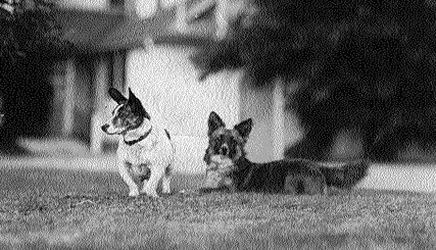
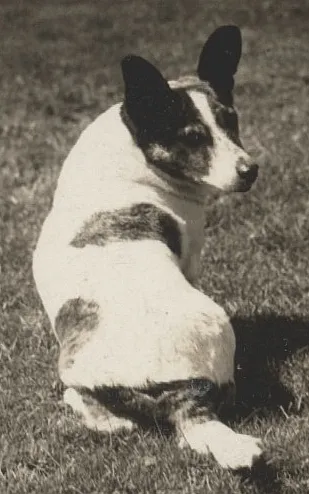
In the early 1930s, two British Cardigans, Cassie and Cadno, were imported to the United States. Their new owner, B. P. Bole, later recalled her first impression of the dogs with some astonishment: they looked so different that it was difficult to believe they belonged to the same breed. In her words: “They bore little resemblance to each other. The dog, a six months old puppy with his ears still down, looked like a miniature long-haired Collie on very short legs. He was long-haired and solid red. The bitch looked like a cross between a Dachshund and a Fox Terrier, with a suggestion of another bar sinister in her French Bull ears. The latter were very large and upright.”
But what happened next was even more interesting.
The first American litters produced puppies of very different types. Some were higher on the leg, others low and stocky; there were long-coated dogs, puppies whose ears failed to stand, dogs with almost straight forelegs — and, at the other extreme, dogs whose forelegs were so strongly curved that Bole compared them to the letter S. And all of this occurred within one young breed.
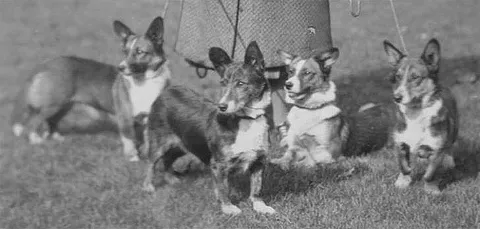
Bole concluded that the Cardigan Welsh Corgi of the time was still far from uniform. Yet she also watched the situation begin to change: through selection, puppies in subsequent generations became increasingly consistent in type.
For our purposes, it is almost a perfect experiment — except that it was conducted not deliberately, but by the history of the breed itself.
Even Breeders Were Still Debating What a Cardigan Should Be
The problem was not simply that the dogs looked different. In the 1930s, even experienced breeders did not fully agree on which of those differences should be preserved.
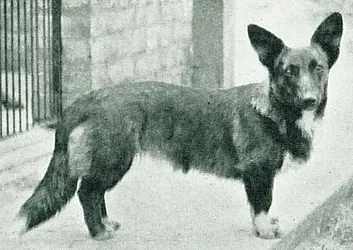
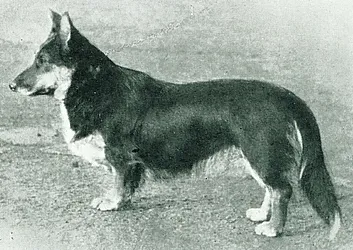
Bole asked British experts for advice — and sometimes received completely contradictory answers.
Some favoured more compact, lower dogs; others remembered the old Cardiganshire type as a considerably heavier and larger animal. Some were unconcerned by certain colours, while others regarded them as evidence of recent crossing with the Pembroke.
This is an important point: a standard already existed, the Cardigan Welsh Corgi had already been recognised as a separate breed, but the understanding of what that standard should look like in a living dog was still developing.
Old photographs, therefore, do not show an early, slightly imperfect copy of the modern Cardigan. They show a period in which breeders were still deciding which variations within the existing type would form the basis of future generations.
After the War, Type Begins to Stabilise
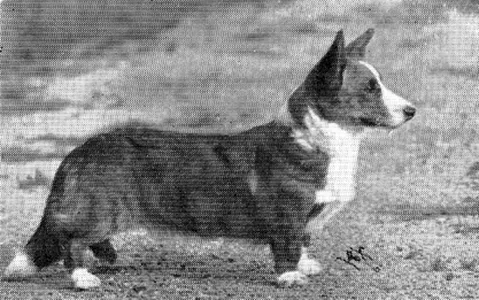
By the 1940s, the effects of deliberate selection become more apparent. Photographs from this period increasingly show a more consistent combination of the characteristics breeders were trying to establish.
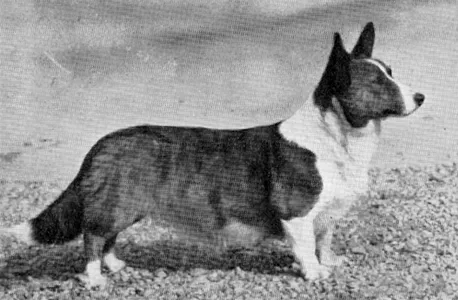
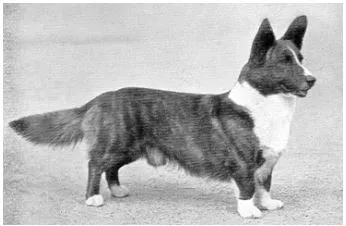
A good example is Ch. Withybrook Brock, born in 1941. C. Patrick Ormos, tracing the development of breed type through old photographs, notes his correct height-to-length relationship, powerful bone, low tail set and erect ears. Brock was by no means flawless, however: his ears, for example, were somewhat soft at the base — a fault that, as Ormos observes, continued to occur in Cardigans many decades later.
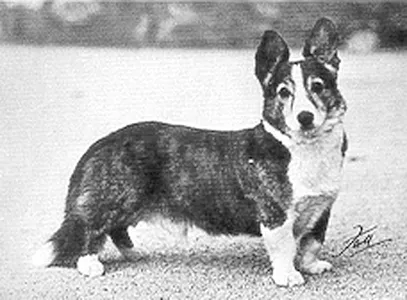
But the influence of a sire is best seen not in the dog himself, but in his offspring. Among Brock’s offspring were Ch. Hannaford Budge and Ch. Withybrook Jill, and here Ormos explicitly speaks of the “stabilisation of type”. In both dogs he notes a better height-to-length relationship, tail set, ears and a head shape more characteristic of the Cardigan.
Kentwood and the Cardigan That Could Still Walk Into the Ring
One of Withybrook Brock’s sons was Ch. Kentwood Dewin — the first champion of the famous Kentwood kennel.
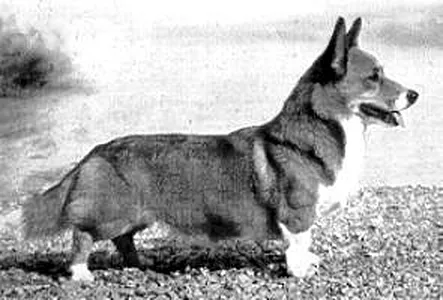
His photograph already shows particularly good depth of chest and a well-developed forechest. C. Patrick Ormos, tracing the development of Cardigan type through old photographs, observes that Dewin could have competed successfully much later.
Even more revealing, however, was his son Ch. Kentwood Cymro.
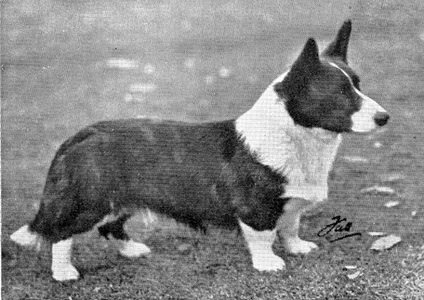
Cymro became one of the best-known dogs of his time and had a major influence on subsequent generations. Moreover, in 1982 the committee of the Cardigan Welsh Corgi Association selected his photograph to illustrate the breed standard.
This gives us a fascinating opportunity to compare two reference points separated by several decades.
In the 1920s, Bob Llwyd, a working farm corgi, became one of the models used in developing the first Cardigan Welsh Corgi standard. In 1982, the Cardigan Welsh Corgi Association selected a photograph of Kentwood Cymro to illustrate that standard.
Looking at these two dogs, we can see both how much breed type changed over the intervening decades — and how many characteristics of the early Cardigan remained.
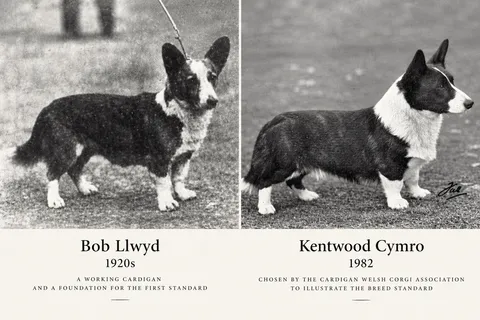
The changes are obvious, yet despite all the differences, in Cymro it is still easy to recognise the Cardigan that the first breeders had seen in Bob Llwyd.
From Early Type to the Modern Cardigan
Kentwood was far from the only kennel to influence the development of the breed. After the war, lines such as Rozavel, Pantyblaidd, Parmel, Dilwel and Robgwen, among others, emerged and became established.
In photographs from the 1950s and 1960s, modern type becomes increasingly recognisable.
Ch. Parmel Dambuster already has a very familiar outline — a long, low body, a good topline and a more elegant neck. Then came Ch. Pantyblaidd Pip, Ch. Parmel Digger, Ch. Echium of Hezelclose and Ch. Wendac Robgwen Midnight Special. By the end of the 1960s, individual dogs certainly still differed from one another, but the breed had acquired a much clearer visual identity.
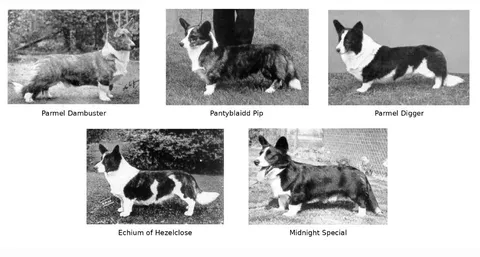
Large ears, a strong head without coarseness, a long body, deep chest, pronounced forechest, characteristically curved forelegs and a long, low-set tail now came together in the outline we readily recognise today.
All of these characteristics had existed in Cardigans before. The difference was that, over time, they increasingly appeared together in the same dog, creating the recognisable breed type we see today.
Development Did Not Follow Quite the Same Path in Every Country
At this point, the history of the Cardigan takes another interesting turn.
The first American dogs came from early British stock, after which breeding on opposite sides of the Atlantic developed relatively independently for a time.
As a result, American Cardigans remained closer for some time to the type of dogs imported from Britain in the early 1930s, while the breed continued to change in Britain itself. Gradually, noticeable differences emerged between dogs on the two sides of the Atlantic in overall outline, head shape, neck length, depth of body and bone. Looking at British and American champions from the same period, it can sometimes be difficult to believe that they were contemporaries: by then, breed type had diverged considerably across the Atlantic.
A good example is provided by two champions born in the same year, 1963: the American Ch. Domino's Beau Jester and the British Eng. Ch. Parmel Digger. Looking at their photographs, it is not easy to believe that the two dogs were contemporaries.
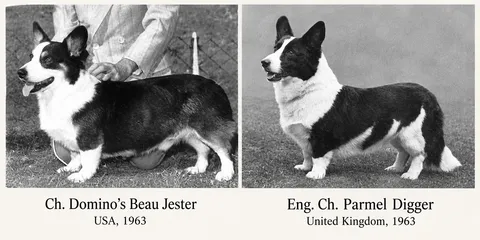
Over time, this difference began to diminish. New imports from Britain and the exchange of breeding stock between countries brought American and British Cardigans closer together again. Characteristics that had developed somewhat differently on opposite sides of the Atlantic over several decades began to mix once more in shared pedigrees, and the differences between the two types gradually became less pronounced.
Large Ears, a Long Body and That Distinctive Front
If the most striking feature in old photographs of Pembrokes is the change in overall outline, with Cardigans it is fascinating to watch characteristics that had existed from the beginning become increasingly consistent.
Large, rounded ears are a perfect example.
They are clearly visible even in Bob Llwyd, although ear shape, size and carriage varied considerably among early dogs. Later, large ears with a broad base became one of the breed’s most recognisable features.
The structure of the forequarters developed in a similar way.
The characteristic curve of the Cardigan’s forelegs is not a later show-ring fashion; early writers described it, and it can be seen in old photographs.
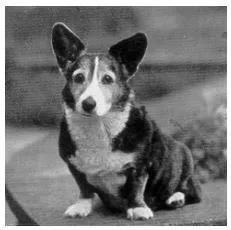
But there is an important difference between the correct curvature of the bones around a deep chest and simply crooked legs — a problem breeders faced in the past and continue to face today. Fronts improved noticeably in later generations, although authors studying the breed’s development continued to regard the forequarters as one of the more difficult areas to breed correctly.
Over time, heads acquired outlines more familiar to us, while body proportions and toplines became more consistent. Gradually, the modern Cardigan developed into a much more uniform type.
How Coat Changes the Outline
There is another reason to be cautious when comparing old and modern photographs: coat. In Cardigans, it can significantly alter the visual impression of a dog’s size and substance. A denser, fuller coat can make a dog appear larger, deeper and heavier, while a close-lying coat emphasises the actual outline of the body more clearly. Some of the apparent differences between Cardigans of different decades may therefore reflect not only their structure, but their coats as well.
The Cardigan Changed — Without Losing Its Identity
If we arrange the photographs in a single sequence — Bob Llwyd → Withybrook Brock → Kentwood Dewin → Kentwood Cymro → Pantyblaidd Pip → Parmel Digger → late twentieth-century dogs → modern Cardigan — the picture is somewhat different from that of the Pembroke.
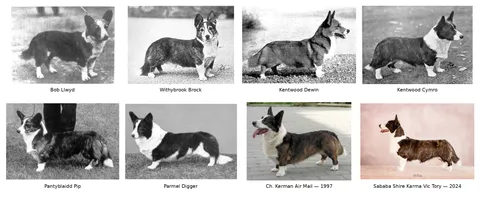
The difference between the first and last dog is obvious.
But something else is even more interesting: the Cardigan’s fundamental characteristics are present through almost the entire sequence. Large ears, a long body, a powerful chest, characteristic forequarter construction and a long, low-set tail did not suddenly appear in the middle of the twentieth century. They had existed in the breed much earlier, but appeared in many different combinations and varied greatly in how strongly they were expressed in individual dogs.
Over the following decades, proportions and details changed, but the most important development becomes apparent when we look at the sequence as a whole: the dogs gradually became more similar to one another. What had existed among early Cardigans as numerous variations within a type eventually developed into a much more uniform and consistent breed appearance.
By the 1970s and 1980s, the breed’s basic outline was already well established, although specialists continued to discuss heads, ears, forequarters, toplines and hindquarters. The breed continued to change — the changes simply became less obvious from one generation to the next.
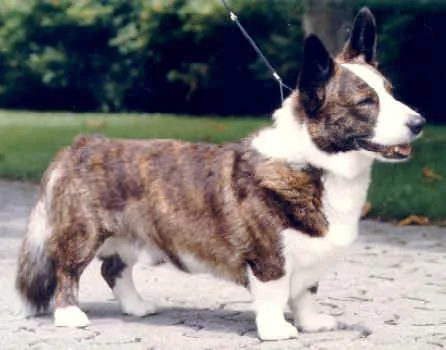
And if we now return to the Pembroke, it becomes particularly clear how differently the two breeds travelled. Over the course of a century, the Pembroke’s outline itself changed noticeably: the body became deeper, the bone heavier and the coat fuller, while the Cardigan retained far more of the characteristics visible in dogs from the first decades of the twentieth century.
Yet in one respect, decades of breeding produced a similar result in both breeds. Early photographs of Pembrokes and Cardigans show astonishing variety: dogs standing side by side could look like representatives of completely different types. Gradually, those differences diminished, while the characteristics associated with each breed increasingly appeared together in the same dog. Two highly variable groups of corgis became two breeds whose individual representatives today are much more alike.
Is the Modern Corgi Better?
After looking at all these photographs, it is tempting to ask the most obvious question: which corgi is actually better — the one from a hundred years ago, or the modern dog?
Old photographs cannot answer that.
A dog of the 1920s lived in a very different world. Many early corgis came from working farm dogs, and organised pedigree breeding was only beginning. There were no dozens of generations of documented pedigrees, enormous international dog shows, or the possibility of sending a dog or genetic material across a continent within hours.
The goals of selection gradually changed as well. Corgis were still expected to be correctly constructed and capable of moving well, but conformity to the standard, breed type and success in the show ring became increasingly important.
We can see fairly clearly what happened over the course of a century.
The Pembroke became heavier in bone and deeper in body, while its proportions and coat changed. The Cardigan retained many characteristics already visible in the earliest representatives of the breed, but its type also became considerably more consistent. In both breeds, the enormous variation in proportions and breed type visible in photographs from the early decades gradually diminished.
We can trace the influence of individual sires and kennels and see desirable characteristics spread within only a few generations. And thanks to the recollections of breeders themselves, we know that the process was anything but linear: sometimes, in trying to correct one fault, a breed began moving towards the opposite extreme.
But that does not mean that every change was necessarily an improvement.
Whether the modern corgi is better than its ancestors is a different question altogether. Comparing old and modern photographs is not enough to answer it. We would need to consider not only conformation, but health and longevity, quality of movement, working ability and the effects that changing proportions may have had on the dogs’ functionality.
Photographs can show us how the corgi changed, but they cannot tell us whether it became better.
That is a subject for another discussion.
A Hundred Years — and Still a Corgi
Perhaps the scale of what happened is easiest to appreciate not by comparing two photographs — “then and now” — but by looking at a long sequence of dogs.
For the Pembroke, we can place Crymmych President, Rozavel Red Dragon, Felcourt Supremacy, Knowland Clipper, Lees Symphony, Duskie Knight, Personality Girl and a modern representative of the breed side by side.
The Cardigan gives us a different sequence: Bob Llwyd, Withybrook Brock, Kentwood Dewin, Kentwood Cymro, Pantyblaidd Pip, Parmel Digger, late twentieth-century dogs and the modern Cardigan.
Between any two neighbouring photographs, very little seems to happen. Puppies resemble their parents. Each new generation resembles the one before it. A breeder chooses one mating and then keeps one puppy. A successful sire produces many offspring. A dog wins a major show, attracts the attention of other breeders — and its characteristics begin to appear more often in subsequent generations.
A particular trait becomes especially valued, and within a few decades it becomes a familiar part of breed type. Sometimes breeders realise that they have gone too far — and the pendulum begins to swing back.
A single decision like this is almost impossible to see in a photograph.
But over a hundred years, there have been thousands of them.
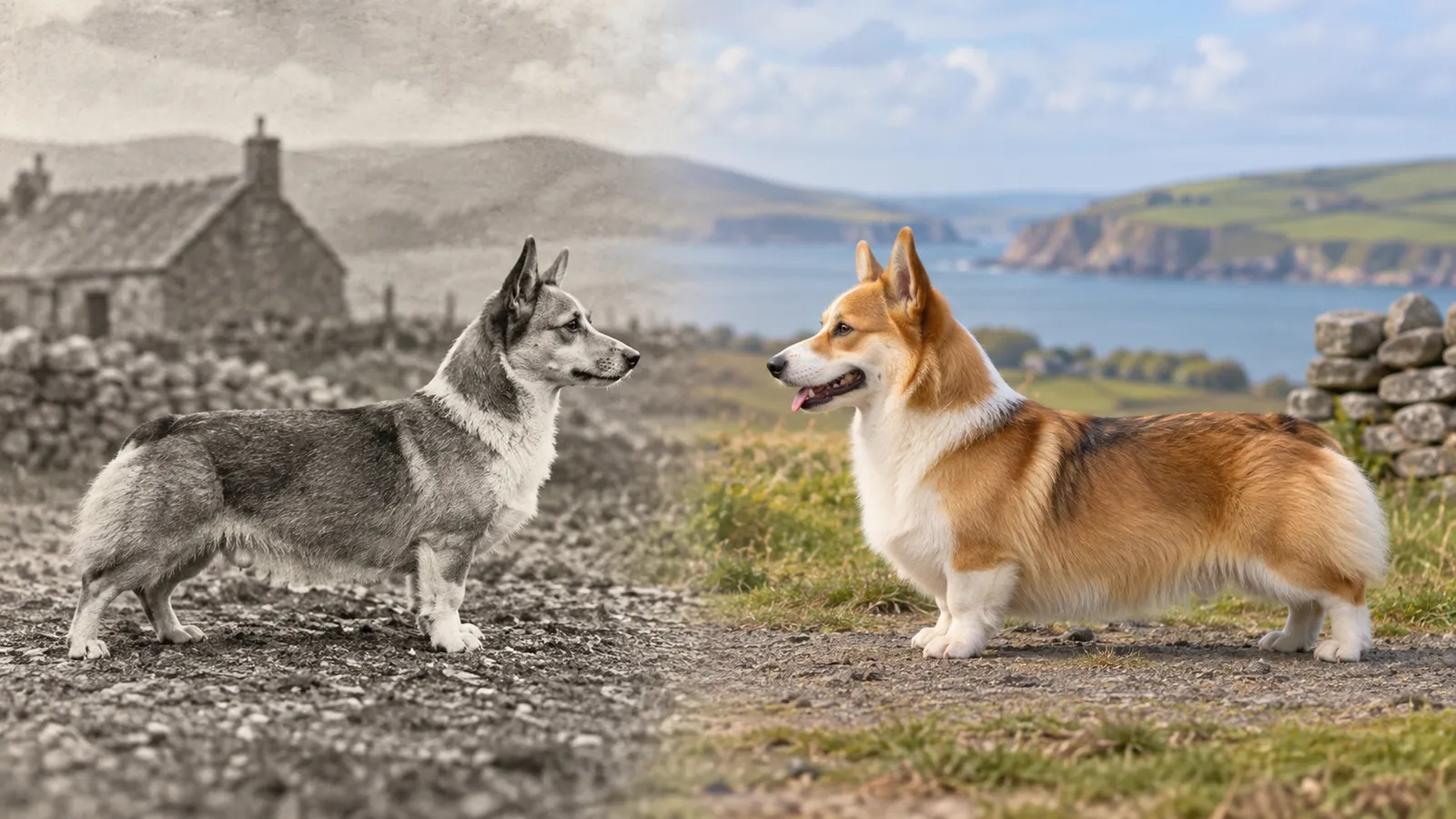
And if we remove all the intermediate generations and place only the earliest registered corgis beside modern dogs, the difference is enormous.
Yet something remarkable happens.
In Bob Llwyd, we still recognise a Cardigan. In Crymmych President, a Pembroke. And however distant a descendant the modern corgi may be, it retains enough of their characteristics for that connection to remain visible dozens of generations later.
Perhaps this is what makes old photographs so fascinating. They show us not only how profoundly people can change a breed, but how those changes accumulate — little by little, generation after generation.
About a hundred years have passed. The corgi has changed considerably. And yet it is still a corgi.
==============================================