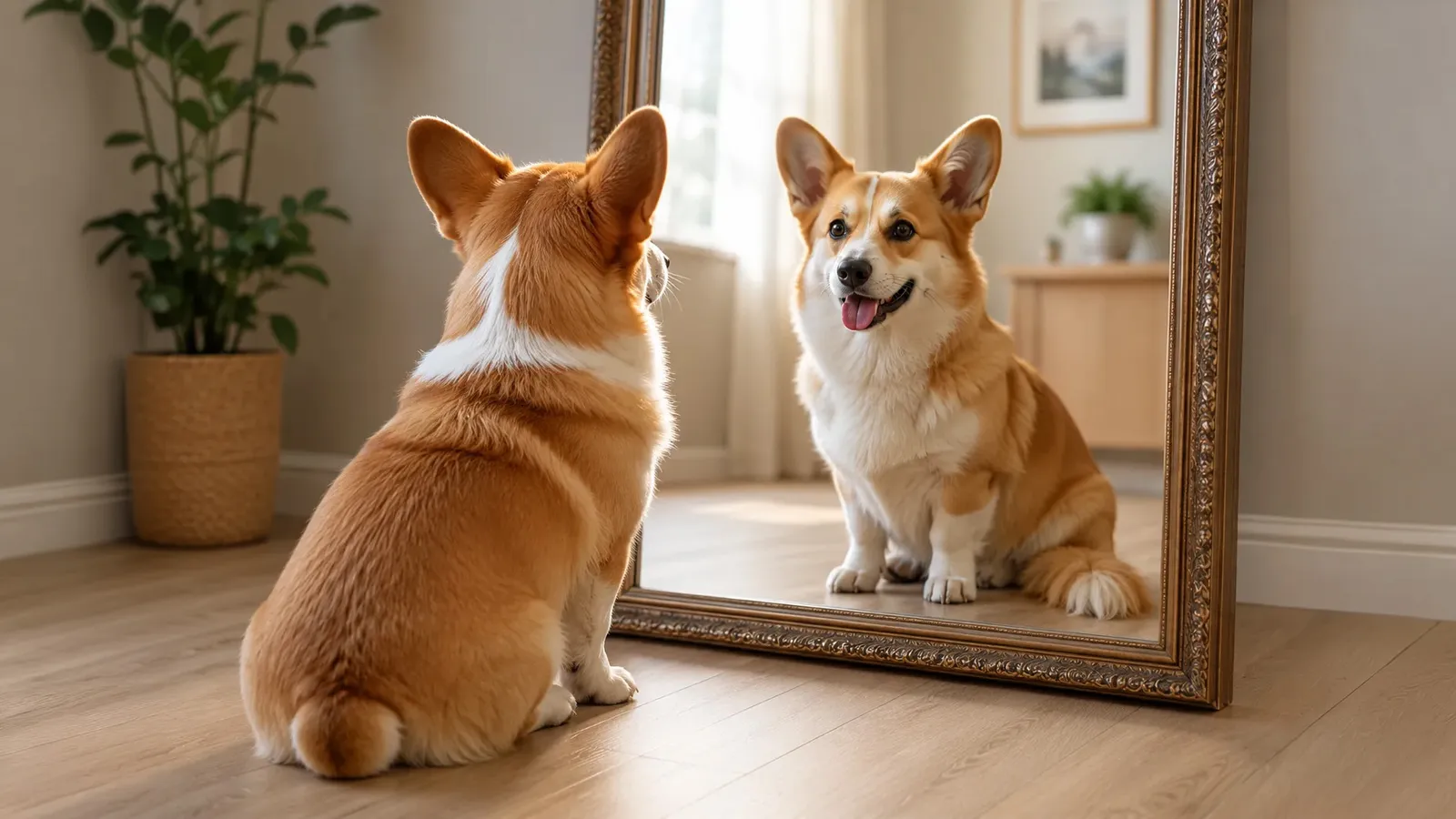
Why are some welsh corgi pembrokes born with short tails, while others have long ones? Is it true that a long tail means the dog is “not purebred”? Why were tails docked in the past, and why is this hardly done anywhere today? Let’s look at the breed’s history, modern genetics, and the most common myths about corgi tails.
Why Do Corgis Have Different Tails?
This is one of the questions we hear most often from future owners.
— Why does this puppy have a tail?
— And this one doesn’t?
— Which option is considered correct?
— Can I specifically choose a bobtail in advance?
In fact, the answers to all of these questions have been known for a long time and are explained by the breed’s history and the laws of genetics.
A Bit of History
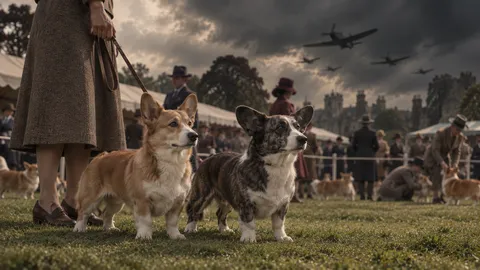
If you look at old photos of welsh corgi pembrokes, it may seem that they all used to be tailless.
In reality, that’s not so.
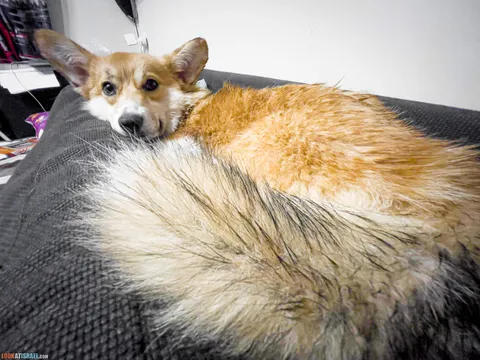
Historically, the breed has always had two variants: dogs born with a naturally shortened tail (natural bobtails) and dogs with a regular long tail.
It’s just that for many decades puppies with long tails had them docked in the first days of life, so several generations of owners got used to thinking that a “real” pembroke had to be tailless.
Interestingly, docking did not originally appear for aesthetic reasons at all. Herding dogs could injure their tails while working with livestock, and in the UK, for a certain period, a docked tail was even one of the signs of a working dog. Later the practical need disappeared, but the tradition continued for many years.
Today, in many European countries — and in Israel — cosmetic tail docking is prohibited by law, so modern breeders leave puppies exactly as they were born.
For this reason, a long tail in a pembroke is no longer a rarity. On the contrary, in most European countries you’re more likely to see long-tailed dogs than natural bobtails, simply because docking is banned and the gene for natural short-tailedness is far from common in all breeding dogs.
A Natural Bobtail and a Docked Tail Are Not the Same Thing
Despite the similar appearance, these are completely different things.
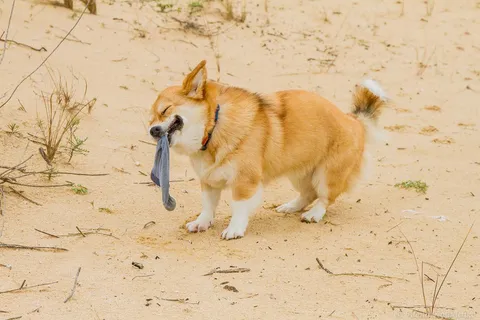
A natural bobtail is a dog born with a genetically determined shortened tail.
The length of such a tail can vary greatly: one puppy may have only one or two vertebrae, another may have several, and sometimes the tail reaches almost half the usual length. All of these variants are completely normal.
A docked tail is an ordinary long tail that has been surgically shortened in the first days of life.
So in one case we’re talking about a hereditary trait, and in the other about human intervention.
By the way, experienced breeders and show judges are often able to distinguish a natural bobtail from a docked tail by its shape, mobility, and the characteristics of the tip. Of course, there are cases when this is not easy, but the claim that they cannot be told apart is just another widespread myth.
An important note — in Israel, tail docking in dogs is prohibited, so a pembroke with a docked tail (even if imported from a country where docking is legal) will not be allowed in the show ring or used for breeding.
How Is the Natural Bobtail Inherited?
Natural short-tailedness is caused by the dominant variant of the T gene.
This means that for a bobtail to be born, it is enough to inherit one copy of this gene from one of the parents.
All natural bobtails have the genotype Tt.
Puppies that inherit two copies of this gene (TT) are non-viable and die at the very earliest stages of embryonic development. Therefore, among live-born dogs there are no natural bobtails with two copies of this gene.
What Does This Mean in Practice?
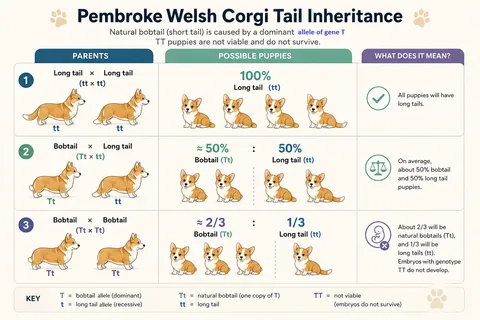
This leads to a simple conclusion: if both parents have long tails, a natural bobtail cannot be born in that litter.
Therefore, if it is fundamentally important for you to get a bobtail, the first thing to look at is the parents’ tails. At least one of them must be a natural bobtail.
At the same time, even if one or both parents are natural bobtails, it is impossible to predict in advance which particular puppy will inherit the corresponding gene. We can talk only about probability, not a guarantee.
The Most Common Myths
Myth No. 1. A True Pembroke Must Be Tailless
No. The breed has always had both natural bobtails and long-tailed dogs; it’s just that in the past long tails were almost always docked.
Myth No. 2. A Long Tail Means the Dog Is Not Purebred
No.
A long tail has no effect on:
- breed purity;
- compliance with the breed standard;
- health;
- temperament;
- working ability;
- show career in countries where docking is banned.
A long-tailed pembroke is just as purebred a representative of the breed as a natural bobtail. The only difference between them is a single gene that controls tail length.
Myth No. 3. The Shorter the Tail, the Better the Dog
No.
The length of a natural bobtail can vary greatly and does not affect health, breed type, or the dog’s quality in any way.
Myth No. 4. If Both Parents Are Bobtails, All Puppies Will Be Bobtails Too
No.
Even in such litters, long-tailed puppies are born, because genetics works a bit more complexly.
Myth No. 5. A Docked Tail Cannot Be Distinguished from a Natural One
Experienced breeders and judges can often determine the origin of a short tail by its structure.
Can You “Order” a Bobtail in Advance?
Unfortunately, no.
Even if one parent is a natural bobtail, it is impossible to predict in advance which puppy will inherit the corresponding gene.
Therefore, no responsible breeder can guarantee that the next litter will definitely have a bobtail of the desired sex and color.
We can talk only about probability.
What Really Matters When Choosing a Puppy
Future owners often pay more attention to the tail than to things that truly matter.
It’s much more important to look at:
- the parents’ health;
- genetic test results;
- temperament;
- the conditions in which the puppies are raised;
- the breeder’s reputation.
A tail is just one feature of appearance, and it in no way determines what kind of companion the dog will become. After a few days at home, most owners stop noticing the tail at all, while a kind character, stable psyche, and good health stay with the family for many years.
The Main Things to Remember
✓ A natural bobtail is a dog born with a genetically determined shortened tail.
✓ The length of a natural bobtail can vary greatly.
✓ A docked tail and a natural bobtail are not the same thing.
✓ Experienced breeders and judges can often distinguish a natural bobtail from a docked tail.
✓ In many countries, tail docking is prohibited by law.
✓ For a natural bobtail to be born, at least one of the parents must be a bobtail.
✓ If both parents are long-tailed, natural bobtails are impossible in that litter.
✓ A long-tailed pembroke is in no way inferior to a natural bobtail — neither in health, nor in breed quality, nor in character.
Our Experience
Below are a few examples of litters born from our dogs:
Litter I - Eevee (long tail, tt) + Kiwi (natural bobtail, Tt):
4 puppies were born: two with long tails (50% tt) and two bobtails (50% Tt).
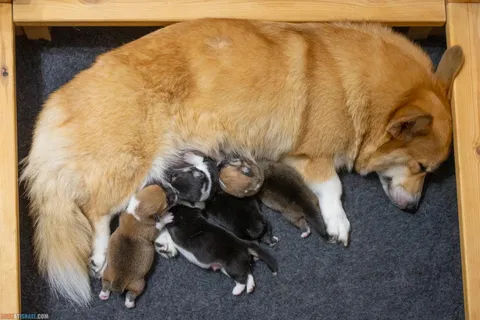
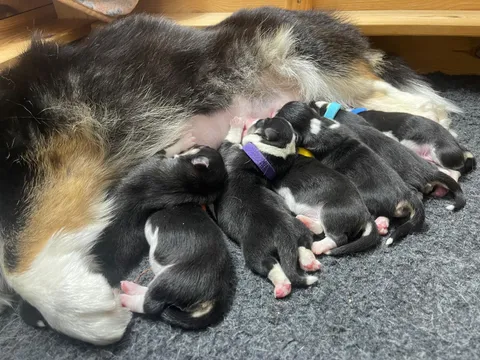
Litter J - Kaya (long tail, tt) + Yankel (long tail, tt):
7 puppies were born, all with long tails (100% tt).
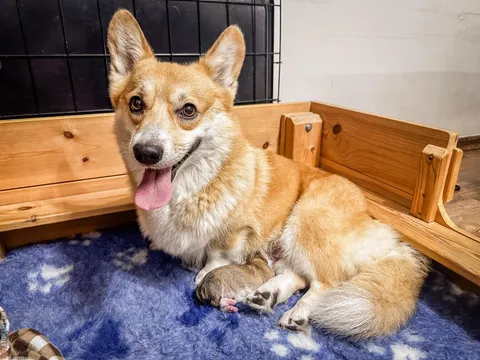
Litter A - Eevee (long tail, tt) + Antonio (natural bobtail, Tt):
One puppy (Una) was born — a natural bobtail (100% Tt).
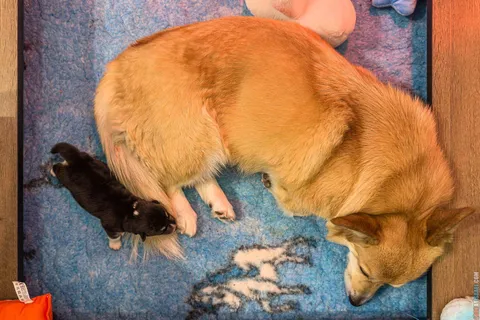
Litter B - Eevee (long tail, tt) + Mateo (long tail, tt):
One puppy (Sol) was born — with a long tail (100% tt).
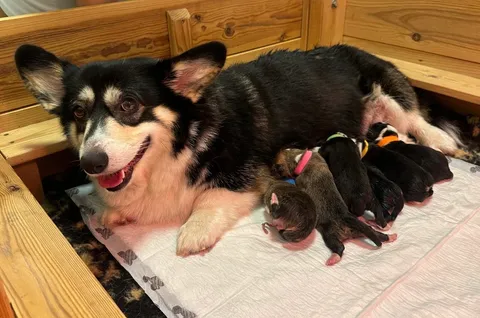
Litter C - Zoe (long tail, tt) + Kiwi (natural bobtail, Tt):
6 puppies were born: two with long tails (33% tt) and four bobtails (67% Tt).
Our Opinion
We are often asked which puppies we consider “better” — natural bobtails or long-tailed ones.
Our answer is always the same: neither.
For us, health, temperament, stable nerves, and correct breed type are far more important. A tail is just one small feature of appearance that does not make one puppy better than another.
That’s why we never evaluate our babies by tail length and advise future owners to choose, first and foremost, their dog, not the number of tail vertebrae.