Raising a dog does not begin with the command “sit” and does not end with a training course. A good owner learns to understand their dog, to be consistent, and not to be afraid to ask for help. Why does a dog trainer primarily teach the human, and how do the first months of living together shape a dog's future? That's what we explore in this article.
The Puppy Is Home. What Comes Next?
The first days at home are filled with joy, excitement, and dozens of new questions:
- Where is the best place for the puppy's bed?
- How do we housetrain the puppy?
- Why does the puppy bite?
- Is the puppy allowed on the sofa?
- Should training begin straight away?
It may seem that this is when the puppy's education begins, but in reality, something else is happening at the same time.
From the very first moments at home, it is not only the puppy who starts learning — the owner does too.
Puppies Are Not Born Knowing the Rules
A puppy does not know the rules of the human world.
It does not understand that chewing shoes, jumping on guests, or begging for food at the table is not allowed.
It is not doing these things out of spite, nor is it trying to “dominate” anyone.
It is simply exploring the world around it and learning from what happens every day.
If a puppy is praised for something today and punished for the same thing tomorrow, it will struggle to understand what is expected of it. Raising a dog should not be based on strictness, but on clear and consistent rules.
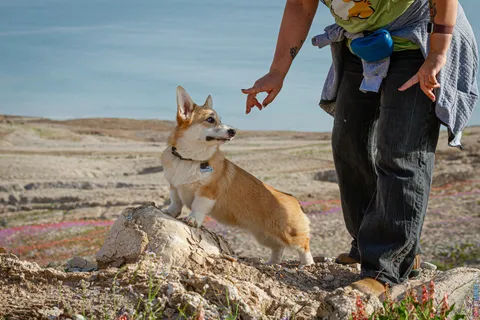
The Whole Family Raises the Dog
Very often, problems arise not because the dog is “disobedient.” The reason is much simpler: one family member allows the puppy onto the sofa, while another forbids it. Someone secretly feeds the puppy from the table, and someone else later wonders why the dog begs during every meal.
To a person, these may seem like small things. To a dog, they are contradictory rules that are impossible to understand.
If the family agrees on the rules in advance, life becomes easier for everyone.
Consistency Matters More Than Strictness
Many people believe that raising a well-behaved dog requires a firm hand. In reality, something else matters much more to a dog: predictability.
If there is a rule, it should apply consistently.
If the puppy is not allowed on the bed today, that rule should not change simply because someone happens to be in a good mood.
Clear and consistent rules make a dog's life calmer. The dog no longer has to guess what is expected and learns more quickly which behaviors lead to positive outcomes.
A Good Dog Trainer Primarily Teaches the Human
Sometimes people postpone working with a dog trainer because they believe professional help is only necessary when serious problems arise.
This is a common misconception.
A good professional does not work only with the dog. They help the owner understand why the dog behaves the way it does, how to communicate new rules clearly, and how to avoid mistakes that people often make without even realizing it.
Very often, after just a few sessions, it is not so much the dog's behavior that changes as the owner's confidence — and that can be the beginning of genuine mutual understanding.
There Is No Shame in Asking for Help
No owner knows absolutely everything.
Every dog has its own personality. Every family has its own circumstances.
Sometimes a problem can be resolved after a single conversation with the breeder. Sometimes a consultation with a dog trainer is helpful. And sometimes a veterinarian is needed, particularly when a change in behavior may be related to the dog's health.
The important thing is not to wait until a small problem becomes a serious one. The earlier you ask for advice, the easier it usually is to find a solution.
Sometimes the most responsible decision is simply to admit that you made a mistake.
Our Experience
We always tell prospective owners one simple thing: if something goes wrong, tell us.
Once, that is exactly what happened.
Just one week after a puppy moved to her new home, the family honestly admitted that they had overestimated what they could manage. They genuinely wanted a dog, but quickly realized that at that point in their lives they were not able to take on such a responsibility.
We immediately offered to take the puppy back — without blame or criticism — and refunded the family the full amount they had paid for her.
Some time later, this little girl found another family, where she has been living happily ever since.
Of course, we were upset at first. But it would have been far worse if the family had kept the dog out of guilt and then, several months later, started looking for a new home for her through online advertisements.
Sometimes admitting that you made a mistake is also an act of responsibility.
A Good Breeder Stays in Touch
A responsible breeder does not disappear once the puppy leaves for its new home.
On the contrary, that is when a new stage of the relationship begins. Questions about feeding, walks, training, teething, choosing equipment, or preparing for a first dog show are all completely normal.
So there is no reason to hesitate to contact your breeder. They know the characteristics of the breed better than most, remember your puppy's personality from the first weeks of life, and genuinely want things to work out for both of you.
Our Experience
For every new litter, we create a separate WhatsApp chat and add all the new owners of our puppies. In these chats, owners can ask us any questions, send photos, ask for advice, and share both happy and difficult moments. We warn everyone from the start: together with the puppy, the new owners get us as well.
For us, sending a puppy to its new home is not the end of a relationship, but the beginning of a new chapter.
Everyone Makes Mistakes
There are no perfect dog owners. Everyone has, at least once, allowed something they had intended to forbid. Everyone has misunderstood their dog's behavior at some point.
And that is completely normal.
What matters is being willing to learn.
Dogs are remarkably patient. They do not expect perfection from us — what matters far more to them is having someone beside them whom they can trust.
The Most Important Thing
A good dog is not an accident or simply the result of being “born with a good temperament.” It is the result of everyday life and learning together.
When an owner is willing to learn, remain consistent, ask for help, and respect their dog, something invaluable gradually develops between them — trust.
That trust becomes the foundation of a happy life together for many years.